
Quick Take
Anthropic is reportedly signing a massive $1.25 billion-per-month compute deal with Elon Musk’s xAI. It secures a dedicated pipeline of raw accelerator power. This surfaces at the same time reports show consumer engagement for xAI’s native model, Grok, is dipping. The timing points to a strategic repositioning of xAI’s infrastructure assets.
What happened:
In a shift that sidesteps the usual tech playbook, Anthropic is turning to a direct competitor—xAI—to buy enormous volumes of GPU compute. It is bypassing its main backers at Google and AWS for this block of capacity. To fund its data-center buildout, xAI is essentially leasing out its supercomputer clusters under a multi-billion-dollar OpEx agreement.
Why it matters now:
The deal highlights how constrained traditional public-cloud infrastructure has become. Even the best-funded frontier labs must look outside the Big Tech circle to find unfragmented, exascale GPU clusters that can be deployed right away. Access to clustered compute remains the real gatekeeper in today’s AI race.
Who is most affected:
AI model builders wrestling with tightening power and compute limits, traditional hyperscalers (AWS, GCP, Azure) whose grip on their flagship AI customers is loosening, and enterprise planners who watch GPU availability shape global pricing.
The under-reported angle:
Behind the headline number sits a clear business pivot. xAI is testing life as an AI-native infrastructure provider. By sub-leasing idle capacity while Grok usage shifts, it turns hardware into recurring cash flow and offsets some of its heavy Capex cycle.
Deep Dive
Have you ever stopped to picture what $1.25 billion a month in raw compute actually buys? At current bare-metal rates of roughly $2–$3 per hour for high-end HPC accelerators like NVIDIA H100s or H200s, that spend buys continuous access to more than 500,000 GPUs. In practice Anthropic is also locking in advanced cluster fabrics, InfiniBand networks, and early Blackwell (B200) capacity. All of it will draw hundreds of megawatts and likely run inside facilities on the scale of xAI’s Memphis Supercluster.
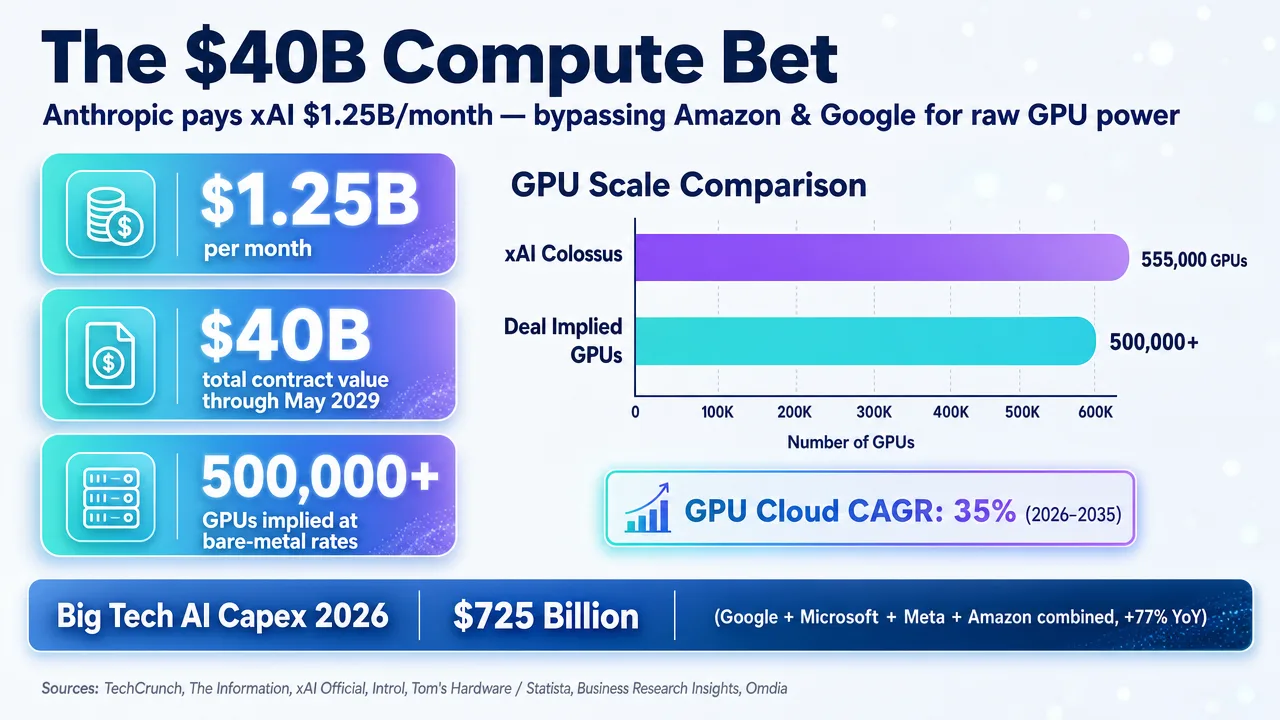
The most striking part, to me, is Anthropic’s decision to step around its own investors. Despite multi-billion-dollar commitments from Amazon and Google, the company is hunting for capacity elsewhere. Traditional hyperscalers design for broad multi-tenancy; they rarely have 100,000 contiguous GPUs sitting ready without long lead times. xAI’s monolithic training clusters were built for speed and scale, giving Anthropic the unfragmented resources it needs for the next wave of Claude models.
Market coverage lately zeroes in on Grok’s softer Monthly Active User numbers. Viewed through an infrastructure lens, though, the picture changes. If inference demand isn’t filling every accelerator, leaving them dark is simply lost revenue. A take-or-pay lease with Anthropic locks in near-100% utilization and helps underwrite xAI’s aggressive expansion.
For Anthropic the appeal is straightforward: it trades cash for immediate access instead of shouldering years of Capex and utility negotiations. Detailed SLAs will cover uptime, latency, and failover, but the core trade-off stays the same—speed now versus ownership later.
The arrangement is unusual: a frontier lab training its flagship models on a rival’s silicon. Questions around vendor lock-in, data controls, and compartmentalization will need careful answers. It also marks a shift in how the industry thinks about infrastructure, where capacity shortages keep forcing unlikely partnerships and blur the line between AI developer and compute landlord.
Stakeholders & Impact
| Stakeholder / Aspect | Impact | Insight |
|---|---|---|
| Anthropic & AI Builders | High | Fast-tracks next-gen model training through dedicated OpEx capacity instead of multi-year Capex builds. |
| xAI & GPU Landlords | High | Converts large infrastructure bets into predictable revenue while hedging against swings in consumer adoption of Grok. |
| Traditional Hyperscalers | Significant | AWS and GCP lose sole claim on their biggest AI partners’ densest workloads, exposing allocation delays in public clouds. |
| Policy & Regulators | Medium | Multi-billion-dollar capacity deals between direct rivals will draw antitrust attention. |
About the analysis
Researched and written with AI assistance under the editorial responsibility of the i10X News team. The title image is an AI-generated illustration. Read our AI Use Policy. Spotted an error? Request a correction.
This independent analysis combines recent market reports, data-center design realities, and basic AI economics to clarify what exclusive capacity contracts really mean. It is written for CTOs, AI strategists, and infrastructure teams working through the capital-intensive realities of exascale deployments.
i10x Perspective
From what I have seen, this deal underlines a growing split between model development and traditional cloud loyalties. xAI has shown that whoever can assemble the largest clusters quickly enough will attract customers, regardless of existing alliances or cap tables. Over the next five to ten years, expect compute to trade more like a financial product—GPU hours bundled, sub-leased, and priced in futures-style contracts. The open question remains how securely frontier IP can be protected when it runs on a direct rival’s hardware.