
Summary: The viral demand for AI-generated retro photography is evolving from simple cloud-based filters to granular, DIY synthetic generation.
- What happened: Consumers and creators are bypassing traditional photo studios and basic AI apps. Instead, they’re building sophisticated, hyper-personalized synthetic photo series that emulate those 90s mall laser backdrops and 80s glamour shots. With tools like Nano Banana, people combine their own image capture, generative AI, upscaling, and precise prompt-based lighting matching to get results that feel consistent across a whole set.
- Why it matters now: This shift shows a real maturation in how everyday users engage with consumer AI. They’re no longer satisfied with the generic, “plastic” outputs of early avatar generators. From what I’ve seen, people now want architectural control over the AI-mixing LoRA-style fine-tuning, era-specific color grading techniques like halation and Kodak Gold emulation, and local processing for series-wide synthetic identities they can actually trust.
- Who is most affected: Consumer AI application developers, cloud infrastructure providers handling high-volume image inference, and legacy creative software giants like Adobe and Canva. All of them are competing to keep these workflows inside their own ecosystems rather than watching users drift toward specialized AI pipelines.
- The under-reported angle: The hidden cost of personalized nostalgia centers on biometric data privacy and structural model bias. While most tutorials focus on aesthetic presets, the real tension shows up in “EXIF hygiene,” likeness consent for model training, and how diffusion models still struggle to render diverse skin tones and hair textures without defaulting to historically white-skewed training data.
- 🧠 Deep Dive: Have you ever scrolled past one of those perfectly imperfect 90s yearbook portraits and wondered how someone made it look so specific? The proliferation of the “90s Yearbook” aesthetic isn’t just a fleeting social media trend. It’s a masterclass in how generative AI is moving from one-off novelties to continuous, controllable synthetic media.
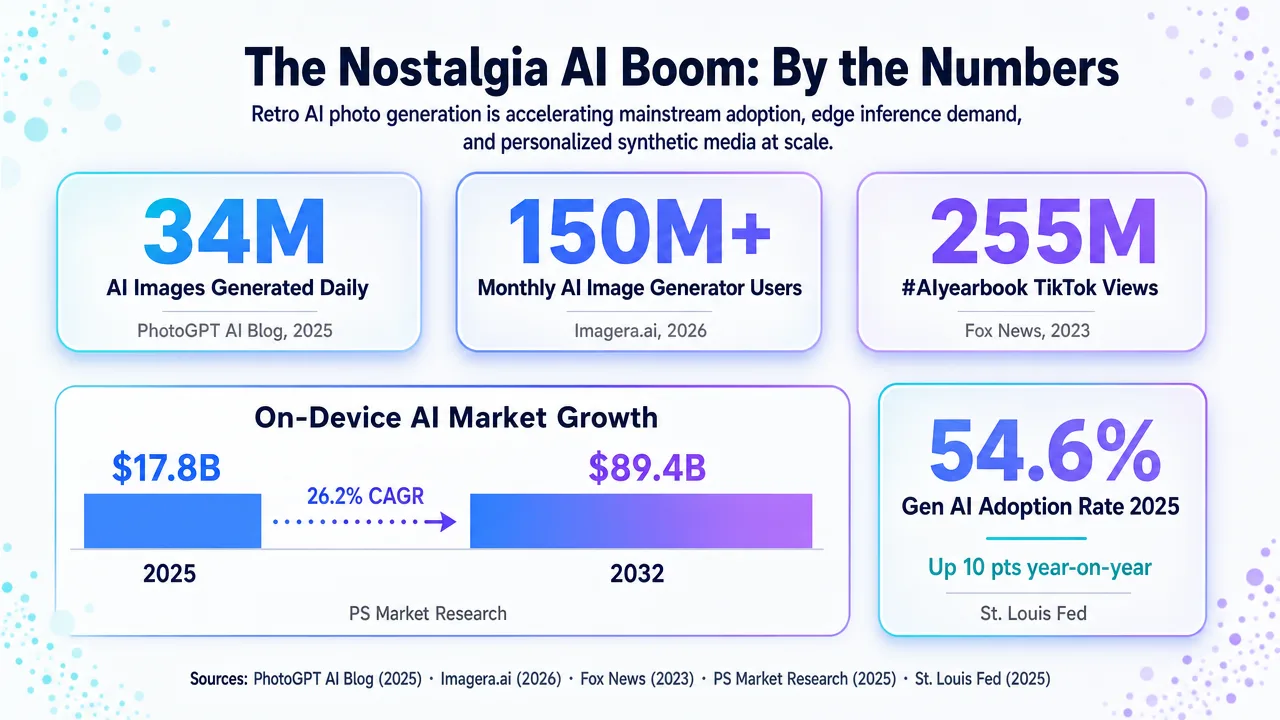
Workflows built around tools like Nano Banana are quietly teaching everyday users to act as prompt-directors and synthetic lighting technicians. Rather than accepting the randomized outputs of early consumer AI filters, people are piecing together step-by-step DIY frameworks, combining capture, generation, and AI-driven upscaling to produce consistent, era-authentic imagery.
A structural collision is unfolding between traditional photo-editing paradigms and AI-first generation. While legacy platforms like Adobe still emphasize manual curves, studio strobes, and physical modifiers, the new AI workflow synthesizes these elements entirely in latent space. Users are learning to command AI to simulate specific film stocks (like Fuji Superia), bake in CRT or halation effects, and apply prompt-based “key/fill/rim” lighting. This democratizes professional aesthetic capacity, sure, but it demands robust local or cloud inference to keep temporal and stylistic consistency across an entire series.
Underneath the vintage presets lies a critical stress test for AI infrastructure and model bias. A gap the basic tutorials rarely mention is how these fine-tuned models handle diverse subjects. Because the baseline weights for 80s and 90s aesthetic diffusion models draw heavily from historical media, they often struggle with accurately grading and lighting non-white skin tones and varied hair textures. Creators end up brute-forcing prompts or layering secondary upscaling and denoising just to avoid the “plastic skin” artifacts that appear in out-of-the-box results.
This hyper-personalized workflow also brings edge compute and data privacy into sharp focus. As users upload their faces to generate these synthetic series, demand for local AI processing has surged. Consumers are waking up to likeness rights and EXIF hygiene, looking for ways to run generations locally instead of feeding biometrics into cloud black boxes. That “smartphone-only under $20” workflow, then, isn’t just about keeping costs down—it’s become a proxy battle between cloud API providers and the improving capabilities of mobile NPUs that can run personalized embeddings directly on-device.
📊 Stakeholders & Impact
| Stakeholder / Aspect | Impact | Insight |
|---|---|---|
| Consumer AI Vendors | High | Must balance the compute cost of high-fidelity series generation with consumer demand for low-latency, mobile-first outputs. |
| Hardware & Chip Makers | Medium-High | The desire to keep personal face-data local drives the case for powerful on-device NPUs in next-gen smartphones. |
| Everyday Creators | High | They’re gaining studio-level synthetic media capabilities, yet they also need practical education on AI likeness rights, consent, and data hygiene. |
| Traditional Creative Software | Significant | Legacy players (Adobe, Canva) now face pressure to streamline complex multi-step generative workflows to compete with niche, one-click AI tools like Nano Banana. |
✍️ About the analysis
Researched and written with AI assistance under the editorial responsibility of the i10X News team. The title image is an AI-generated illustration. Read our AI Use Policy. Spotted an error? Request a correction.
This independent, research-based analysis maps consumer adoption patterns of generative AI tools against broader infrastructure and privacy trends in the LLM and multimodal ecosystem. Written for AI product managers, developers, and ML strategists, it brings together search intent, competitor content gaps, and market dynamics to forecast where personalized synthetic media is heading next.
🔭 i10x Perspective
The Nano Banana phenomenon shows that the future of generative media isn’t just about base model capabilities. It’s about giving users absolute control over their synthetic identities. As consumers grow savvier about biometric privacy, we’ll see a rapid move away from cloud-hosted avatar generation toward edge-based, locally run LoRAs where people fully own their likeness models. In the end, “vintage photo generation” is simply a Trojan horse that’s training the public to become sophisticated directors of their own AI-generated realities.