
LLM Referral Share and the Measurement Crisis
⚡ Quick Take
“LLMs are mutating from reasoning engines into the internet’s primary routing layer, triggering a measurement crisis for anyone relying on web traffic. In the Generative AI era, if you cannot measure your citations, you effectively do not exist.”
The shift is already reshaping how visibility gets counted. Teams in PR, marketing, and growth are quietly moving toward “LLM Referral Share” as their new north-star metric. It tracks the actual visibility, citations, and clicks that large language models now send (or withhold) across a scattered set of AI platforms.
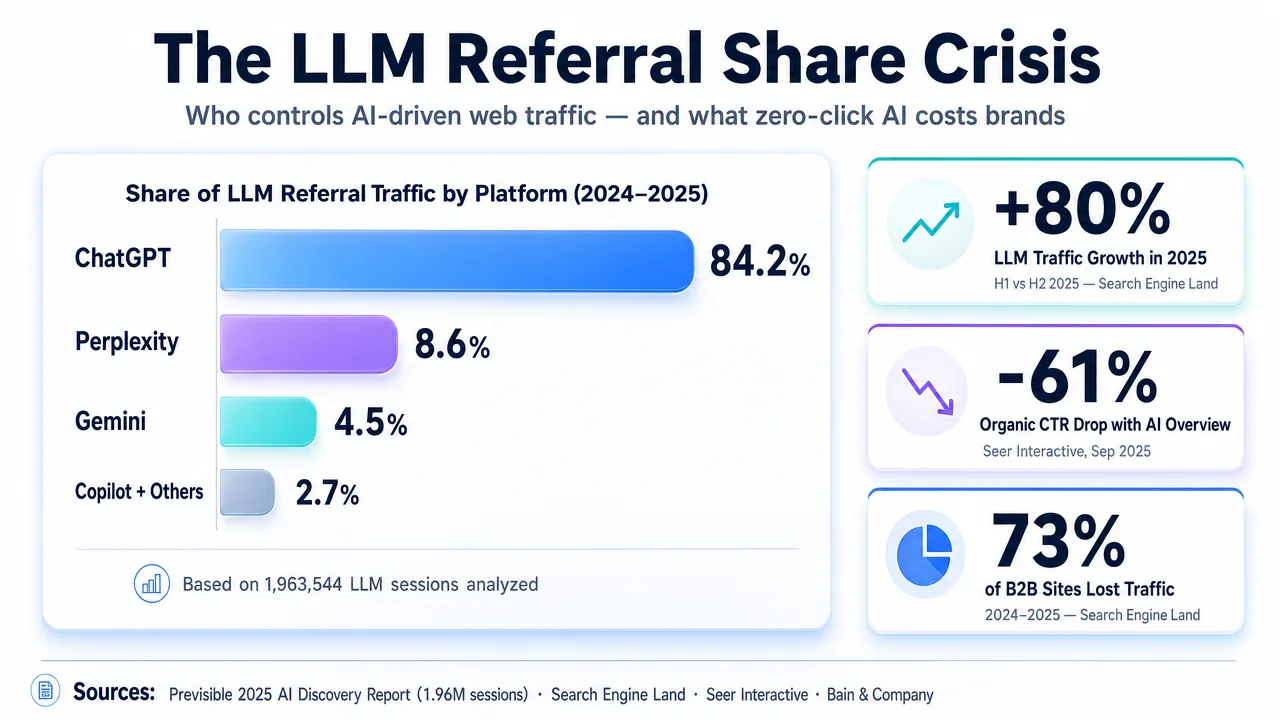
Analytics vendors and SEO platforms are racing to build ways to isolate traffic from tools like ChatGPT, Perplexity, and Google’s AI Overviews. Older search attribution models simply do not capture these newer journeys, so the gap keeps widening.
That pressure is mounting fast. As ChatGPT Search expands and RAG becomes the default way people find answers, a sizable chunk of AI-driven activity stays invisible. Without proof that models are citing a brand—and without the ability to count the clicks that follow—it becomes difficult to defend budgets or run effective Generative Engine Optimization (GEO) work.
The groups feeling this most are the usual suspects: PR leads, digital marketers, and enterprise brands watching their organic reach get rerouted. AI providers are also under pressure, with publishers increasingly asking for clearer attribution before they allow scraping to continue.
One angle that rarely gets discussed is brand safety. A strong referral share from an LLM also means higher exposure to hallucinations, which creates compliance headaches that traditional SEO dashboards were never built to flag.
🧠 Deep Dive
Large Language Models are quietly rewriting the economics of the web. Where search once handed you a clear click path, today’s answer engines pull together summaries that often meet user needs without sending anyone onward. The result is an attribution gap that keeps growing, and most dashboards still have not caught up.
Right now the tooling landscape sits in pieces. Solutions from BrightEdge and SEOclarity have leaned heavily into Google’s AI Overviews, which makes sense for that slice of traffic. Yet the broader picture spans ChatGPT link-outs, Perplexity citations, and smaller tools—each with their own, often murky, referrer signals. Many brands are left staring at incomplete data.
“LLM Referral Share” has emerged as one attempt to pull these signals together into a single, usable KPI. Teams are combining GA4 records, server logs, and running lists of known AI referrers to get closer to the real picture. It is basically market share reframed for a world where an AI’s internal patterns decide whether a brand gets seen at all.
Even so, plenty of blind spots remain. We still lack solid thinking on how earned versus owned media shapes what models actually output, and regional differences in adoption barely register. At the same time, pushing for more citations brings a fresh risk: ending up in a hallucinated or non-compliant summary. That turns visibility into a risk-management concern, not just a growth target.
Over time, the push for better measurement will likely force changes at the infrastructure level. Publishers and brands want clearer credit for the data they supply, which could push model builders toward more transparent routing if they want continued access to fresh training material.
📊 Stakeholders & Impact
| Stakeholder / Aspect | Impact | Insight |
|---|---|---|
| AI / LLM Providers | High | Must balance user experience (zero-click answers) with the need to provide transparent referrers to appease publishers and avoid blocking raw data access. |
| SEO & Analytics Vendors | High | Massive commercial opportunity to build the definitive cross-engine dashboard for Generative Engine Optimization (GEO). |
| Enterprises & PR Teams | High | Forced to abandon legacy organic search metrics in favor of tracking citations, AI share of voice, and cross-engine referral patterns. |
| Publishers / Media | Significant | Survival depends on monetizing or accurately tracking the traffic that AI models extract from their original reporting. |
✍️ About the analysis
Researched and written with AI assistance under the editorial responsibility of the i10X News team. The title image is an AI-generated illustration. Read our AI Use Policy. Spotted an error? Request a correction.
This independent analysis traces the move from conventional SEO measurement to Generative Engine Optimization (GEO) metrics. It draws on current industry approaches to tracking AI-driven traffic and is meant for digital leaders, CTOs, and PR strategists who need to navigate shifting attribution in the AI-powered web.
🔭 i10x Perspective
From what I’ve seen so far, the race to define and capture “LLM Referral Share” is only the opening move in a larger contest over how value flows online. Inference speeds keep rising, and agentic systems will soon act with even less human oversight. In that environment, clicks from people will keep declining. The real question for the next decade becomes whether an enterprise can position its APIs, data, and core facts as the reliable source layer that autonomous agents draw from by default.