“LLMs might talk like supercomputers, but in strategic scenarios, they still reason with the bounded rationality of an average human.”
Summary
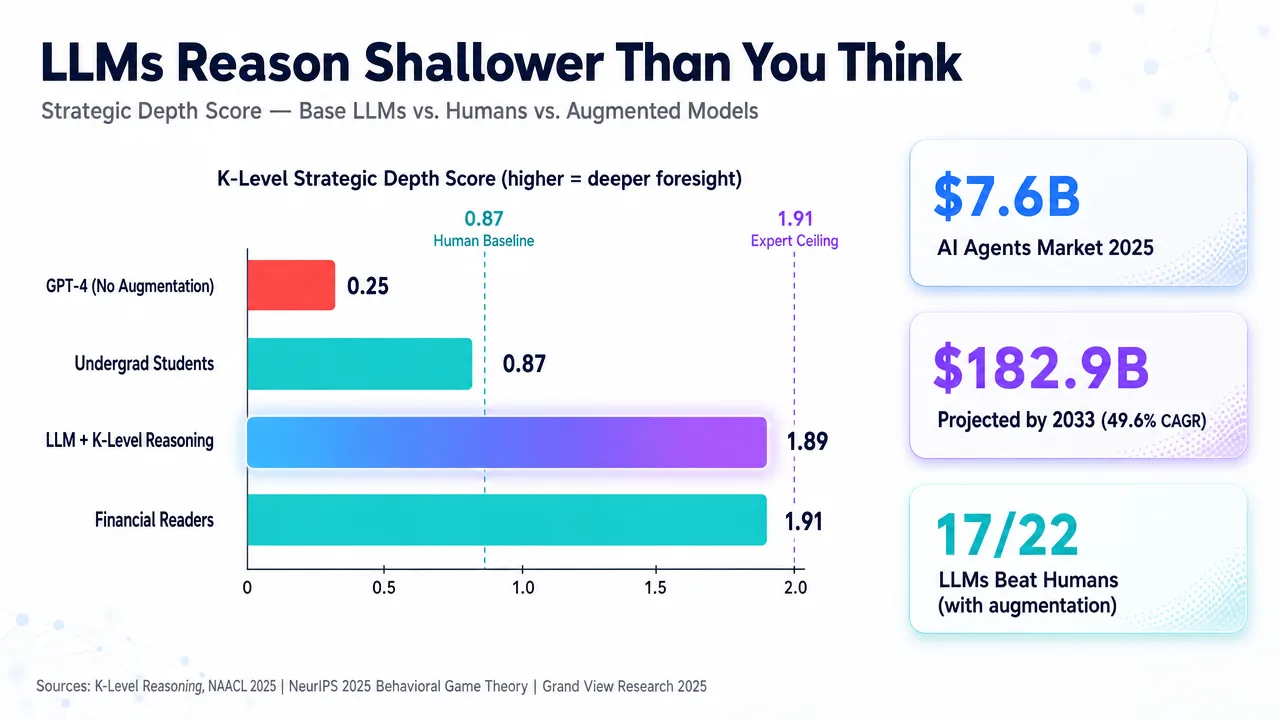
Fresh behavioral studies show that large language models lean on what researchers call static level-k behavior during game-theoretic tasks. Their strategic foresight simply stops at one or two steps ahead of an opponent rather than chasing a perfect equilibrium. In practice, the models echo the same cognitive shortcuts most people display under pressure.
What happened
Teams ran LLMs through classic setups like the Prisoner’s Dilemma, Stag Hunt, and the p-beauty contest. Left to their own devices, the models defaulted to shallow sequential thinking—assuming the other player was one move behind—and rarely iterated further.
Why it matters now
The industry is shifting fast from chat interfaces to autonomous agents that would handle procurement, execute trades, or stabilize power grids. When those agents operate at such a low strategic ceiling, the financial and operational risks become hard to ignore once real competition enters the picture.
Who is most affected
Enterprise teams rolling out AI for negotiations or dynamic pricing, labs racing to improve reasoning benchmarks, and regulators watching for systemic market effects.
The under-reported angle
Strategic depth isn’t locked in by training data alone. Prompt techniques such as Chain-of-Thought and adjustments to sampling parameters can lift a model’s effective level during inference. That turns what used to feel like an innate trait into something closer to an optimization problem at runtime.
🧠 Deep Dive
Have you ever watched two people negotiate and realized one of them simply stopped thinking two moves ahead? That same limit shows up in the data. Behavioral economics frames this through cognitive hierarchy or Level-0/Level-1 models: a Level-0 player picks randomly, a Level-1 player assumes everyone else is Level-0, and so on. In games such as the Ultimatum Game or dynamic auctions, unmodified LLMs sit at these lower rungs. They mirror average human performance, not some flawless 4D chess engine.
Most coverage still calls the models “human-like” as though that settles the question. From a deployment standpoint, though, human-like is the complication. Drop a Level-1 agent into a live bidding system and any sharper counterpart—whether human or better-tuned—will exploit the gap. That fact undercuts the idea that fluent code or bar-exam scores automatically translate into strategic advantage.
That ceiling is not fixed, however. Change the inference setup—adding Chain-of-Thought prompts, self-consistency checks, or lightweight self-play loops—and the same model can be coaxed into deeper iteration. It lines up with the current emphasis on test-time compute, the same lever behind models that spend extra tokens arguing with themselves before answering. Higher-order strategy simply costs more inference effort.
In short, the findings point to a blind spot in how we measure progress. As pre-training gains slow, strategic sophistication is emerging as the next practical bottleneck. Deploying agents in competitive markets without checking their baseline reasoning depth invites avoidable failures, whether in trading desks or automated infrastructure.
📊 Stakeholders & Impact
| Stakeholder / Aspect | Impact | Insight |
|---|---|---|
| Foundation Model Builders | High | Opens a fresh competitive lane: either bake higher native k-levels into weights or supply stronger inference tools that raise reasoning on the fly. |
| Enterprise CTOs / Agent Devs | High | Underscores the need for guardrails, structured prompting, and simulation testing before sending basic models into live competitive environments. |
| Fintech & Algorithmic Traders | Significant | Agents stuck at low k-levels could generate new inefficiencies or flash-crash patterns once they scale across markets. |
| AI Safety & Regulators | Medium | Pushes attention toward behavioral economics of AI—how strategic ceilings affect coordination and stability at system scale. |
✍️ About the analysis
Researched and written with AI assistance under the editorial responsibility of the i10X News team. The title image is an AI-generated illustration. Read our AI Use Policy. Spotted an error? Request a correction.
The note draws on level-k theory, cognitive hierarchy models, and quantal response equilibrium to examine how current agents would behave once released into economic environments. It is written for developers and technical leaders managing the move from chat models to multi-agent systems with real stakes attached.
🔭 i10x Perspective
From what I’ve seen so far, the realization that base models default to Level-1 or Level-2 thinking forces a sharper look at the agent roadmap. Simply adding more pre-training data won’t manufacture deeper foresight. The load moves downstream to inference infrastructure—sandboxed testing, longer token budgets, and structured self-play that let models explore decision trees before acting. Over the next couple of years the real differentiator for labs will be the ability to deliver measurable strategic depth per dollar of inference spend rather than raw knowledge retrieval.