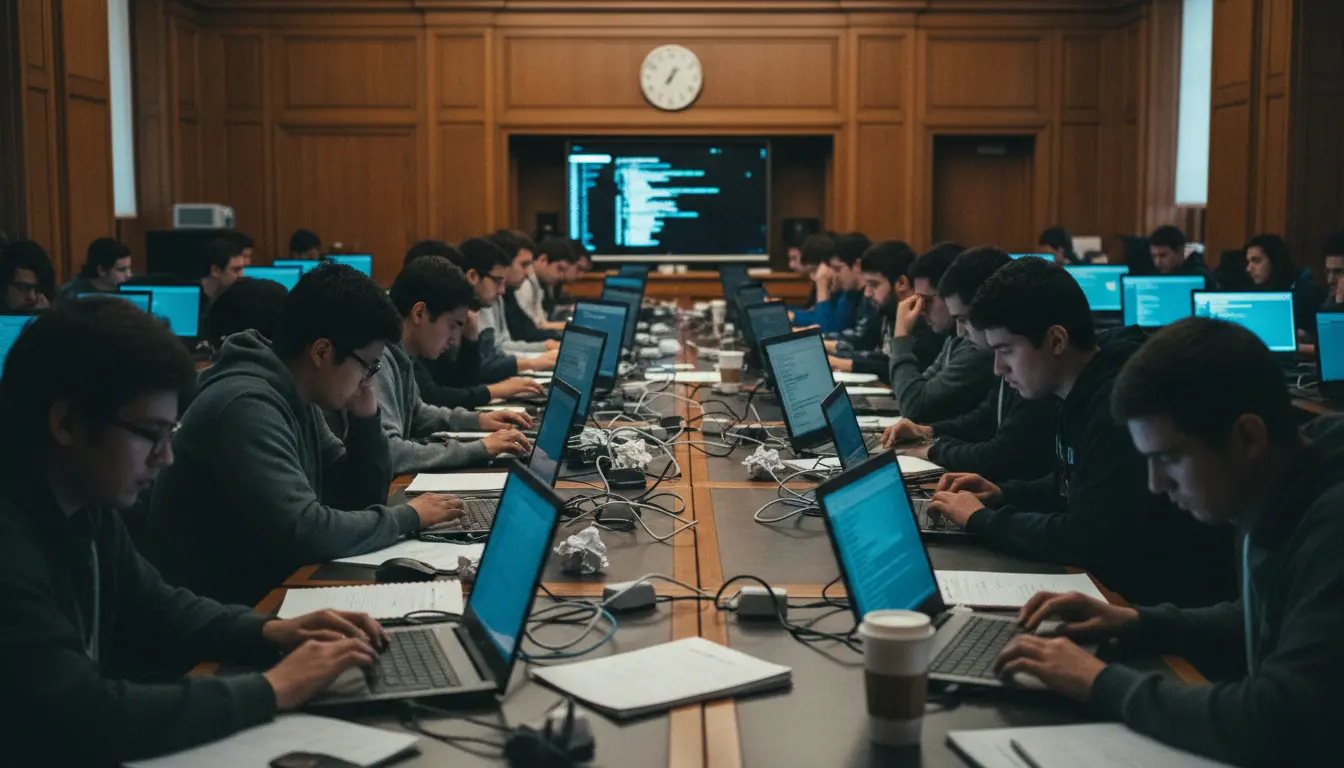
OpenAI, Sequoia Capital, and Citadel Securities have joined forces to run “No Limit,” a pokerbot tournament that tests how far AI tools can take software development under pressure. The Boston regional at Harvard put over 330 students through a 60-minute challenge to build autonomous agents from the ground up, pointing to a sharper edge in how top firms scout AI talent.
Quick Take
- The event: The “No Limit” Boston regional drew 270 teams from 30 universities, competing for five advancing spots to a $100,000 San Francisco finale.
- The constraint: Participants were given exactly 60 minutes to develop an offline poker bot for an unfamiliar variant, practically mandating the heavy use of AI coding tools.
- The technical gauntlet: Bots were required to operate entirely offline without API access, executing strategic decisions with a ruthless one-millisecond response time.
- The talent dragnet: Organizers are using the competition as a high-fidelity filter to spot developers who excel at steering LLMs and AI agents under extreme latency and uncertainty constraints.
What happened
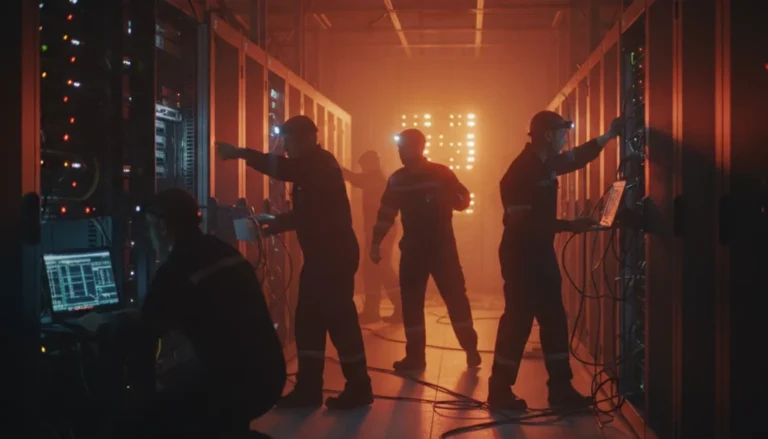
More than 330 students packed into Harvard’s David Rubenstein Treehouse for the Boston round of the “No Limit” tournament. OpenAI, Sequoia Capital, and Citadel Securities backed the event, which replaced the usual multi-day hackathon with a single intense hour. Students worked alone or in pairs to code a pokerbot that could handle an unfamiliar game variant on its own.
To move forward, each bot had to hold up through 10,000 simulated games across six rounds. The rules were strict: no network access, no external APIs, and decisions had to come in under one millisecond. Of the 270 teams that entered, just five made it through to the San Francisco finals and a shot at the $100,000 prize.
Why it matters now
This tournament acts as a live stress-test for the new era of software engineering. By limiting the build window to just 60 minutes on a complex, math-heavy task, the organizers force participants to lean on advanced AI coding agents. A human developer simply cannot write, debug, and tune a solid game-theory engine from scratch in that span. The real test becomes how effectively teams can direct LLMs to produce high-performance logic under tight time pressure.
The sponsors also reveal what matters most in intelligence infrastructure right now. Citadel Securities needs engineers fluent in algorithmic decision-making, game theory, and ultra-low latency execution, which explains the one-millisecond rule. OpenAI is hunting for people who can push autonomous agents that reason through incomplete information. Sequoia Capital, for its part, wants to back the founders who rise out of this kind of technical pressure cooker. Poker, with its mix of risk, bluffing, and missing data, serves as a strong stand-in for real-world AI challenges.
Who is most affected
| Stakeholder | Impact | Why |
|---|---|---|
| Computer Science Students | Paradigm shift in competitive programming | Traditional algorithmic tests are being replaced by AI-assisted “agent orchestration” challenges that prioritize speed and strategic architecture. |
| AI Development Tooling | Live edge-case benchmarking | A 60-minute offline build window ruthlessly exposes the capabilities, latency limits, and code-generation hallucinations of current AI coding assistants. |
| Elite Tech Recruiters | High-signal talent filtering | Finding engineers who can build low-latency, offline AI logic is now a top priority for high-frequency trading firms and frontier model labs. |
For recent graduates and university students, “No Limit” redefines the competitive landscape. The ability to manually draft C++ or Python syntax is no longer the primary differentiator; the new moat is product decision-making, agent orchestration, and prompt-engineering fluency under extreme technical constraints.
About the analysis
Researched and written with AI assistance under the editorial responsibility of the i10X News team. The title image is an AI-generated image. Read our AI Use Policy. Spotted an error? Request a correction.
This independent i10x analysis synthesizes local campus reporting, technical rule breakdowns, and official announcements to evaluate the evolving landscape of AI talent acquisition. The piece is tailored for CTOs, AI developers, and industry observers tracking how frontier tech firms identify their next generation of engineers.
- The Harvard Crimson: Sequoia, OpenAI, and Citadel Host Pokerbot Tournament at Harvard
- Tilt.now: Sequoia, OpenAI and Citadel Securities Launch $100K Poker Bot Tournament
- Zeniteq: Sequoia and OpenAI Open a $100K Pokerbot Tournament
- Ababnews: Sequoia Capital’s Boston regional contest draws 270 teams, 5 advance to San Francisco final
- Sequoia Capital on X: Announcing No Limit
i10x Perspective
The “No Limit” tournament offers a clear preview of the post-coding future. When syntax generation becomes fully commoditized by LLMs, the real value of an engineer moves to system architecture, latency optimization, and strategic constraint-solving. By forcing students to build offline agents with sub-millisecond reaction times, OpenAI and Citadel are looking past conversational interfaces and straight at the mechanics of autonomous intelligence. This is more than a campus game; it is a live-action simulation of how the next decade of AI infrastructure and algorithmic trading will take shape.