
Quick Take
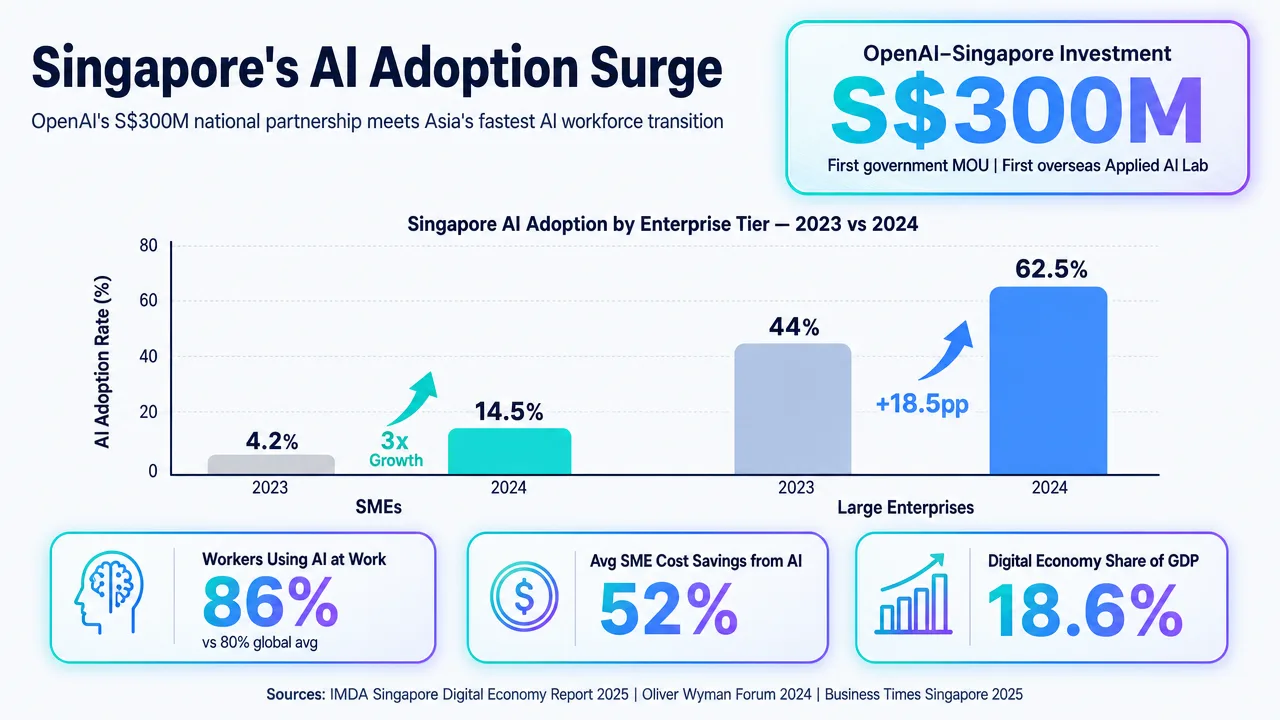
OpenAI has formalized a massive S$300+ million partnership with Singapore’s Ministry of Digital Development and Information (MDDI), signaling a major geo-strategic push to embed its LLM ecosystem directly into a national workforce development pipeline.
Summary: The creators of ChatGPT are bypassing standard enterprise sales to partner natively with the Singaporean government, committing over S$300 million to a nationwide AI skills, EdTech integration, and enterprise support initiative. This public-private alliance is designed to build an AI-fluent workforce from the ground up, using advanced language models as the backbone of the country’s digital learning infrastructure.
What happened
OpenAI and Singapore’s MDDI are rolling out joint funding and programs that target the AI capabilities of local educators, students, and small-to-medium enterprises (SMEs). Resources will go toward subsidized tool access, curriculum frameworks, and clear workforce upskilling tracks.
Why it matters now
As the “AI race” moves from raw compute scaling to wide-scale enterprise deployment, nation-states are becoming key players. By positioning itself as the underlying infrastructure for an entire nation’s digital upskilling, OpenAI is locking in a highly educated, strategic APAC talent pool that builds natively on its APIs and platforms.
Who is most affected
Regional CTOs evaluating which model ecosystem to adopt, Singaporean developers, EdTech builders who must integrate with this new subsidized stack, and competing frontier AI labs (like Google and Anthropic) who now face a heavily entrenched competitor in Southeast Asia.
The under-reported angle
Most coverage treats this as a philanthropic or straightforward educational grant, missing the deeper ecosystem lock-in. By weaving its tools into Singapore’s structured learning pipelines—and navigating strict local data governance—OpenAI is creating an operational blueprint for “sovereign integration” that it can replicate with other governments.
Deep Dive
OpenAI’s shift from raw infrastructural build-outs to nation-state enablement marks a clear evolution in the AI market. Compute and frontier models solve very little without humans who can prompt, integrate, and maintain the application layer. Singapore, facing pressure to keep its status as a premier Asian tech hub, needs to upskill its workforce quickly while managing the high costs of enterprise-grade AI tooling. The S$300 million MDDI partnership bridges that gap, treating ChatGPT and OpenAI APIs more like national utilities than off-the-shelf software.
Official statements focus on localized EdTech deployment and job creation, yet the underlying structure is more complex. Success hinges on execution details that public announcements leave vague: how API credits reach SMEs, what certification pathways actually involve, and how closely OpenAI’s tools align with existing frameworks like Singapore’s SkillsFuture. Without sharper clarity on these points, the initiative could fragment rather than deliver a streamlined talent pipeline.
That said, this partnership also serves as a live testbed for AI governance and regulatory compliance. Singapore maintains tight controls on data privacy and digital ethics. By working directly with a government ministry, OpenAI must demonstrate that its models can handle student data privacy, bias mitigation, and enterprise IP protection. The collaboration gives OpenAI a chance to refine its enterprise compliance in a trusted regulatory setting—a useful proof-of-concept for potential deals elsewhere.
Beyond that, the move strengthens OpenAI’s position against competitors like Anthropic and Meta’s open-weights models. Subsidizing EdTech and SME access today means tomorrow’s workforce is more likely to default to OpenAI’s developer stack and tooling. It pushes regional startups to align their roadmaps with OpenAI’s update cycles, building a dependency that runs from early education through to enterprise use.
Stakeholders & Impact
- AI / LLM Providers — Impact: High. Insight: Positions OpenAI as the default cognitive infra in Singapore, forcing competitors to find alternative market entry points in APAC.
- Local EdTech & Developers — Impact: High. Insight: Shifts product strategies; localized EdTech builders must now leverage subsidized frameworks to compete for ecosystem grants and usage.
- Singapore Enterprises (SMEs) — Impact: Medium–High. Insight: Reduces the barrier to entry for AI adoption, subsidizing access to advanced tooling and lowering compute integration costs.
- Regulators & Policy — Impact: Significant. Insight: Tests real-world governance frameworks; localizes AI safety, data privacy, and ethical compliance mechanisms inside a national curriculum.
About the analysis
Researched and written with AI assistance under the editorial responsibility of the i10X News team. The title image is an AI-generated illustration. Read our AI Use Policy. Spotted an error? Request a correction.
This independent, research-based analysis integrates policy tracking, competitor positioning, and semantic ecosystem mapping, specifically designed for technical leaders, enterprise managers, and CTOs navigating public-private AI adoptions.
i10x Perspective
The Singapore-OpenAI partnership offers an early glimpse of the coming “Sovereign AI Ecosystems” era. The real competitive moat for foundational model builders won’t just be parameter count, but national integration—who can embed their platform directly into a country’s economic and educational operating system. If OpenAI can show measurable gains in national productivity metrics through this S$300 million effort, expect a broader global scramble as governments look to tie their digital futures to established AI providers.