
OpenAI’s newly detailed ‘Verify’ tool marks the end of isolated AI watermarking, fusing Google’s SynthID and C2PA metadata into a multi-layered cryptographic pipeline that turns image provenance from an afterthought into core AI infrastructure.
Summary: As image generation models reach photorealism, leading AI vendors are coalescing around a unified provenance fusion approach to track synthetic media. OpenAI has formally detailed its Verify architecture, heavily integrating Google DeepMind’s SynthID watermarking with the open C2PA standard to detect and label AI-generated images out in the wild.
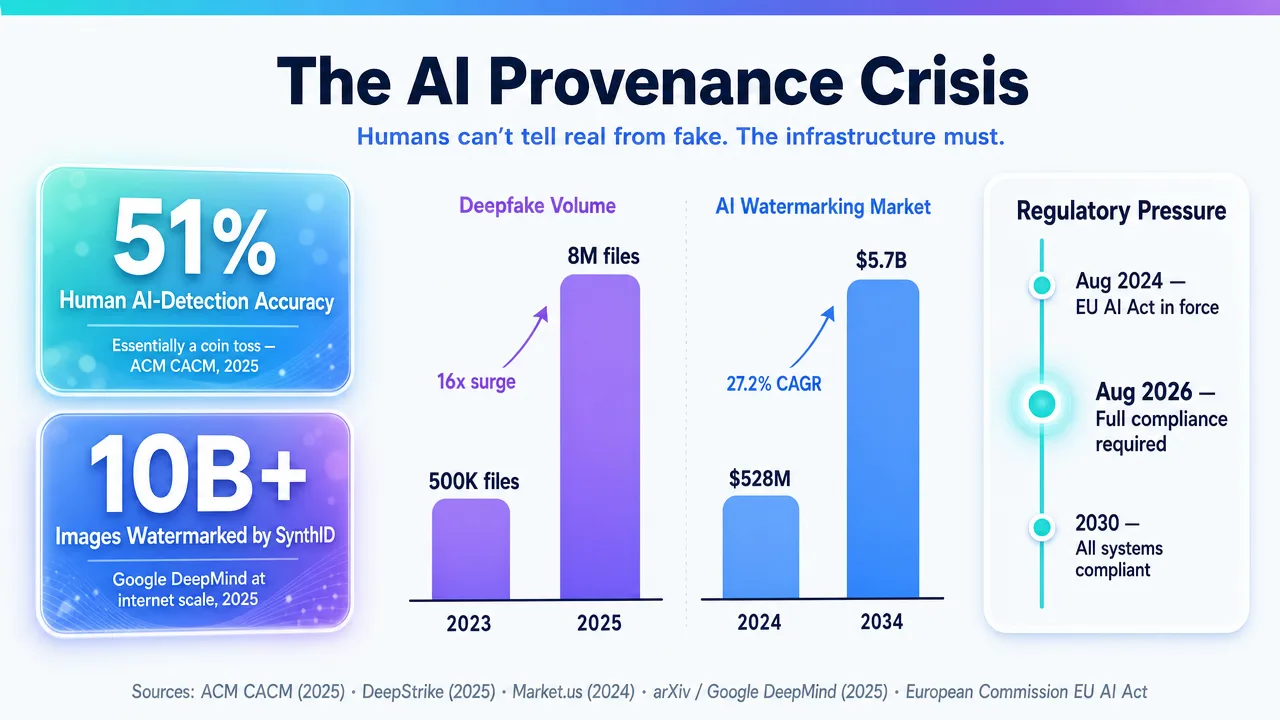
What happened
OpenAI released research and tools for “Verify,” a system designed to detect content originating from its models. Instead of relying on a single brittle method, Verify fuses two distinct signals: invisible pixel-level watermarks via DeepMind’s SynthID and cryptographic metadata manifests via C2PA. Together, these form a robust confidence pipeline backed by API and UI integration paths for developers.
Why it matters now
Single-signal identification has failed; metadata is routinely stripped by social platforms, and basic watermarks are susceptible to editing, cropping, and JPEG compression. By standardizing a “fusion” approach, the ecosystem is laying the groundwork for algorithmic compliance ahead of sweeping regulations like the EU AI Act, which mandates clear disclosures for AI content.
Who is most affected
Platform trust and safety teams, newsrooms, and enterprise AI developers who must now architect end-to-end media pipelines where outputs are captured, generated, signed, and published with unbroken chains of mathematical custody.
The under-reported angle
Most coverage treats this as a consumer feature, but it is actually a nascent infrastructure protocol. What’s critically missing is a cross-vendor interoperability framework resolving what happens when an image features mixed edits (human + AI) or when open-weight models bypass these cryptographic guardrails entirely, posing severe adversarial and threat-modeling challenges.
Deep Dive
Have you ever stopped to wonder how long the industry could keep pumping out photorealistic images without a way to trace them? The era of zero-liability synthetic media is closing fast. For the past two years, the AI ecosystem has poured billions into scaling generation—DALL·E, Imagen, Midjourney—while underinvesting in the infrastructure needed to track those outputs. Now, as the specter of deepfakes threatens digital trust and invites regulatory crackdowns, frontier labs are scrambling to deploy a standardized “trust layer.” OpenAI’s newly formalized Verify system is the clearest signal yet that image verification is pivoting from a fractured PR talking point to a mandatory, multi-vendor infrastructure stack.
At the heart of OpenAI’s approach is a recognition of a painful industry reality: single-layer provenance is brittle. If developers only use C2PA—a robust cryptographic manifest standard—it breaks the moment a user uploads the image to a social media platform that strips metadata natively. If they solely use AI watermarking, adversarial prompt injections and heavy compression can degrade detection confidence. By deploying provenance fusion—layering C2PA signatures directly over Google DeepMind’s invisible SynthID watermarks—Verify calculates a calibrated confidence score. If the metadata is stripped, the pixel-level anomaly remains; if the pixels are altered, the metadata signature persists as a fallback.
That said, looking strictly through the lens of OpenAI and Google PR obscures a massive integration bottleneck for the broader market. The missing piece for enterprise CTOs and deployment teams is an end-to-end reference architecture. Implementing this isn’t just about calling an API; it requires robust key management, secure signing authority configurations, and handling false-positive dispute workflows for user-facing badges. Platforms and newsrooms are still lacking standardized UX patterns—like A/B tested Content Credentials badges—to show audiences when an image is fully synthetic versus human-captured but AI-edited.
Furthermore, this infrastructure push aligns neatly with impending compliance mandates, heavily mapping to the EU AI Act‘s risk disclosure rules. AI developers aren’t building these tools purely for public goodwill; they are actively designing the compliance templates needed to avoid massive regulatory fines. The capability to programmatically verify an image’s origin allows social networks and digital publishers to automate their trust and safety policies, potentially downranking unverified “naked” media as suspicious by default.
Ultimately, this signals a shift in how the industry handles the model lifecycle. The standard pipeline—capture, generate, publish—is being rewritten to capture, generate, sign/watermark, publish, verify. As tools like Content Credentials and SynthID merge into a baseline standard, the next frontier will be dealing with open-source and edge-device models, where malicious actors can surgically remove signing logic at the source code level before an image is ever generated.
Stakeholders & Impact
- Frontier Model Providers: High impact. Shifting from isolated model development to providing integrated generation-and-verification API pipelines (OpenAI Verify, Google SynthID).
- Social / Publishing Platforms: High impact. Forced to rethink image ingestion to preserve C2PA metadata and implement automated verification at scale to satisfy transparency laws.
- Enterprise Developers: Medium–High impact. Need to update CI/CD pipelines and infrastructure to securely manage cryptographic signing keys and handle fallback detection scenarios.
- Regulators & Policy: Significant impact. These technical frameworks (provenance fusion) provide the tangible mechanisms to enforce upcoming AI labeling and disclosure laws.
About the analysis
Researched and written with AI assistance under the editorial responsibility of the i10X News team. The title image is an AI-generated illustration. Read our AI Use Policy. Spotted an error? Request a correction.
This independent, research-based analysis synthesizes current ecosystem documentation around C2PA standards, DeepMind’s SynthID, and OpenAI Verify. It is designed for CTOs, product managers, and trust & safety teams who need to operationalize AI media provenance pipelines and navigate upcoming regulatory requirements.
i10x Perspective
The push toward provenance fusion is an ambitious attempt by major AI labs to establish a private regulatory layer before governments force a worse one upon them. By standardizing cryptographic metadata and pixel-level watermarks, the industry is setting a precedent: within five years, unwatermarked digital media will likely be treated as synthetic or untrustworthy by default. From what I’ve seen working with these systems, the critical unresolved tension remains the open-source ecosystem. Until device-level capture signing and open-model verification are reconciled, the market will stay divided between traceable walled gardens and an untrackable digital frontier.