OpenAI vs Anthropic: Enterprise Stakes Beyond the Chatbot Wars
Summary
The mainstream debate comparing OpenAI’s ChatGPT and Anthropic’s Claude is failing to address the complexities of enterprise AI infrastructure, focusing instead on consumer benchmarks rather than Total Cost of Ownership (TCO) and systemic latency.
What happened
As OpenAI and Anthropic race to dominate the frontier LLM market with models like GPT-4o and Claude 3.5, their battleground has shifted from basic reasoning capabilities to enterprise procurement checklists, API ecosystem integration, and advanced agentic routing.
Why it matters now
For engineering managers and CTOs, choosing exactly which proprietary API to embed dictates infrastructure budgets, data residency architecture, and compliance alignment over the next decade. If you build heavily on proprietary toolkits, you risk extreme vendor lock-in as compute costs scale.
Who is most affected
Enterprise IT leaders, AI engineering teams, and cloud providers who must balance the high performance of closed ecosystem models against the rising need for abstraction layers that prevent total dependency on a single vendor.
The under-reported angle
The true threat to both OpenAI and Anthropic isn’t each other; it’s the convergence of high-performing open-weight models (like Llama 3 and DeepSeek) combined with LLMOps abstraction layers that allow companies to seamlessly route traffic away from expensive proprietary endpoints.
Deep Dive
If you search the web for “OpenAI vs. Anthropic,” the first results are mostly generic consumer reviews mapping feature lists, pricing tiers, and basic writing capabilities. From what I’ve seen, though, that framing entirely misses what matters for the intelligence infrastructure ecosystem. The real battle lines run through enterprise procurement offices and cloud server racks. CTOs are left grappling with unresolved tensions around Retrieval-Augmented Generation (RAG) evaluations, token latency under massive load, and inference economics—even as Google’s AI Overview pushes top-level summaries for everyday users.
The most glaring gap in current market coverage is the absence of rigorous Total Cost of Ownership (TCO) modeling. Building on proprietary APIs at scale isn’t a flat SaaS subscription. It’s a dynamic, usage-based tax on your company’s intelligence workflows. Both OpenAI and Anthropic are fighting to capture this recurring revenue by expanding context windows and lowering the cost of smaller models (like GPT-4o-mini and Claude 3 Haiku). Yet adopting either one still means navigating a maze of required security controls—SOC 2, ISO 27001, HIPAA, and the looming EU AI Act. Migrating from OpenAI to Anthropic (or the other way around) isn’t just swapping an API key; it means rewriting prompt architectures, agent frameworks, and evaluation configurations from the ground up.
To combat this vendor lock-in, infrastructure builders are turning more often to abstraction layers like LiteLLM and LangChain. The market is shifting from “picking a winner” to building hybrid deployment strategies. A mature AI pipeline today might use Anthropic’s Claude 3.5 Sonnet for complex code generation thanks to its context precision, while routing standard user summaries to highly quantized open-weight models running on local GPU clusters. This approach keeps performance high without letting cloud inference costs spiral out of control.
The philosophical divergence between the two companies is also shaping their regulatory and safety strategies. Anthropic’s “Constitutional AI” and rigorous red-teaming have made it the go-to choice for risk-averse sectors like banking and healthcare. OpenAI, for its part, leans on massive deployment scale, speed-to-market, and strong multimodal capabilities (vision, audio, tooling) to stay the default for early-stage developers and consumer-facing apps.
This duopoly looks like a transition phase more than anything permanent. As global compute economics shift and inference hardware becomes more localized, reliance on closed proprietary endpoints will likely ease. Developers are already weighing OpenAI and Anthropic not just against each other, but against the rising tide of sovereign AI, open weights, and the need for long-term architectural portability.
Stakeholders & Impact
| Stakeholder / Aspect | Impact | Insight |
|---|---|---|
| AI / LLM Providers | High | OpenAI and Anthropic must prove their massive API premiums are justified over rapidly improving open-weight models like Llama 3. |
| Enterprise IT & CTOs | High | Face critical architecture choices. Locking into one ecosystem risks high cloud inference costs and limits data compliance agility. |
| LLMOps & Infra Tooling | Significant | Massive growth opportunity for routing platforms, abstraction layers, and evals that make migrating between Anthropic and OpenAI seamless. |
| Policy & Regulators | Medium | Anthropic’s safety-first Constitutional AI model sets a theoretical compliance benchmark for upcoming strictures like the EU AI Act. |
About the analysis
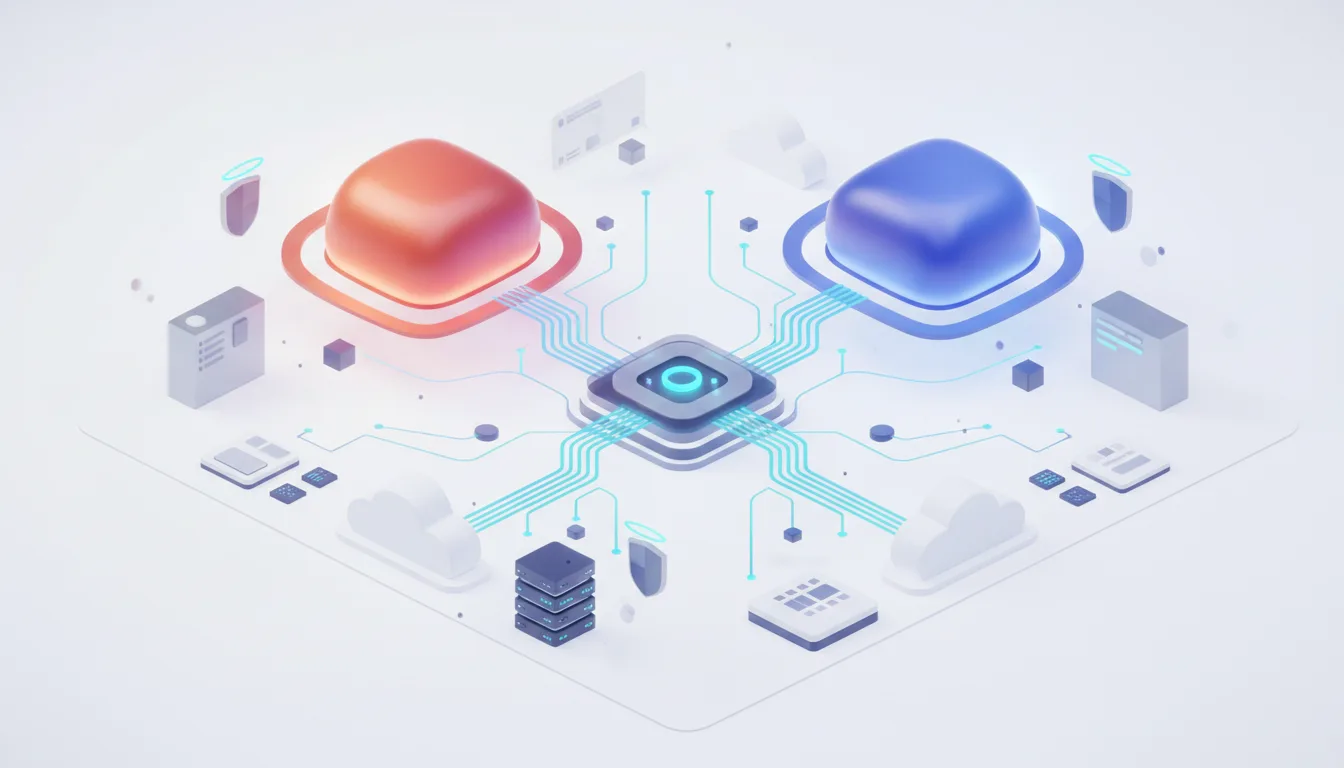
Researched and written with AI assistance under the editorial responsibility of the i10X News team. The title image is an AI-generated illustration. Read our AI Use Policy. Spotted an error? Request a correction.
This is an independent, research-based analysis synthesizing current SERP narratives, competitive positioning, and enterprise content gaps regarding the OpenAI and Anthropic ecosystems. It is designed for developers, engineering managers, and CTOs seeking to navigate beyond consumer-level benchmarks to frame robust, cost-effective, and portable AI rollout strategies.
i10x Perspective
The obsession with crowning either OpenAI or Anthropic as “the winner” is a distraction from how intelligence application layers will actually be structured in the next five years. The future does not belong to a single, monolithic frontier model; it belongs to dynamic model routers and abstraction ecosystems that treat AI as a liquid, tradable utility. Observers should keep a close eye on inference compute economics: as the gap between proprietary behemoths and localized open-weight alternatives narrows, the true moat will shift from raw reasoning capabilities to trusted data governance, specialized alignment, and ecosystem orchestration.