
Quick Take
- Summary: Perplexity CEO Aravind Srinivas has signaled a target timeline of 2028 for the company’s initial public offering, giving the AI search disruptor a four-year runway to solidify its underlying economics.
- What happened: While commenting on the broader capital ecosystem, Srinivas confirmed the 2028 IPO target and openly defended the high private-market multiples currently commanded by frontier model builders like OpenAI and Anthropic, framing them as foundational to the next software paradigm.
- Why it matters now: A publicly stated timeline shifts the market’s focus from raw user acquisition to the brutal realities of AI unit economics. To survive Wall Street scrutiny, an AI search engine must prove it can turn computationally expensive queries into a highly profitable, self-sustaining enterprise and consumer flywheel. From what I’ve seen, that gap between growth metrics and real margins often trips up even the strongest contenders.
- Who is most affected: Tech investors weighing liquidity windows, cloud infrastructure providers tracking inference demands, and enterprise tech leaders evaluating the long-term viability of AI-native search alternatives to Google.
- The under-reported angle: The true hurdle to a Perplexity IPO isn’t just proving its valuation against OpenAI; it’s solving “margin on inference.” The company must demonstrate that ad revenues and Pro subscriptions can outpace the inherently high compute costs of generative search before filing an S-1. Plenty of reasons, really, why timing matters here.
Deep Dive
Have you ever wondered why some AI tools race ahead in users but still feel miles from sustainable? By pointing to 2028, Perplexity is openly acknowledging a fundamental truth of the current AI cycle: building a generational application takes time, but tuning the intelligence infrastructure to make it profitable takes even longer. While Srinivas uses his platform to defend the towering valuations of foundational tier players like OpenAI and Anthropic, his own company faces a distinctly different set of pressures at the application layer. Perplexity is attempting to usurp the world’s most lucrative business model—search—using one of the most computationally expensive technologies ever scaled.
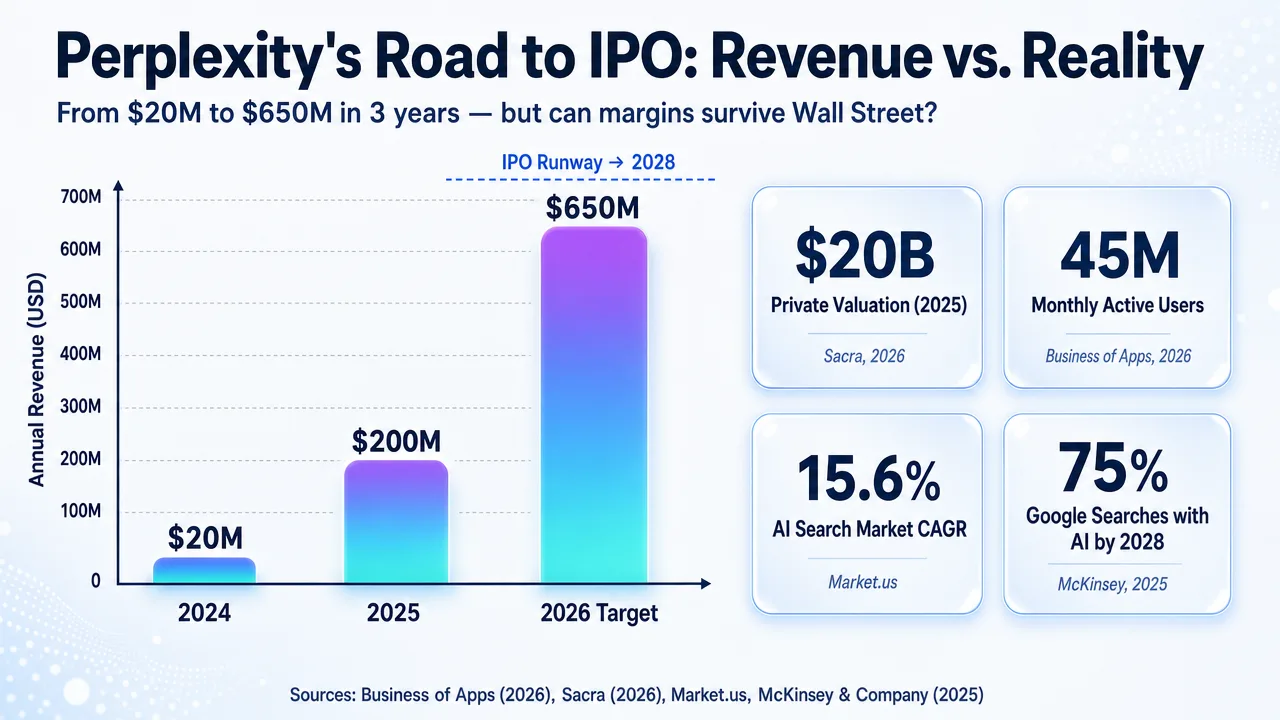
The core tension in an AI search IPO lies in unit economics, functioning as a real-time stress test of the “compute cost fulcrum.” Traditional search engines retrieve links at virtually zero marginal cost. In contrast, Perplexity synthesizes answers, burning inference compute with every user prompt. By 2028, public market investors will demand a clear trajectory toward scalable gross margins. This means Perplexity must strategically weave smaller, cheaper proprietary routing models with expensive frontier APIs (like GPT-4o or Claude 3.5 Sonnet) to deliver high-fidelity answers without eroding profitability.
That said, this four-year runway also sets the clock for rigorous IPO readiness. While current media coverage focuses heavily on user growth and funding rounds, the underlying mechanics to track are structural. Perplexity needs to build public-company governance, map clear regulatory risk mitigations regarding copyright and web scraping, and establish predictable SaaS metrics. Moving forward, metrics like Remaining Performance Obligations (RPO) from their enterprise B2B tier will become just as critical as daily active user counts.
Furthermore, a future S-1 filing will require Perplexity to de-risk its dependency on third-party model providers. If their primary cognitive engine relies entirely on competitors who also harbor ambitions for search (e.g., OpenAI’s SearchGPT), Wall Street will flag it as a critical vulnerability. The road to 2028 will likely force Perplexity into deeper silicon and infrastructure partnerships – locking in compute capacity, advancing customized edge-inference hardware, and fortifying a moat that relies as much on specialized data-indexing infrastructure as it does on raw LLM intelligence.
Stakeholders & Impact
AI / LLM Providers
Impact: High
Insight: Validates the ecosystem; Perplexity’s success at the application layer provides structural justification for the massive valuations of model providers like Anthropic and OpenAI.
Infra & Cloud Players
Impact: Medium–High
Insight: Highlights a critical need for inference-optimized architecture. The public market will scrutinize cloud overhead required to run generative queries at scale.
Investors & VC
Impact: High
Insight: Sets a realistic liquidity expectation. Pushes the focus away from “hype-based” pre-IPO multiples toward standard public market scrutiny (revenue predictability, Moat).
Regulators & Policy
Impact: Significant
Insight: An S-1 filing will force deep transparency regarding data scraping, copyright claims, and publisher compensation models before hitting the public exchanges.
About the analysis
Researched and written with AI assistance under the editorial responsibility of the i10X News team. The title image is an AI-generated illustration. Read our AI Use Policy. Spotted an error? Request a correction.
This independent analysis synthesizes executive commentary, venture mapping data, and AI infrastructure economics to evaluate Perplexity’s path to the public markets. It is tailored for technology leaders, investors, and infrastructure strategists seeking to understand how compute economics shape the viability of AI-native business models beyond the initial hype cycle.
i10x Perspective
A 2028 Perplexity IPO is not just a milestone for one company; it will serve as Wall Street’s ultimate referendum on whether the “answer engine” is a viable, standalone business or merely a high-burn feature destined to be swallowed by larger ecosystems. The true differentiator won’t be the intelligence of the models they use, but the efficiency of their infrastructure routing. Over the next four years, watch for Perplexity to aggressively internalize its inference stack—because in the AI economy, the player who drives the cost of intelligence closest to zero is the one who ultimately owns the market.