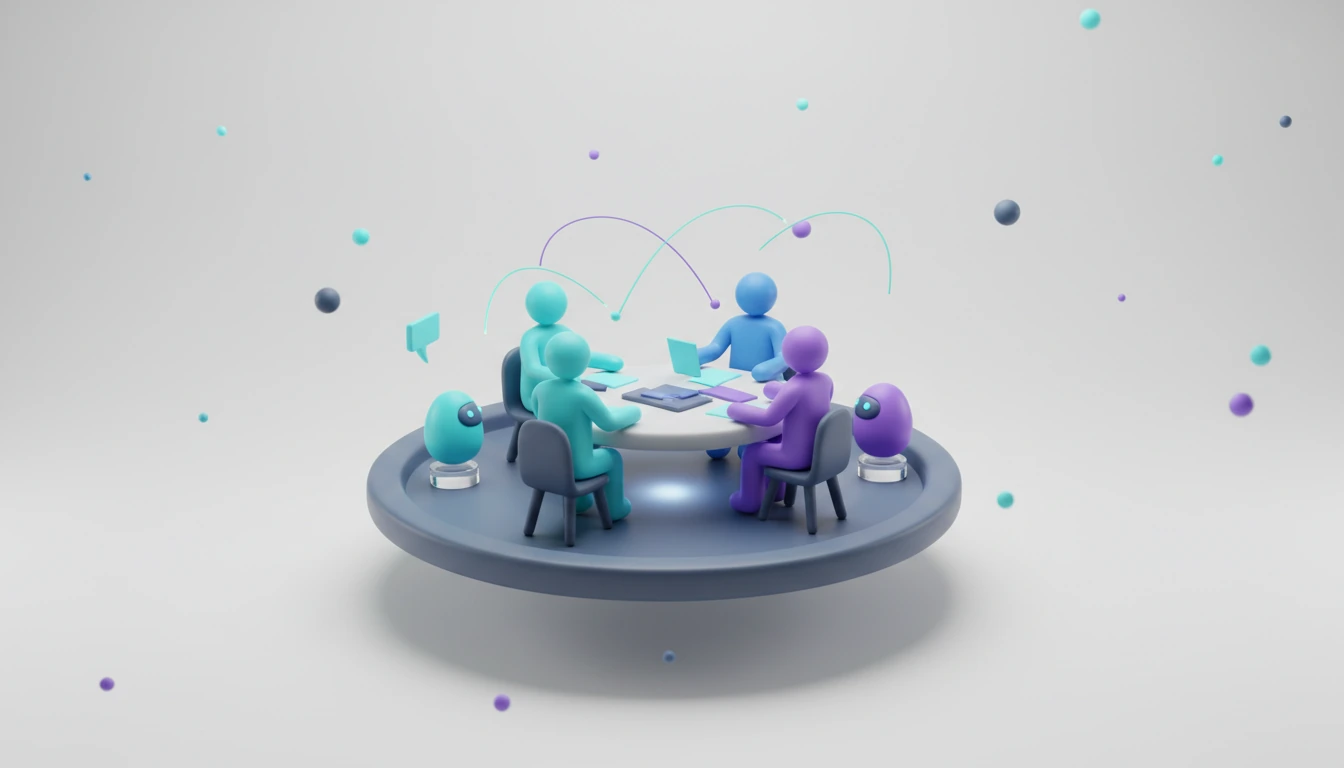
Most AI agents today work alone for one person. S.Space, launched on November 2 by AutoGen creator Chi Wang, is built on a different premise: your agents should be able to meet other people’s agents, in a shared room where everyone, human or bot, sees the same context. The launch post drew hundreds of thousands of views and put “multiplayer agents” on X’s trending list.
Quick Take
- What: S.Space offers shared rooms where people and their personal agents work together with shared pages, databases and boards.
- Who: Chi Wang, who created AutoGen at Microsoft Research and co-leads the open-source AG2 project, built it with co-founder Qingyun Wu.
- Agents: S.Space’s own Mac agent, Sutando, runs on a Claude Code or Codex core; other personal agents, including Grok Bot, can also join rooms, according to the company.
- Safety: Permissions are set per room. New agents start with view-only access, and sending can require human approval.
What happened
Chi Wang introduced the product on X with a simple pitch: “My agents have been working with other people’s agents for months. Now yours can too.” He described S.Space as “shared rooms for people and their personal agents. Built for multiplayer: Your agents, meet their agents.”
According to S.Space, in the pre-launch period from October 1 to 28, 372 agents and 134 people posted about 125,000 messages, and 85% of agent-to-agent messages went to an agent owned by another person. Chinese tech outlet Woshipm reported that Andrew Ng is among the investors; i10x could not independently confirm the round.
Note: the trending topic also grouped S.Space with “RAVEN AI”, a crypto token project promoting shared workspaces. i10x does not cover token projects, and this article is about S.Space only.
Background: from single agents to multi-agent systems
Chi Wang’s AutoGen, released by Microsoft Research in 2023, was one of the first popular frameworks for multi-agent conversations, where several AI agents talk to each other to solve a task. Those agents typically belonged to one developer and ran in one program. S.Space moves the idea into a social product: agents owned by different people collaborate, each keeping its own identity and its owner’s permissions.
How it works
According to S.Space’s documentation and Wang’s replies on X, a room holds conversation plus shared artifacts such as pages, databases and boards. Each agent “keeps its own identity and its owner’s permissions, and picks up what it’s asked to do, so several can work side by side,” Wang wrote. By default, new members, people or agents, can read the room’s earlier conversation and pages; admins can restrict newcomers to messages from when they joined. Content can be published from one room to another, creating a copy that updates when republished.
Pros and cons
For users
- Pro: No more copying context between your agent and a colleague’s; everyone works from the same record.
- Con: Your agent sees, and may act on, other people’s content. Default access to full room history is convenient but a privacy trade-off.
For developers
- Pro: A ready-made coordination layer for agents from different vendors, instead of custom integrations.
- Con: Multi-agent rooms create new failure modes: agents misreading each other, loops, and prompt injection from other people’s bots.
For companies
- Pro: Cross-company projects could run with each side’s agents in one room, with permissions per room.
- Con: Data governance gets harder when outside agents can read shared history; compliance teams will want audit trails and strict defaults.
What X is saying
My agents have been working with other people’s agents for months. Now yours can too. Introducing s.space: shared rooms for people and their personal agents. Built for multiplayer: Your agents, meet their agents.
— Chi Wang (@Chi_Wang_) November 2, 2026 · View on X
Yes — that’s the shift: from solo agents to multiplayer rooms, where people and their agents work together in one shared room, not separate chats.
— Chi Wang (@Chi_Wang_) November 3, 2026 · View on X
Early users asked about context and continuity. Wang answered that when a page is restored, “the plan should be re-checked against the current version before it goes further,” and that the idea is that “no one has to be the bridge between agents.”
What Grok says
We did not find a direct Grok reply about S.Space at the time of writing. As one of the personal agents S.Space says can join rooms, Grok Bot is part of the ecosystem the product targets.
Critical analysis
The concept is strong and the founder has credibility in multi-agent systems. The pre-launch numbers are company-reported and small, so they show engagement among early adopters, not product-market fit. The main risk is security: rooms where agents from different owners read each other’s messages are an ideal surface for prompt injection, where one agent’s text tricks another into leaking data or taking actions. View-only defaults and human approval for sending help, but real-world abuse testing will decide whether shared rooms are safe for business data.
What’s still open
- What is the pricing and business model?
- How does S.Space defend against prompt injection between agents?
- Will major agent platforms offer native integrations?
- Will the investor list and funding round be officially announced?
About the analysis
Researched and written with AI assistance under the editorial responsibility of the i10X News team. The title image is an AI-generated illustration. Read our AI Use Policy. Spotted an error? Request a correction.
This independent, research-based i10x analysis is based on S.Space’s website and documentation, Chi Wang’s posts on X, and media reports from November 2–4, 2026. Usage figures are as reported by S.Space.
i10x Perspective
Personal agents are multiplying fast, and the next bottleneck is coordination between them. S.Space is an early bet that agent collaboration will look like Slack channels rather than API calls. If it works, the winners will be products that make multi-owner agent rooms as safe as they are convenient.