xAI Hires Starlink Engineer for Grok Training Operations

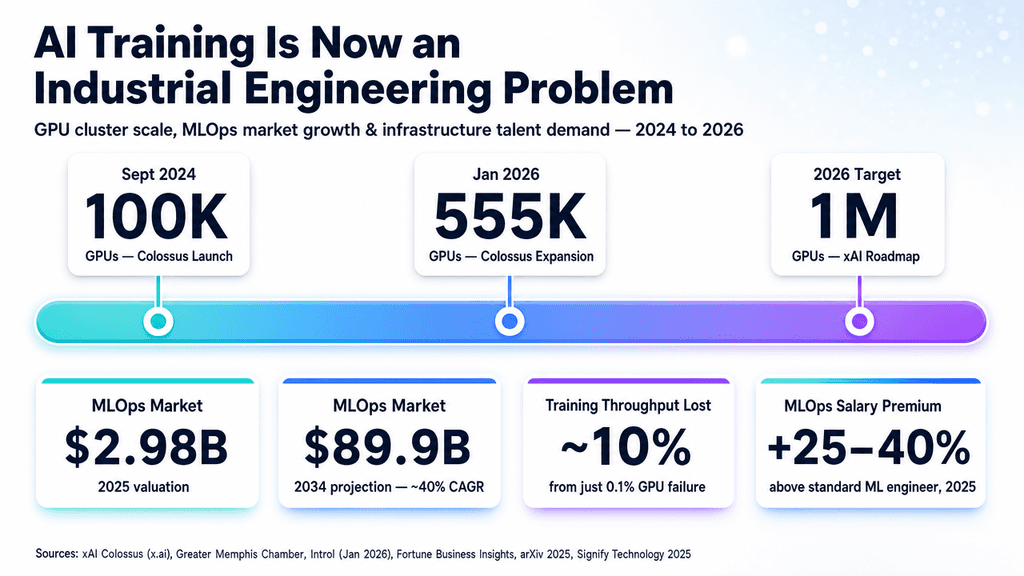
“AI model training is no longer an artisanal research endeavor - it is an industrial engineering problem of distributed systems and network resilience.”
xAI has quietly started pulling talent from across Elon Musk’s companies. The latest example is a veteran from Starlink now leading the training operations for Grok. It points to a broader change in how the biggest models get built: less emphasis on pure research papers, more focus on keeping enormous clusters of GPUs running without constant breakdowns.
What happened
A senior engineer from Starlink, SpaceX’s satellite internet arm, has taken over the LLM training team at xAI. The move is small on paper, yet it reveals where the real constraints now sit.
Why it matters now
Have you ever watched a training run stall because a few dozen GPUs dropped offline? At the scale required for something like Grok-3, clusters of 100,000 GPUs become the norm. Hardware failures, network hiccups, and data pipeline hiccups turn into the main obstacles. A background spent keeping thousands of satellites talking to each other suddenly looks very relevant.
Who is most affected
Other frontier labs are paying attention. OpenAI, Anthropic, and Google all face the same infrastructure walls. Inside those organizations, the engineers who design training loops and keep them stable are suddenly finding their skills in higher demand.
The under-reported angle
From what I’ve seen, most coverage treats this as another leadership shuffle inside the Musk ecosystem. The quieter story is the deliberate blending of aerospace-grade systems thinking with AI development. xAI appears to be reorganizing around MLOps reliability, data pipelines, and distributed training rather than chasing another theoretical breakthrough.
🧠 Deep Dive
When that Starlink engineer steps into the Grok training organization, the signal is clear. The mathematics of scaling transformers have become table stakes. The harder problem is maintaining tens of thousands of GPUs in lockstep for months at a time. Training runs have turned into prolonged infrastructure tests.
xAI wants to keep moving from one model release to the next faster than most competitors allow. That pace demands a level of operational discipline that satellite networking already requires: constant telemetry, rapid error recovery, and tolerance for partial failures. The Memphis supercluster now under construction will need exactly those habits if it is to stay productive instead of repeatedly rebooting.
Public discussion still fixates on benchmark scores. Yet the actual bottleneck has shifted downstream, into automated monitoring, data quality checks, and recovery systems that keep pretraining, fine-tuning, and RLAIF loops moving even when individual components falter. Without those systems, extra researchers alone will not close the gap.
This also reframes the talent question. Top researchers who invent new architectures remain scarce. Engineers who can keep a massive training fabric alive are, at this moment, more immediately useful. By reaching into Starlink rather than raiding other AI labs, xAI is voting with its feet on which skill set matters more right now.
📊 Stakeholders & Impact
- xAI & Grok engineers — Impact: High. Insight: Shift from open-ended research toward tightly managed, resilient training operations.
- Frontier AI competitors — Impact: Medium. Insight: Other labs may begin pulling infrastructure talent into core training roles.
- Data center & GPU networks — Impact: High. Insight: Network reliability and topology become the next competitive frontier.
- Open source MLOps tooling — Impact: Significant. Insight: Greater demand for tools that handle observability and automatic recovery at extreme scale.
✍️ About the analysis
The piece draws on hiring patterns, infrastructure reports, and internal signals to map how leading labs are adapting their organizations to the practical limits of large-scale training. It is written for technical leaders who need to anticipate where the operational bottlenecks are moving.
🔭 i10x Perspective
The days of small, craft-focused AI teams are fading. What is taking shape instead looks more like heavy industrial manufacturing, where the advantage comes from mastering complex physical systems as much as from writing clever code. xAI’s decision to import satellite-network expertise into LLM training underscores that point. Over the next several years the real differentiator may well be which organization can keep its enormous training clusters running smoothly when everything that can go wrong eventually does.
Related News

Mistral Large 4: Europe's Top Open-Weight Model
Mistral Large 4 launches as a 1T-parameter MoE model optimized for enterprise coding and cybersecurity. See how it compares to leading Chinese open-weight models and why it matters for buyers. Explore the guide.

AI Agent Videos: The Operator-First Education Gap
Enterprise searches for AI agent videos reveal a split between technical tutorials and hype. Discover why operator-first, no-code resources are essential for non-technical teams to deploy LLM agents effectively. Explore the analysis.

AI Leadership: Why Human EQ Now Outweighs Expertise
Frontier LLMs are automating leadership tasks, raising the stakes for human emotional intelligence and accountability. Learn how organizations can protect core leadership skills while integrating AI.