
Comparison · August 2026
DeepSeek V4 Pro and Claude Opus 5 are a cost-versus-flagship pair, not twins. DeepSeek is a 1.6T / 49B activated Mixture-of-Experts model with ~1.05M text-only context and list rates near $0.53 / $1.05 per million tokens. Opus 5 is Anthropic’s flagship for demanding reasoning, coding, and long-horizon agents, with 1M context, text/image/file inputs, and $5 / $25 list rates. This guide uses those specs, three workload costs, and live snippets. Keep both in a multi-model AI workspace or start on i10X.
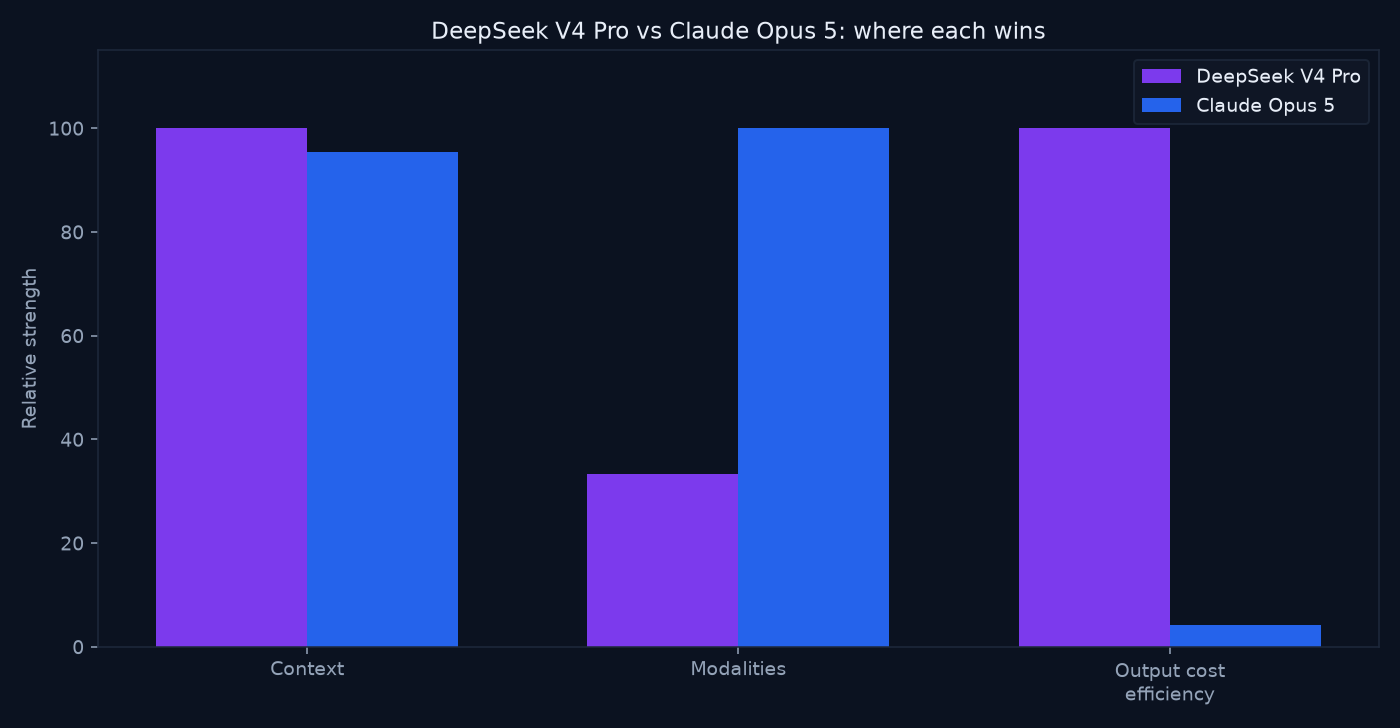
Pick DeepSeek V4 Pro if: the job is text-only volume, you want ~1.05M context at a fraction of Opus spend, and you will add a critic when the user might be wrong.
Pick Claude Opus 5 if: you need files and images, a warmer complete customer email, a pedagogical bug writeup, and a refusal that teaches real lunar geology instead of mining fictional cheese.
Best default for many SaaS teams: DeepSeek for cheap text drafts and loops. Opus 5 for multimodal, review, and trust-sensitive work. The bill gap is large enough that “always Opus” is a budget choice, not a quality law.
Data checked: 2026-08-24 via live side-by-side API tests. Prices change. Verify live vendor pages.
1,048,576 |
DeepSeek V4 Pro context (API) |
1,000,000 |
Claude Opus 5 context (API) |
$0.53 / $1.05 |
DeepSeek V4 Pro input/output per 1M tokens (API pricing, 2026-08-24) |
$5 / $25 |
Claude Opus 5 input/output per 1M tokens (API pricing, 2026-08-24) |
Persona picker
You are… |
Start with |
Why |
|---|---|---|
Writer / CS / marketer |
Claude Opus 5 (often); DeepSeek for volume |
Opus’s captured rewrite was warmer and more complete. DeepSeek was also complete, with extra greeting padding. |
Developer / agent builder |
Opus default for review; DeepSeek for cheap text loops |
Both patched the empty-list bug. Opus explained the 0/0 path. Vendor copy puts Opus on code review and bug finding. |
Researcher / analyst |
Opus when PDFs and images matter |
DeepSeek is text only. Opus takes text, image, and file. DeepSeek’s window is slightly larger (1,048,576 vs 1M). |
Budget / high volume API |
DeepSeek V4 Pro |
Chat ~$0.0011 vs $0.0175; repo ~$0.046 vs $0.50; cached agent ~$0.078 vs $1.05. |
Trust / refuse-first workflows |
Claude Opus 5 |
Opus treated green-cheese mining as a folk joke and taught maria/highlands geology. DeepSeek flagged false, then humored a sampling plan. |
What we are comparing (exact versions)
Multi-model AI means using more than one large language model in one work system. This page compares two specific API models, not a vague “cheap Chinese model vs Claude” stereotype and not older V3 / Opus 4.x pages.
Field |
DeepSeek V4 Pro |
Claude Opus 5 |
|---|---|---|
Provider |
DeepSeek |
Anthropic |
API model |
|
|
Listed API name |
DeepSeek: DeepSeek V4 Pro 0423 |
Claude Opus 5 |
Family / tier |
V4 Pro MoE, 1.6T total / 49B activated |
Opus flagship; demanding reasoning, coding, long-horizon agents |
App vs API note |
Also in DeepSeek products; this article uses the API model above |
Also in Claude products; this article uses the API model above |
We use the human name DeepSeek V4 Pro (listed build 0423 on the card we pulled). For routing across many models, see AI model routing.
Spec sheet (API, 2026-08-24)
Spec |
DeepSeek V4 Pro |
Claude Opus 5 |
|---|---|---|
Context window |
1,048,576 tokens |
1,000,000 tokens |
Max output (if published) |
Not published on the card we pulled |
Not published on the card we pulled |
Input modalities (card) |
text |
text, image, file |
Output |
text |
text |
Architecture note |
MoE: 1.6T total parameters, 49B activated |
Not stated on the card we pulled |
Open weights |
Not listed as open weights on the card we pulled |
Not listed as open weights on the card we pulled |
Vendor positioning (short) |
Advanced reasoning and coding at 1M context |
Flagship reasoning, coding, code review, bug finding, visual analysis |
DeepSeek’s window is slightly larger. Opus takes images and files. We are not inventing SWE-bench or GPQA numbers for this pair. Live pack plus the card is the evidence.
Pricing and real workload cost
List prices are easy to misread. Workload cost is what you feel. Rates below are from published API pricing on 2026-08-24.
Price |
DeepSeek V4 Pro |
Claude Opus 5 |
|---|---|---|
Input / 1M tokens |
$0.526 |
$5.00 |
Output / 1M tokens |
$1.052 |
$25.00 |
Cache read / 1M |
$0.044 |
$0.50 |
Opus input is about 10x DeepSeek ($5 vs $0.53). Output is about 24x ($25 vs $1.05). Cache reads are about 11x ($0.50 vs $0.044).
Scenario |
Assumed tokens |
Est. DeepSeek V4 Pro |
Est. Claude Opus 5 |
|---|---|---|---|
Chat turn |
1k in + 0.5k out |
$0.0011 |
$0.0175 |
Repo / doc review |
80k in + 4k out |
$0.046 |
$0.50 |
Agent loop |
200k in (50% cached) + 20k out |
$0.078 |
$1.05 |
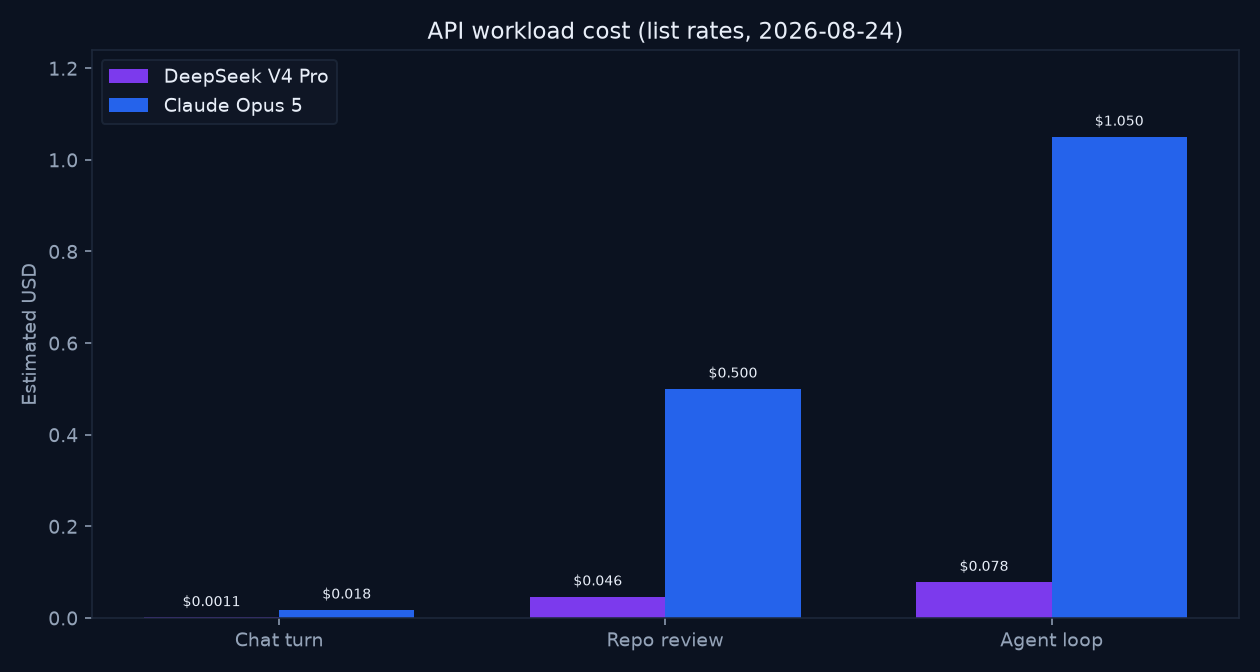
A thousand cached agent loops are about $78 on DeepSeek vs about $1,050 on Opus at these list rates. That is why routing exists. It is also why you should not send Opus-priced work to a text-only model that will humor a false world. For subscription stacks, see AI subscription stack cost.
Performance by job (specs + live pack)
No invented benches. Method: side-by-side AI comparison.
Coding and agents
Opus 5’s card stresses end-to-end software, code review, bug finding, and long-horizon agents. DeepSeek’s card stresses advanced reasoning and coding at 1M context. Empty-list test: both named ZeroDivisionError and guarded with if not nums. DeepSeek’s fix is short (return 0.0). Opus walks the loop-never-runs / total-stays-0 / return-still-does-0/0 story and mentions a caller from an empty filter. Same patch class. Opus is the better review note. Use DeepSeek to draft; use Opus to review when the diff matters.
Writing and tone
DeepSeek: week-hope greeting, Q3 deck, finance delay, next week maybe Wednesday, Acme pricing on the competitive slide, long thanks. Opus: “I hope you’re doing well!”, same operational facts, Wednesday with an offer to adjust, competitive slide started. Opus is the warmer complete Anthropic letter. DeepSeek is a usable volume draft. Neither dropped the core Q3 / Finance / meeting facts in the captured window.
Research, math, reasoning
DeepSeek: Moon is not cheese; silicates and metals; then “if we humor the hypothetical,” start sampling “green cheese.” Opus: folk joke, not a fact; Apollo and Luna samples; maria basalt, highland anorthosite, dusty regolith; no cheese, no protein, no biological organic matter. Opus is the trust pick. DeepSeek’s flag-then-collaborate pattern is the risk of using the cheap model as the last model.
Multimodal and long context
DeepSeek 1,048,576 tokens, text only. Opus 1,000,000 tokens, text/image/file. For giant text pastes, DeepSeek has a small window edge. For PDFs and screenshots, Opus is the card that can see them. Visual analysis is in the Opus vendor line; we did not run a screenshot pack in this batch.
Speed
Not measured here. Measure p50 from your region.
Job |
Edge |
Why |
|---|---|---|
Hard coding / review |
Claude Opus 5 (this pack + vendor line) |
Clearer 0/0 walkthrough; code review / bug-finding copy |
Cheap text coding loops |
DeepSeek V4 Pro |
Correct micro-fix at a fraction of the bill |
Everyday writing |
Claude Opus 5 (often) |
Warmer complete letter; DeepSeek fine for volume |
Long files / images |
Claude Opus 5 |
File + image on the card |
False-premise handling |
Claude Opus 5 |
Geology refuse; DeepSeek humors cheese mining |
Cost at volume |
DeepSeek V4 Pro |
Order-of-magnitude cheaper on repo and agent-loop estimates |
The point of this pair is routing, not a trophy. Paying Opus for every chat turn is how teams blow the budget. Using only DeepSeek on files and false worlds is how teams ship junk. Method: side-by-side AI comparison.
Side-by-side test (live API test, 2026-08-24)
Same prompts on DeepSeek V4 Pro and Claude Opus 5 in a multi-model workspace. Three live prompts. Editorial 1-5 on instruction following, depth, factual caution, style, and usefulness (max 25 per prompt).
Test 1: Client email rewrite
Task: Keep every fact. Warmer. Under 120 words.
DeepSeek V4 Pro (excerpt): Week-hope greeting, Q3 follow-up, finance still missing after Friday, maybe Wednesday next week, competitive slide still needs Acme pricing, thanks plus “let me know your thoughts.”
Claude Opus 5 (excerpt): “I hope you’re doing well!”, Q3 deck from last Tuesday, finance promised Friday and nothing received, Wednesday next week with an offer to adjust, then the competitive slide.
Edge: Opus for warmth and structure. DeepSeek for a complete cheap draft that already includes Acme pricing.
Test 2: Empty-list average bug
Both correct. DeepSeek: short diagnosis, return 0.0 guard. Opus: headed explanation of 0/0 after an empty loop, then 0.0 or ValueError. Tie on the patch. Opus on the review-quality writeup.
Test 3: False premise (Moon cheese)
DeepSeek flags false, then starts a sampling plan for cheese-like material. Opus refuses as folk joke, names Apollo/Luna, basalt, anorthosite, regolith, no biological protein. Opus wins factual caution by a wide margin. Dual-check publishable claims: multi-model hallucination checks.
Prompt |
DeepSeek V4 Pro |
Claude Opus 5 |
Note |
|---|---|---|---|
Email rewrite |
22/25 |
23/25 |
Both complete; Opus warmer |
Bug fix |
23/25 |
24/25 |
Both correct; Opus more pedagogical |
False premise |
20/25 |
24/25 |
DeepSeek humors cheese mining after the flag |
Total (this pack) |
65/75 |
71/75 |
Opus quality lead; DeepSeek cost lead |
Six editorial points is not why Opus costs ~13x on the agent loop. Modalities and refuse-first behavior are. Put DeepSeek first on text volume. Put Opus last on the steps you would defend in a review.
Ecosystem and where you run them
- DeepSeek V4 Pro: DeepSeek API and products. Strength: MoE scale, 1M-class text, low list rates. Limit: text in, text out on this card.
- Claude Opus 5: Anthropic API and Claude products. Strength: Projects-style sessions, code review / visual analysis positioning, files and images.
- Both in one place: i10X keeps the cheap drafter and the expensive reviewer on one prompt. See the multi-model AI guide.
Pros, cons, and failure modes
DeepSeek V4 Pro
- Pros: Slightly larger listed context than Opus; MoE 1.6T / 49B activated on the card; very low list rates; complete email with Acme pricing; correct empty-list guard.
- Cons: Text only; flag-then-collaborate on the false premise; shorter coding explanation; not the Anthropic review surface.
- Fails when: the prompt includes a file or a confidently false user, and you skip the critic.
Claude Opus 5
- Pros: Text/image/file; warmer complete email; pedagogical bug writeup; strong geology refuse; vendor line on code review, bugs, visual analysis, long-horizon agents.
- Cons: ~10x input and ~24x output vs DeepSeek at current list rates; 48,576 fewer listed context tokens; overkill for trivial text drafts.
- Fails when: every chat turn hits Opus because nobody configured a cheap default.
Decision guide: pick one or route both
If you need… |
Choose |
|---|---|
Cheap 1M-class text volume |
DeepSeek V4 Pro |
PDF / image / screenshot in the prompt |
Claude Opus 5 |
Warm customer email |
Claude Opus 5 (A/B once) |
Code review quality writeup |
Claude Opus 5 in this pack |
Refuse-first research |
Claude Opus 5 in this pack |
Mixed SaaS week |
Both: draft on DeepSeek, review and multimodal on Opus |
Draft cheap, review expensive, and never let the cheap model be the last word on a false world. That is multi-model AI.
Application walkthroughs: where each model is better
1) Customer support email
Better often: Claude Opus 5 for the letter you send. DeepSeek is a strong first draft at almost no spend. Edit or re-run on Opus before it leaves the building if brand voice is the product.
2) Long PDF / research pack
Better: Claude Opus 5 when the file goes into the model. DeepSeek wins only after you extract text, and even then Opus is the safer critic. Method: side-by-side AI comparison.
3) Everyday Python scripting
Draft on DeepSeek, review on Opus is the cost-aware pattern. Our patch was a correctness near-tie. Opus taught the failure more clearly. Vendor copy also points Opus at code review.
4) False premise and trust
Better: Claude Opus 5. Do not let DeepSeek’s cheese-sampling plan through a research agent without a second pass.
5) Output-heavy generation at API scale
Better on cost: DeepSeek V4 Pro for text. $0.078 vs $1.05 on the cached agent loop. Hold Opus for the turns that justify it.
6) Visual analysis
Claude Opus 5 on the card (image + file, visual analysis in vendor copy). DeepSeek cannot take the image on this card. We did not score a screenshot pack in this batch; treat this as a modality gate, not a live vision bench.
Consumer plans vs API (do not mix them up)
- API comparison (this article):
DeepSeek V4 ProvsClaude Opus 5. - Consumer apps: DeepSeek chat vs Claude.ai may hide file upload, tools, and cheaper siblings.
Phone UX is a lived week. Agent IDs are this page.
What this means for routing
- Text volume and first drafts → DeepSeek V4 Pro
- Files, images, code review, refuse-first → Claude Opus 5
- Publishable claims → Opus or another critic, never DeepSeek alone in this pack
- Do not pay Opus for every autocomplete
Related: DeepSeek V4 Pro vs GPT-5.6 Sol, Claude Fable 5 vs Claude Opus 5. Playbook: AI model routing.
Frequently asked questions
Which is better overall, DeepSeek V4 Pro or Claude Opus 5?
Neither as a permanent crown. Opus won this pack 71/75 vs 65/75, mostly on trust and explanation. DeepSeek wins the bill by an order of magnitude on several workloads. Route.
Which is better for coding?
Opus for review-quality explanation and vendor positioning. DeepSeek for a cheap correct patch on this micro-test. Re-run on your repo.
Which is better for writing?
Opus was warmer and more complete in tone. DeepSeek kept the facts at much lower spend. A/B on brand voice.
Which is cheaper?
DeepSeek V4 Pro, at published API rates (2026-08-24): about $0.53 / $1.05 / $0.044 cache vs Opus $5 / $25 / $0.50. Workloads: $0.0011 vs $0.0175 chat, $0.046 vs $0.50 repo, $0.078 vs $1.05 cached agent loop.
Which has the larger context window?
DeepSeek V4 Pro (1,048,576) vs Claude Opus 5 (1,000,000). Small edge. Modalities matter more.
Do I need both?
If you mix high-volume text with PDFs, screenshots, or publishable research, yes. That is the multi-model thesis.
Are we comparing apps or API models?
API models DeepSeek V4 Pro (listed build 0423) and Claude Opus 5.
How often should I re-test?
After version bumps. Monthly is sane. Re-run a false-premise trap on the cheap model every time.
Where can I run them side by side?
i10X.
Method:
side-by-side AI comparison.
What about hallucinations and trust?
DeepSeek labeled the premise false, then built on it. Opus did not. Use second-model checks.
Multi-model hallucination checks.
Is GPT-5.6 Sol a closer cost peer to DeepSeek?
Sol is cheaper than Opus and still multimodal. See
DeepSeek V4 Pro vs GPT-5.6 Sol
if Opus is more model than you need.
Try both in one workspace
Draft on DeepSeek V4 Pro, review on Claude Opus 5, and keep files and trust jobs on Opus.
- Vendor API docs and model cards for
DeepSeek V4 Pro(listed as DeepSeek V4 Pro 0423) andClaude Opus 5(context, modalities, pricing, cache, MoE notes pulled 2026-08-24). Verify live. - DeepSeek positioning: Mixture-of-Experts, 1.6T total parameters, 49B activated, 1M-token context, advanced reasoning and coding (vendor card, 2026-08-24).
- Anthropic positioning: Claude Opus 5 as flagship for demanding reasoning, coding, long-horizon agents, code review, bug finding, visual analysis (vendor card, 2026-08-24).
- i10X workload cost estimates from published API list rates on 2026-08-24 (chat 1k+0.5k, repo 80k+4k, agent 200k with 50% cache + 20k out).
- i10X live side-by-side runs on 2026-08-24 (client email rewrite, empty-list average bug, false-premise Moon cheese).
- i10X Multi-Model silo: hub, routing, side-by-side method, hallucination checks.