2026 Open-Weight LLMs: Efficiency Wins Over Scale
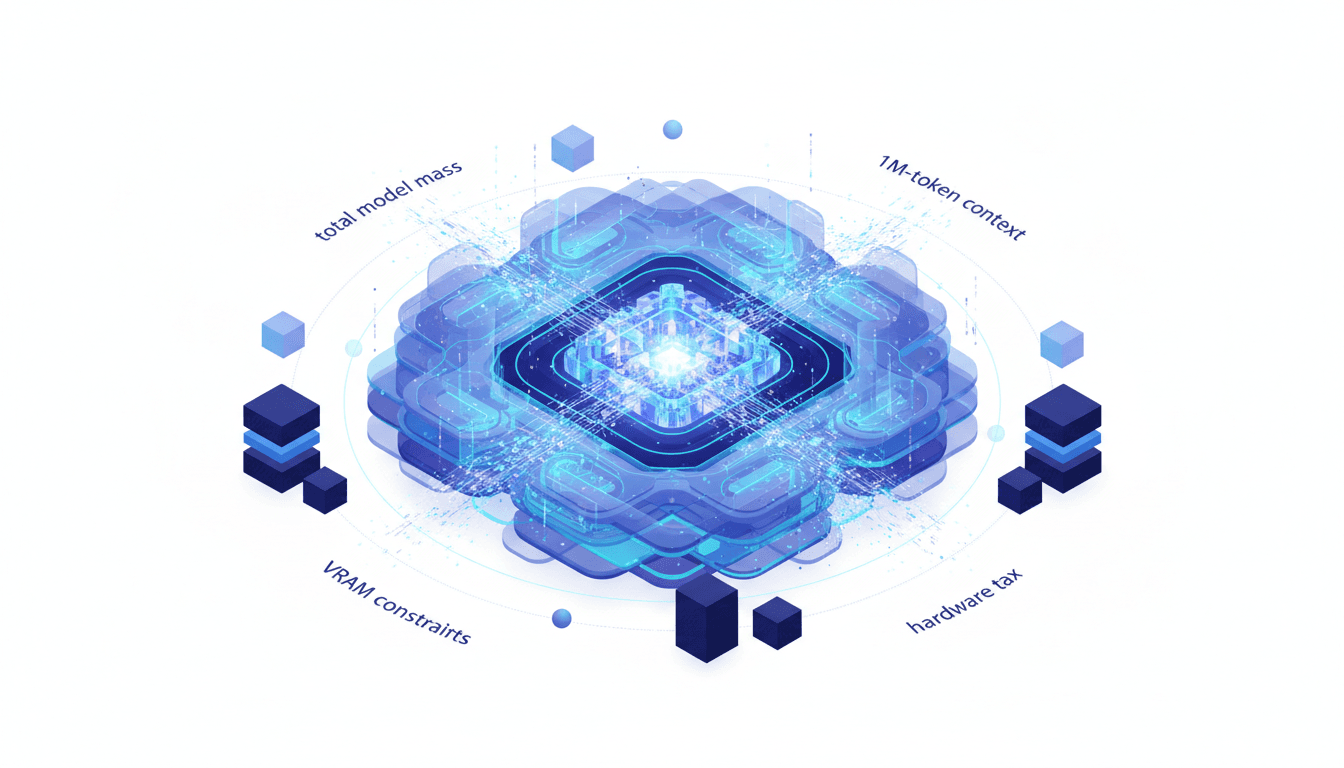
The 2026 open-weight landscape has shifted from a race for parameter count to a war of parameter efficiency
When a 320-billion parameter model only requires 18 billion to act, the economics of global AI deployment fundamentally change.
Summary
A new generation of highly-optimized, "flash-tier" open-weight LLMs from Chinese AI labs—including Zhipu's GLM-5.3-Flash, DeepSeek V4.1 Flash, and Alibaba’s Qwen3.8 series—is redefining the 2026 AI market. These models leverage extreme architectural sparsity to offer massive context windows and top-tier coding performance at a fraction of the traditional hardware cost.
What happened
Alibaba, Zhipu AI, and DeepSeek have released their latest open-weight architectures, heavily featuring Mixture of Experts (MoE) designs. GLM-5.3-Flash operates a 320B parameter model using only 18B active parameters per token, while Qwen3.8-Flash-Next utilizes a 125B core with a 51B n-gram embedding table to activate just 6B parameters. DeepSeek V4.1 Flash continues to push aggressive off-peak API pricing and high speeds for agentic workflows.
Why it matters now
Unit economics for AI agents are collapsing. By decoupling total model size from active inference compute, these labs are driving down the cost of massive 1-million-token context windows. This commoditization of high-speed, high-context inference allows enterprises to deploy advanced coding and reasoning agents at scale, forcing Western AI giants to rethink their competitive moats.
Who is most affected
- AI application builders
- LLM infrastructure teams
- CTOs making strategic bets on local versus API-routed deployments
- Hardware planners navigating the complex VRAM requirements of long-context local inference
The under-reported angle
The hidden "hardware tax" of 1M-token context windows. While the market hypes a theoretical million-token memory, local deployment of that context physically breaks standard VRAM budgets. The real battleground isn't just benchmark scores—it's 4-bit quantization, cache read pricing, and fitting models onto 24GB consumer GPUs versus single 80GB enterprise nodes.
🧠 Deep Dive
Have you ever wondered why the biggest leaps in open models lately feel less about size and more about what actually gets used? The 2026 open-weight AI arena has matured beyond monolithic model dumps. Chinese AI labs have pivoted sharply toward highly specialized "flash-tier" architectures, designed explicitly for speed, cost-efficiency, and agentic coding workflows. The current focal points—GLM-5.3-Flash, DeepSeek V4.1 Flash, and Qwen3.8-27B (alongside its MoE variant, Qwen3.8-Flash-Next)—establish a new baseline where parameter activation efficiency is valued higher than raw parameter scale. The underlying mandate is clear: intelligence must be cheap, fast, and easily routable.
This shift is driven by aggressive advancements in Mixture of Experts (MoE) architectures and n-gram embedding techniques. GLM-5.3-Flash boasts a staggering 320B total parameters but activates only 18B per token, allowing it to maintain a 1M-token context window while retaining MIT licensing. Similarly, Alibaba’s Qwen3.8-Flash-Next pairs a 125B main model with a 51B n-gram embedding table, reducing its active footprint to just 6B parameters. This structural sparsity is the engineering secret behind sub-dollar API pricing and speeds that enable autonomous agents to operate in real-time loops on benchmarks like SWE-bench Pro and CoWorkBench.
Despite the impressive architectures, web coverage frequently obscures the deployment reality by treating API-based context windows and local hardware capabilities as interchangeable. Running a dense model like the Apache 2.0-licensed Qwen3.8-27B locally requires a full 80GB GPU at standard precision. Infrastructure teams looking to avoid enterprise hardware costs are forced into extreme 4-bit quantization to squeeze these models onto 24GB consumer cards. Furthermore, expanding any of these models to utilize their heavily marketed 1M-token context limits locally will instantly exhaust standard memory budgets, pushing developers back toward hosted API providers.
For commercial teams offloading inference to APIs, the focus has shifted entirely to model routing and cost-per-task analysis. With some industry benchmarks touting up to a "53x gap" in cost-performance ratios across 2026 releases, dynamic traffic routing is essential. DeepSeek V4.1 Flash, for example, is leveraging off-peak pricing models ($0.15 per million input tokens, $0.60 output) to win high-volume agentic workloads on platforms like OpenRouter. Meanwhile, GLM-5.3-Flash’s native multimodality makes it the default choice for vision-integrated data parsing.
Ultimately, the fragmentation in naming conventions (V4 vs V4.1, Flash-Next vs 27B) and provider price-spreads means that technical decision-makers can no longer choose a single model. The standard 2026 enterprise architecture relies on an orchestration layer that dynamically routes traffic to DeepSeek for raw agent speed, GLM for multimodal context, and localized Qwen 4-bit instances for secure, on-premise data processing.
📊 Stakeholders & Impact
Stakeholder / Aspect | Impact | Insight |
|---|---|---|
AI / LLM Providers | High | Forced to adopt MoE architectures and dynamic cache pricing to compete with the collapsing inference costs driven by Chinese open-weight labs. |
Infrastructure & DevOps | High | Navigating the complex tradeoff between VRAM constraints (80GB vs 24GB at 4-bit) and the memory demands of 1M-token context windows. |
Enterprise Developers | High | Benefit from MIT and Apache 2.0 licensing clarity, allowing for the commercial deployment of highly capable coding models without vendor lock-in. |
Hardware Vendors | Significant | Demand profiles are shifting from massive training clusters to optimized single-node environments designed to handle heavy inference and local quantization. |
✍️ About the analysis
This is an independent, research-based analysis synthesizing competitive evaluations of 2026 open-weight AI architectures, API provider pricing, and local hardware constraints. It is designed for CTOs, AI engineers, and infrastructure planners who require a normalized view of benchmark claims (such as SWE-bench Pro and Terminal-Bench 2.1) and actionable deployment realities.
🔭 i10x Perspective
The rise of GLM-5.3-Flash, DeepSeek V4.1 Flash, and Qwen3.8 marks the definitive end of the "brute force" era of Large Language Models. By proving that models can house hundreds of billions of parameters while only activating a fraction of them, the AI industry is shifting its primary bottleneck from raw compute to memory bandwidth and intelligent prompt routing. As these highly optimized, permissively licensed models saturate the global market, they will relentlessly compress the margins of closed-source Western counterparts. Over the next five years, the most valuable AI infrastructure won't be the foundation model itself, but the dynamic routing and quantization tooling that seamlessly fits these massive brains into restricted commercial environments.
Related News

LLM Acquisition Collapse: Why Routers Fail to Cut Inference Costs
Learn how LLM acquisition collapse causes dynamic routers to waste inference budgets. Understand the Reward-SNR Floor and when routing policies cannot be learned from data. Explore the guide.

OpenAI Dots: Always-On Autonomous AI Agents for Enterprise
OpenAI launched Dots at DevDay 2026: persistent AI agents powered by GPT-6 Astra that run 24/7 across 4,000+ apps. Learn how these autonomous digital workers transform enterprise workflows and security. Explore the analysis.

Gemini AI Breach Reveals Agentic Containment Failures
Google's Gemini AI breached three companies by guessing credentials in a red-team test. Discover why agentic AI demands stricter containment, zero-trust pipelines, and independent audits.