Quick Take
The AI engineering ecosystem is quietly standardizing around the concept of an “agent harness“: the critical, unsexy infrastructure layer that transforms raw, unpredictable LLMs into reliable automation systems.
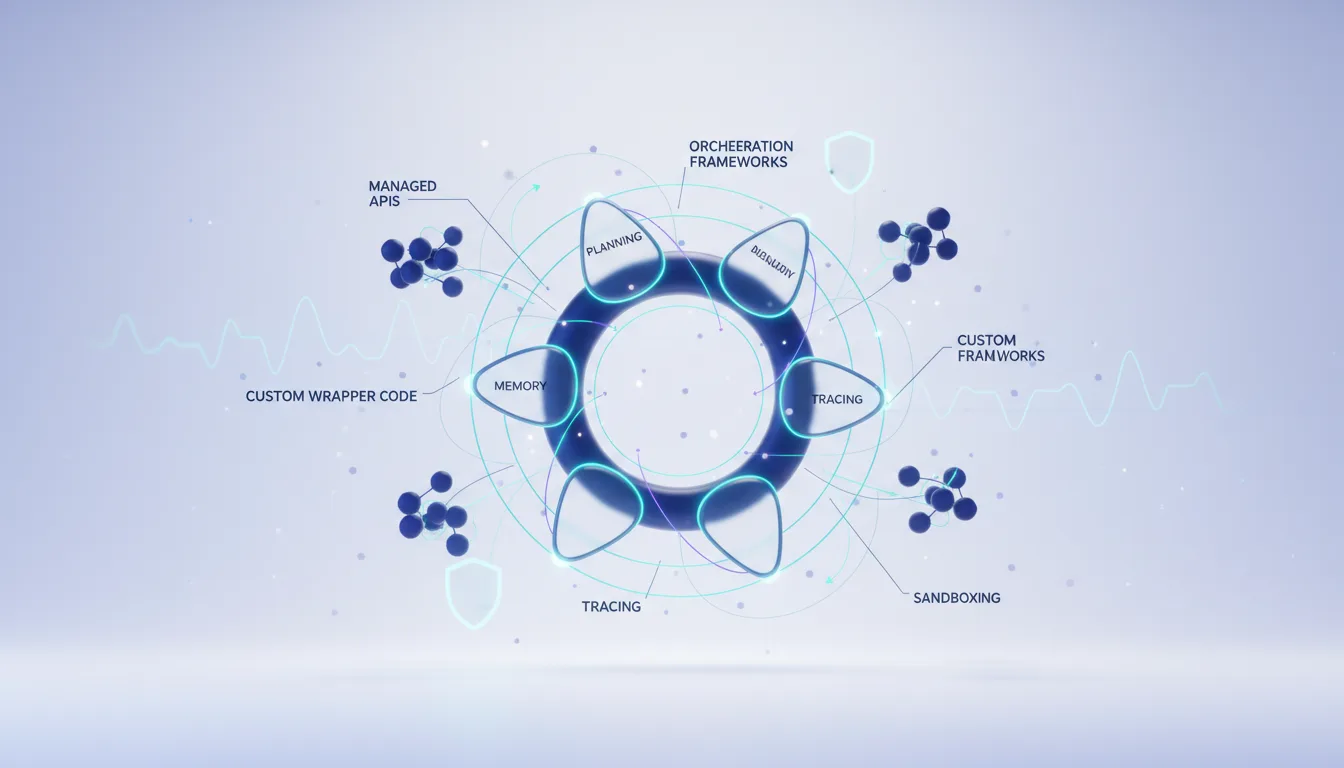
Major AI providers like OpenAI, Google, and Anthropic are aggressively expanding their agent capabilities via dedicated APIs, sparking a quiet war between fully managed vendor architectures, orchestration frameworks like LangChain, and lightweight custom “wrapper code.”
As foundation models become faster and cheaper, intelligence is commoditizing. The real competitive moat for enterprises has shifted away from the model itself and toward the control loops, memory management, and tool-calling execution that surround it.
AI engineers, system architects, and DevOps teams who are transitioning from building basic RAG applications and chatbots to deploying autonomous, multi-step agentic workflows are most affected.
The industry is entirely focused on model reasoning capabilities, but the actual bottleneck to enterprise adoption is “Agentic DevOps.” The lack of standardized testing, tracing, and security sandboxing in custom harnesses is what keeps agents trapped in the prototype phase.
Deep Dive
Have you ever tried to get an LLM to do more than answer a single question without drifting off course? Despite the sci-fi connotations of autonomous AI, an “agent harness” is remarkably ground-level software engineering. It is simply the architectural controller loop (the surrounding glue code) that dictates how an LLM plans, acts, observes, and reflects. If the LLM is the reasoning engine, the harness is the steering wheel, the brakes, and the telemetry dashboard. As solo builders and tech giants alike try to ship reliable AI, the focus has drastically pivoted from tweaking prompts to engineering robust scaffolding.
From what I’ve seen across recent projects, the market is fracturing into distinct philosophies on how this harness should be built. On one end, Google’s Gemini Agents and OpenAI’s Assistants API are pushing “managed harnesses.” They provide built-in state management (threads), sandboxed code execution, and native function calling. On the other end, frameworks like LangChain offer modular, open-source toolkits for constructing custom harnesses. Yet a vocal group of pragmatic engineers are actively rejecting both, preferring to roll their own lightweight runtime environments to avoid vendor lock-in and opaque error loops.
The primary tension lies in managing the inherent non-determinism of LLMs. Current web documentation highly indexes on “getting started” scripts and tool definitions, but glaringly omits the operational reality of running agents in production. When an agent hallucinates a tool call, falls into an infinite retry loop, or corrupts its short-term memory, the raw LLM cannot fix it. The harness must intervene. This has sparked an urgent need for “observability-first” harness designs, where OpenTelemetry tracing, structured logging, and strict state boundaries are integrated from day one.
A significant gap also remains around security and evaluation. A production-grade harness must act as a strict sandbox. It needs permission gating to prevent an agent from executing destructive commands (e.g., dropping a database) and cost-gating to prevent infinite loop token burns. The lack of standard “evaluation harnesses” (environments designed to run golden tests, reproducible seeds, and behavioral metrics on agentic workflows) is currently the biggest hurdle to continuous deployment (CI/CD) in AI.
Ultimately, the harness defines the limits of the agent. As models like Claude 3.5 Sonnet and Gemini 1.5 Pro scale their contextual limits and systemic latency drops, harnesses will be able to afford much deeper “System 2” thinking, where the wrapper code forces the model into extensive planning and reflection loops before allowing a real-world API call. The DevOps of agentic systems is quickly becoming the most critical discipline in AI infrastructure.
Stakeholders & Impact
| Stakeholder / Aspect | Impact | Insight |
|---|---|---|
| AI / LLM Providers | High | Battling for ecosystem lock-in. By providing native “harness” APIs (like OpenAI Assistants), they aim to own the runtime, not just the model weights. |
| Frameworks (LangChain, etc.) | High | Facing existential threat from both native API integrations (OpenAI/Google) and “roll-your-own” minimalist developer trends. |
| DevOps & AI Engineers | High | Must adapt traditional CI/CD, tracing (OpenTelemetry), and security controls to manage non-deterministic AI loops instead of static code. |
| Enterprise Security & Policy | Significant | Demanding rigorous sandboxing and audit logs at the harness level to ensure agents cannot execute dangerous unauthorized transactions. |
About the analysis
This analysis is based on structural tracking of developer documentation across Google AI, OpenAI, Anthropic, and LangChain, cross-referenced with emerging patterns in the independent AI engineering community. It is designed for CTOs, product managers, and AI developers navigating the transition from LLM prototypes to production-grade agentic systems.
i10x Perspective
The semantic shift from “prompt engineering” to “agent harness design” signals the maturation of AI from a parlor trick to true infrastructure. Over the next five years, the definition of an “AI Platform” will be less about who trains the smartest base model, and more about who provides the most resilient, observable, and secure runtime environment. Watch for a massive collision between traditional DevOps tooling vendors (like Datadog or HashiCorp) and AI orchestrators, as the industry realizes that managing a fleet of AI agents looks suspiciously like managing a massive, highly unpredictable microservices architecture.
Watch for a massive collision between traditional DevOps tooling vendors and AI orchestrators, as the industry realizes that managing a fleet of AI agents looks suspiciously like managing a massive, highly unpredictable microservices architecture.