Quick Take
Venture capital is undergoing a violent structural shift, abandoning its software-era roots to bankroll the physical and computational infrastructure required for the global AI race.
Summary: The traditional definition of venture capital is being rewritten by a global funding surge concentrated almost entirely on artificial intelligence and its underlying infrastructure. Driven by the massive capital requirements of frontier LLMs (Large Language Models) and data centers, venture funding is shifting from agile software bets to heavy, capex-intensive industrial underwriting.
What happened: AI models and infrastructure startups (including Mistral AI, Moonshot AI, Kling AI, Crusoe, and Nscale) have recently secured mega-rounds exceeding $3 billion. This scale of investment is forcibly mutating standard VC frameworks, diverting funds historically used for hiring and go-to-market strategies directly into compute infrastructure, GPUs, and power grids.
Why it matters now: Training next-generation LLMs requires upfront capital expenditure that breaks traditional VC fund economics. To back a frontier model today, venture capitalists must also underwrite the physical compute capacity, forcing VC firms to understand liquid cooling, energy availability, and NVIDIA supply chains just as intimately as product-market fit.
Who is most affected: AI founders facing complex term sheets and rapid dilution, traditional limited partners (LPs) recalibrating fund risk, infrastructure providers securing unprecedented private equity, and hyperscalers who are increasingly acting as both investors and compute vendors.
The under-reported angle: The blurring line between venture capital and infrastructure project finance. Legacy financial explainers treat VC as a tool for “lightweight” innovation, completely missing that modern AI venture capital is fundamentally tied to financing megawatts, physical grid expansions, and industrial-scale data centers.
Deep Dive
If you search for “venture capital” today, the top financial authorities (Investopedia, JPMorgan, Silicon Valley Bank) will serve up neat, evergreen definitions of early-stage equity funding for high-growth, high-margin software businesses. But this legacy framing entirely misses the reality of the current market. Venture capital has been hijacked by the intelligence era. The current global surge in VC funding is not about software scaling; it is a brute-force capital allocation toward AI models and the physical infrastructure required to sustain them.
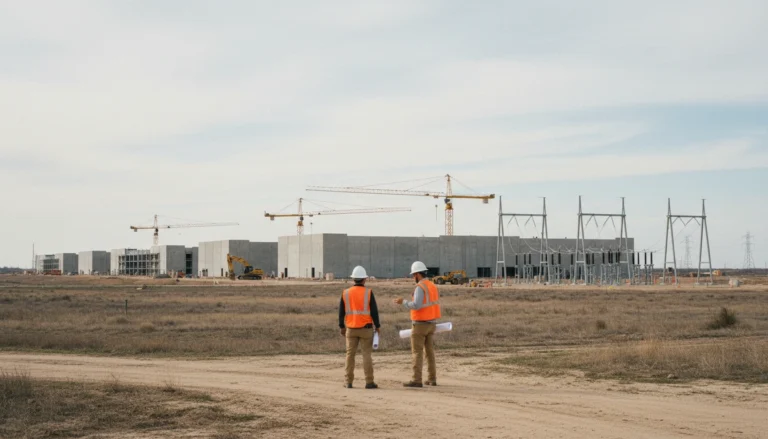
Look at the mechanics of the recent AI mega-rounds. Entities like Crusoe (clean compute), Moonshot AI, Mistral AI, Nscale, and Kling AI aren’t just raising seed capital; they are commanding rounds north of $3 billion. Historically, this volume of capital was reserved for late-stage private equity or public markets. But the scaling laws of Large Language Models dictate a harsh reality: compute is the new currency. The “use of proceeds” section in an AI founder’s pitch deck is no longer dominated by headcount and marketing. Instead, it is immediately routed to securing GPU clusters and cloud credits, effectively acting as a pass-through mechanism from VCs to hyperscalers and semiconductor fabs.
This capital-intensive reality is breaking traditional VC fund economics. From what I’ve seen, general partners (GPs) and limited partners (LPs) are realizing that backing AI requires fundamentally different risk modeling. Term sheets are evolving rapidly to account for massive founder dilution and complex strategic dependencies. Hyperscalers like Microsoft, Google, and AWS are frequently joining these mega-rounds, creating a tangled web where the investor is also the primary infrastructure vendor. For founders, navigating these term sheets requires understanding not just valuation and board seats, but how compute-provisioning clauses impact their long-term equity and operational independence.
Furthermore, this shift creates a geographic and sector fracture. While ecosystems in the US and Europe concentrate heavily on funding base models and massive compute clusters, other global markets are forced into the application layer, unable to match the billion-dollar entry ticket for sovereign AI infrastructure. We are witnessing a phase where venture capital firms must act like sovereign wealth funds and energy financiers, tying the future of artificial intelligence directly to physical grid capacity and global supply chains.
Stakeholders & Impact
| Stakeholder / Aspect | Impact | Insight |
|---|---|---|
| AI / LLM Providers | High | Massive compute requirements lead to earlier, larger mega-rounds, resulting in complex term sheets, severe dilution risks, and strategic dependencies on hyperscalers. |
| VC Firms & LPs | High | Fund economics are deeply stressed. The shift from low-capex software to high-capex infrastructure demands larger fund sizes, new risk models, and longer paths to profitability. |
| Infrastructure & Utilities | High | Data center and compute startups (e.g., Crusoe, Nscale) are capturing billions in traditional VC dollars, directly linking startup funding to grid expansions and energy procurement. |
| Regulators & Policy | Significant | As venture capital scales into industrial infrastructure, investments trigger heightened antitrust scrutiny (especially regarding hyperscaler involvement) and environmental/grid oversight. |
About the analysis
This independent analysis synthesizes real-time market data on AI venture funding with an evaluation of current financial education gaps, targeting founders, investors, and AI strategists. It contrasts the traditional, software-centric definitions of venture capital with the emerging, capex-heavy reality of intelligence infrastructure financing.
i10x Perspective
The era of the “lean startup” is officially dead on the AI frontier; we have entered the era of the “heavy startup.” As intelligence becomes a fundamental utility, venture capital is morphing to resemble industrial project finance, deeply entwined with energy markets and semiconductor supply chains. Over the next decade, watch for a structural convergence: traditional VC firms will increasingly partner with, or operate as, infrastructure funds. The players who can underwrite the gigawatts and the GPUs will be the ones who ultimately control the governance and deployment of next-generation AI.