Martin Scorsese’s recent support for AI-generated storyboards has stirred sharp debate in Hollywood. It lays bare the widening gap between directors chasing faster pre-production and the concept artists who fear their skills are being sidelined. Beyond the immediate clash over jobs, the episode marks a deeper change in how AI tools are built and sold: generative systems are shifting from post-production effects into the earliest stages of turning scripts into finished productions.
Quick Take
- What happened: Martin Scorsese defended using AI to generate pre-production storyboards, prompting immediate backlash from the creative labor force over unconsented training data and job displacement.
- The tech reality: While Hollywood debates ethics, a booming shadow ecosystem of commercial AI storyboard generators—like Boords, LTX Studio, and Krock.io—is already normalizing automated script-to-shot-list pipelines for agencies and marketers.
- The AI capability gap: The debate highlights a glaring limitation in current visual models; they excel at generating isolated, high-fidelity images but struggle with the continuous spatial logic and visual problem-solving required for actual filmmaking.
- The underlying tension: This is a proxy war over copyright risk and whether open-weights or scraped models (like those from Black Forest Labs) will face enterprise pushback when their outputs are integrated into multi-million dollar studio pipelines.
What happened
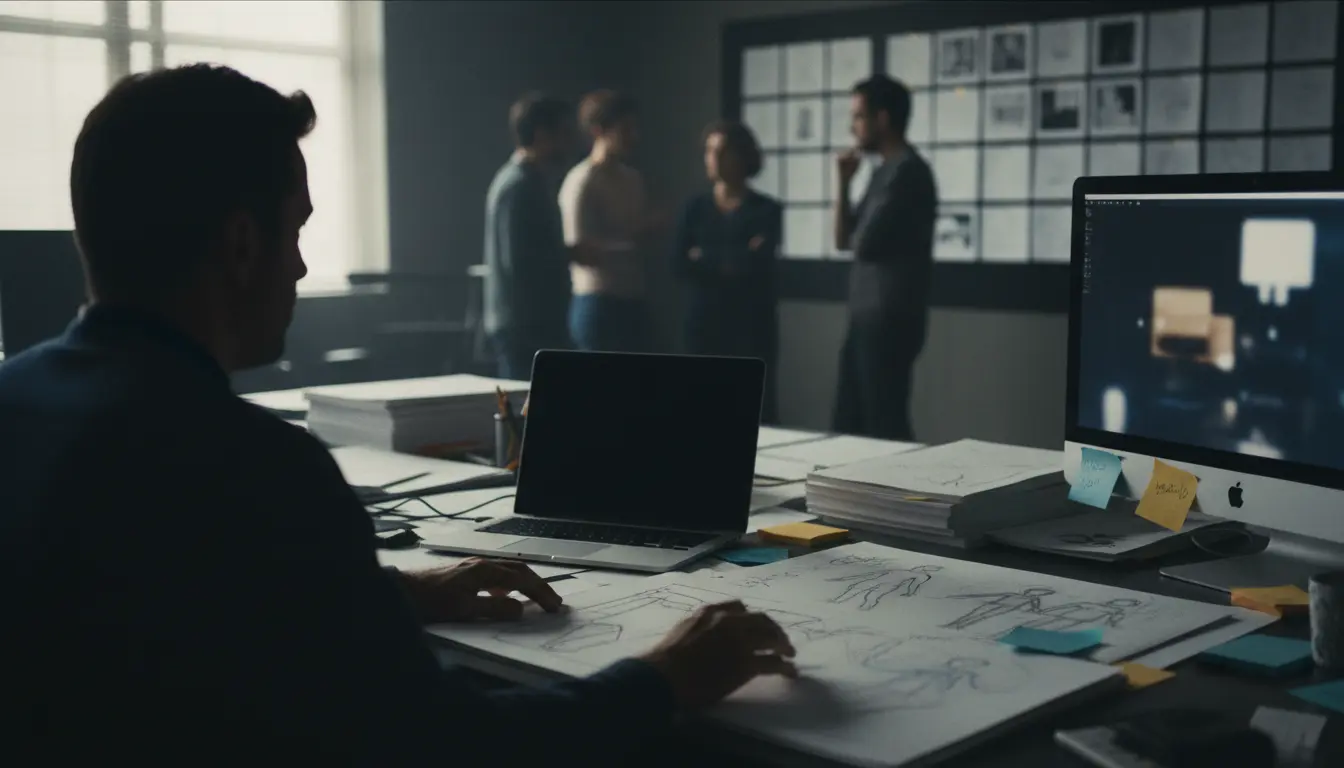
Veteran director Martin Scorsese recently confirmed his investment in and use of AI-generated storyboards as a rapid pre-production communication aid. He presented the technology as a way to move his ideas quickly to cast and crew, drawing a clear line between those early visuals and the final film. The statement drew swift criticism from artists and filmmakers including Karla Ortiz and Boots Riley, who accused him of undercutting the very people who make the work possible.
Critics point out that the models in question, often tied to firms like Black Forest Labs, were trained on artists’ copyrighted material without permission or payment. The argument is not just about new tools but about whether AI storyboarding cheapens the human judgment needed to turn a script into a coherent sequence of images.
At the same time, commercial platforms have already turned the practice into a product. Services such as Adobe Firefly, Storyboarder.ai, and Krock.io let users drop in a CSV or plain text and receive styled frames, scene breakdowns, and animatics ready for client review.
Why it matters now
Pre-production is shaping up as the next major testing ground for multimodal AI. The move is from simple image creation toward systems that can handle narrative structure. If a model can take a script and produce shots that hold together in time and space, it opens a large commercial market. Storyboarding involves camera placement, pacing, and continuity, not just pretty pictures. Current tools often break character consistency or shift lighting without warning, which is why developers are adding asset libraries and 3D controls to impose order on the output.
The Scorsese episode also tests how studios will handle copyright questions at scale. Studios tend to avoid legal risk. Using scraped models for early visuals may look harmless until those visuals feed into productions worth millions, at which point union rules and ownership claims become difficult to untangle. The divide is growing between directors experimenting on their own and the locked-down, indemnified systems studios prefer.
The conversation is pushing companies to move faster toward specialized video tools. Platforms like LTX Studio are already extending from static boards to direct storyboard-to-video pipelines. As that happens, demand for compute is shifting from training large text models to running inference that keeps video consistent across frames and space.
Who is most affected
The immediate impact falls on storyboard and concept artists, who face a rapid commoditization of their initial ideation phases. However, the ripple effects hit AI tool builders and major film studios, forcing them to navigate a minefield of labor relations, union contracts, and unproven legal frameworks surrounding AI-generated IP.
| Stakeholder | Impact | Why |
|---|---|---|
| Storyboard & Concept Artists | Severe disruption and margin compression. | AI tools automate the sheer volume of thumbnailing and mood-boarding, reducing billable hours and threatening junior roles. |
| Multimodal AI Developers | Surging demand for spatial/consistency features. | The market is demanding tools that understand scene continuity, camera angles, and character lock, driving the next generation of model architecture. |
| Film & Commercial Studios | Workflow acceleration vs. Legal risk. | Studios want the speed of AI pre-visualization but face backlash, potential union strikes, and IP contamination if using unlicensed models. |
The structural AI gap
The artist backlash stems from a basic mismatch between what today’s generators deliver and what pre-production actually needs. An AI can quickly produce an image of a cyberpunk alleyway, yet a human artist still has to decide how the camera travels through that space across six shots to show a character’s state of mind. Current systems favor visual polish. The industry need is for structural logic that holds across a sequence. Until models gain native spatial reasoning—tracking a three-dimensional setting through successive two-dimensional frames—AI will stay a useful but limited assistant rather than a full stand-in for cinematic planning.
About the analysis
Researched and written with AI assistance under the editorial responsibility of the i10X News team. The title image is an AI-generated image. Read our AI Use Policy. Spotted an error? Request a correction.
This is an independent, research-based i10x analysis designed for AI developers, creative technologists, and studio executives navigating the intersection of generative models and media production.
- Martin Scorsese accused of ‘throwing artists under bus’ with AI storyboards
- Even Martin Scorsese uses AI for storyboards. Can the art survive?
- The 6 Best AI Storyboard Generators in 2026
- Best 11 AI storyboard generators in 2026 for video and product demos
- Best AI Storyboard Generators in 2026: 9 Tools Compared
- Free AI Storyboard Generator
i10x Perspective
The uproar over AI storyboards is fundamentally a misalignment between what generative AI currently does (synthesize pixels) and what pre-production actually requires (architect visual logic). As foundational models evolve from simple text-to-image prompting toward native text-to-world simulation, this friction between traditional craft and computational speed will only intensify. The ultimate winner in the AI tooling race won’t be the model that renders the most beautiful frame, but the infrastructure that allows a director to dynamically simulate a scene through a continuous, physics-aware latent space.