Most AI leaders talk about AI that improves AI. Sam Altman wants to talk about data centers that build data centers. On Stripe co-founder John Collison’s podcast Cheeky Pint, the OpenAI CEO said the company has “a robotics program that we’re going to point at making lots of data centers,” and called “self-replicating data centers” something “we have within grasp.” The interview first aired on October 29, but a clip resurfaced this weekend and turned into one of the most discussed AI posts on X, complete with a price target: from about $70 billion per gigawatt down to $20 billion.
Quick Take
- What he said: OpenAI has its own chip, is “learning how to build our own data centers,” and plans to aim its robotics program at building them, Altman told Collison.
- The big idea: AI-controlled robots that “run fabs, and build turbines or solar panels, and build data centers,” to “make a lot of really cheap compute.”
- The numbers: Altman picked about $70 billion as the five-year cost to build and run one gigawatt of AI capacity, noting that estimates vary. He said $20 billion “would be really great,” but getting there means energy has to get cheaper.
- The pushback: Collison noted that data centers are held up by permits and components, not labor. Altman’s answer: robots could make more components, “eventually,” over “a long period of time.”
- Why now: The clip went viral on November 14 and 15, days after reports that OpenAI broke up its stand-alone robotics team.
In plain English
AI needs enormous buildings full of computers, and they are very expensive to build and power. Sam Altman, who runs OpenAI, says he wants robots, guided by AI, to help build those buildings and even the factories that make the parts. If that worked, AI could become much cheaper to run. He also admits it would take a long time. Right now, the biggest delays are permits and parts, not a lack of construction workers.
What happened
The Cheeky Pint episode, titled “Why Sam Altman is against a single superintelligence,” was released on October 29, according to TNW, which covered it the same day. Asked how the compute shortage is going, Altman said demand for capable models at a low price “only goes one way.”
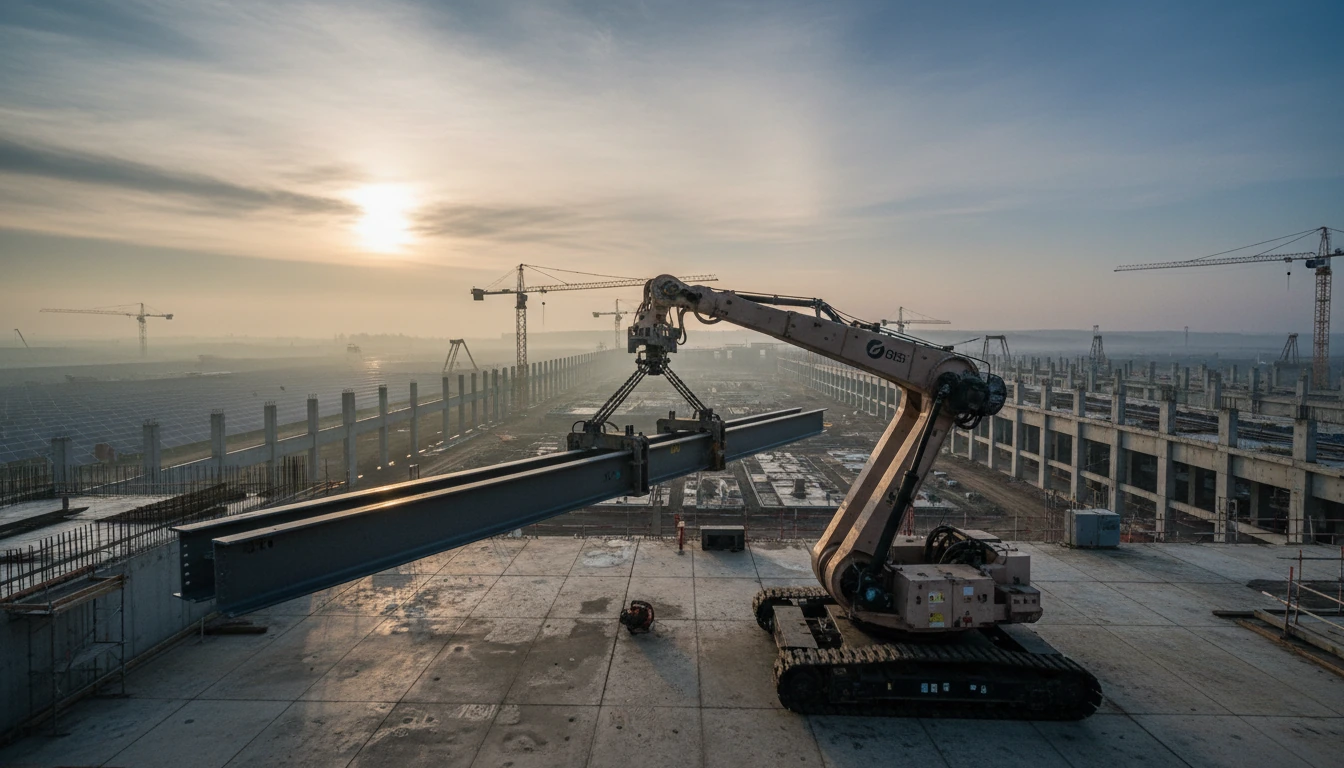
Then the key passage, from Cheeky Pint’s own transcript: “We made a chip that is an incredible performance at units of intelligence, performance of units of intelligence per watt. We are learning how to build our own data centers. We have a robotics program that we’re going to point at making lots of data centers.” Collison interjected: “The real RSI.” Altman: “People talk a lot about RSI as an AI that does AI research. There’s very little, relatively little talk about self-replicating data centers. This idea that you can use AI to control robots, and run fabs, and build turbines or solar panels, and build data centers. But, I think we are… I think we have that within grasp.”
RSI stands for recursive self-improvement. Altman’s twist is a physical version of it: compute that helps build more compute.
On November 14, @unusual_whales summarized the segment for its large finance audience, and the story spread from there. On November 15, a viral post put the “$70B to $20B” framing in front of hundreds of thousands of viewers.
Background: the cost of a gigawatt
The numbers need care. In the transcript, Altman says: “People give different numbers for the cost per gigawatt measured in the five-year total cost of ownership right now. But let’s say, let’s pick $70 billion as a number.” Then: “I think if that number were 20 instead of 70, we should be much happier.” Later: “Even to get down to 20, you’re getting into the realm of energy’s got to get cheaper,” and “all of the gross margin stacking that happens between melting sand… Or the equivalent of melting sand and getting the token back. A lot of that’s got to get compressed.” Asked whether cutting profits alone would do it, he said: “If you assumed all materials were free and no one made a profit, maybe you could get there in the current energy envelope. But only just.” TNW notes it has not verified the figures.
So $20 billion is a wish, not a plan with a date. And the path Altman describes is mostly about cheaper energy and thinner supply-chain margins, with robots as one long-term lever.
The timing adds a twist. On November 14, OpenAI disbanded its stand-alone robotics team, moving researchers and hardware staff into other groups while saying robotics remains a core goal. Altman’s “robotics program” remark predates that reorganization.
How “self-replicating” data centers would work
Based on Altman’s description, the loop has four parts:
- Chips: OpenAI’s own chip, tuned for “intelligence per watt.”
- Factories: AI-controlled robots running chip fabs and making components such as turbines and solar panels.
- Construction: Robots building the data center halls themselves.
- Feedback: The new compute runs better models, which control the robots more capably, which build more compute.
None of this is described as operating today. Altman’s own words are “within grasp” and “over a long period of time.” He did not give a timeline, a budget or partners.
Pros and cons
For users
- Pro: If compute gets dramatically cheaper, AI services could get cheaper and more capable at the same time.
- Con: This is a long-term vision. It does nothing for today’s rate limits or prices.
For developers
- Pro: A “compute glut,” which Altman and Collison discussed as a goal, would mean more capacity and lower inference costs for everyone building on AI.
- Con: Concentrating chips, power and construction inside one company could make developers more dependent on that company’s platform.
For companies
- Pro: Vertical integration from silicon to buildings could cut margins that Altman says are “stacking” between raw materials and tokens.
- Con: It is capital intensive and slow. Permits, grid connections and local opposition, all mentioned in the debate, are not problems robots solve.
What X is saying
The post that restarted the debate:
Sam Altman says OpenAI will aim its robotics program at building its own data centers.
— unusual_whales (@unusual_whales) November 14, 2026 · View on X
Speaking on Stripe co-founder John Collison’s Cheeky Pint podcast, he said self-replicating data centers are now “within grasp”: AI-controlled robots running chip factories and building turbines, solar panels and more data centers, to produce “a lot of really cheap compute.”
Skeptics pointed out what robots cannot fix:
Altman says self-replicating data centers are within grasp. Robots building the chip factories, the turbines and the data centers themselves.
— Razumasu (@Razumasu) November 16, 2026 · View on X
Love the idea. Here in Europe the robots would still spend three years waiting for a building permit 😂
Others took the sci-fi route. “Robots building chip fabs that build robots that build more data centers… we’re one firmware update away from Skynet’s construction company,” joked @keyse_as. Investor-focused @overheardpods saw a strategic shift: “If that’s even half right, the moat in AI moves from who has the best model to who owns the factories that build more factories.” And the jobs debate followed, with @PugetPointCap writing: “People keep saying AI will create new jobs just like every prior revolution. I disagree.”
Grok’s take
Asked whether the quote was real, Grok replied: “Yes, Altman said it on the Cheeky Pint podcast. The $70B is an illustrative 5-year total cost of ownership (build + run) per GW; he wants it closer to $20B via cheaper energy, chips, and scale.” In another reply it added that “full self-replicating sites remain early and aspirational.”
Critical analysis
Altman is describing a direction, not a product. The transcript is full of hedges: “within grasp,” “eventually,” “over a long period of time.” Collison’s challenge, that data centers are bottlenecked by permits and components rather than labor, is the right one, and Altman’s answer only addresses components. Robots will not speed up a zoning board or a grid interconnection queue.
The cost claim also tends to get distorted. The viral version says OpenAI plans to cut costs “from $70 billion to $20 billion per gigawatt.” What the transcript shows is Altman picking $70 billion as an illustrative number, saying estimates vary, and calling $20 billion a much happier place, with energy prices doing much of the work. That is a target-shaped thought, not a cost roadmap.
Still, the idea is strategically coherent. OpenAI already designs chips and is building its own data centers. Owning more of the physical stack is how it would escape what Altman calls the “gross margin stacking” of its suppliers. The open question is whether OpenAI, which just reorganized its robotics staff, has the hardware muscle to make it real.
What’s still open
- What OpenAI’s robotics effort looks like after the November reorganization, and whether any of it is assigned to data center construction.
- Whether OpenAI will publish concrete cost targets or timelines for its own data centers and chips.
- Which partners, if any, would supply construction robotics.
- How regulators and local communities, already pushing back on data center growth, respond to robot-built sites.
About the analysis
Researched and written with AI assistance under the editorial responsibility of the i10X News team. The title image is an AI-generated image. Read our AI Use Policy. Spotted an error? Request a correction.
This independent i10x analysis is based on Cheeky Pint’s official transcript of the episode, coverage by TNW, and public posts on X. Direct quotes are taken from the published transcript.
i10x Perspective
“Self-replicating data centers” is a great phrase and a long road. The useful signal is not the robots, it is the ambition: OpenAI wants to own as much of the path from sand to tokens as it can, because that is where the cost of AI really sits. Whether robots help or not, expect more of that vertical push in 2027, in chips, power and buildings. Just do not expect a robot to get your data center permit approved.