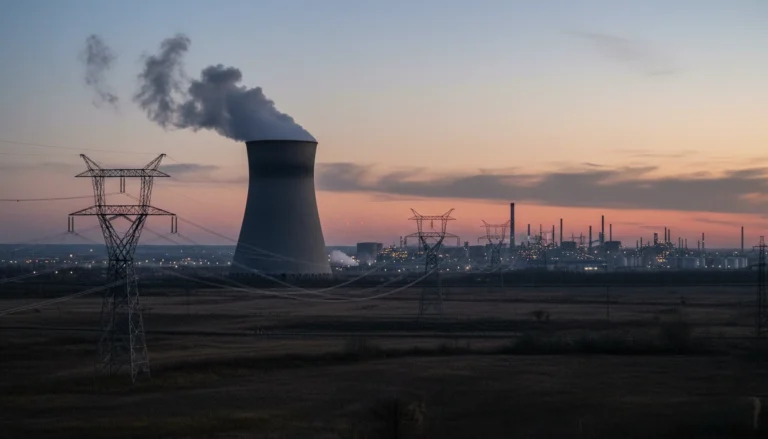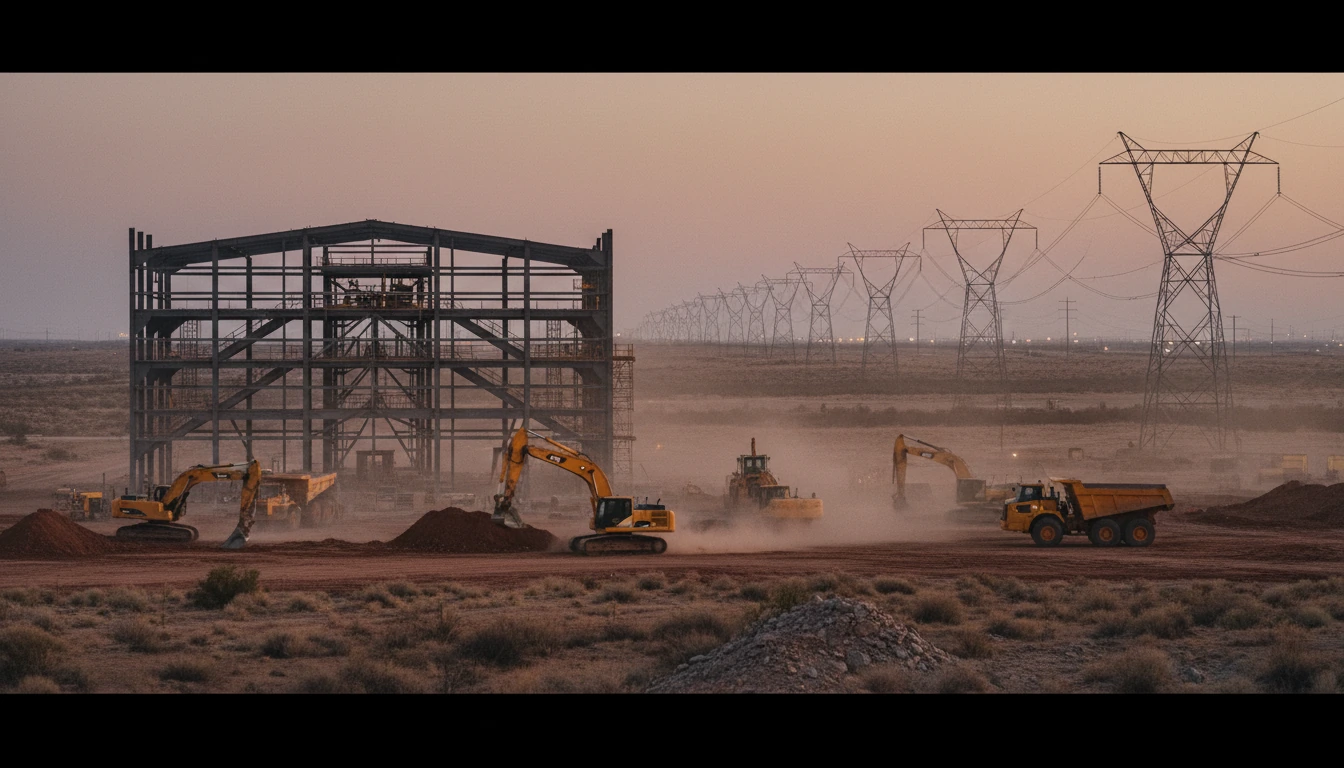
Three massive data centers under construction along the Texas-New Mexico border will emit millions of tons of greenhouse gases annually, threatening to undo years of climate planning in both states, according to an investigation by The Texas Tribune. The facilities, built by Oracle, Meta Platforms, and a third planned for Fort Bliss Army post, are among the largest in the country and will collectively release data center emissions equivalent to more than two million cars per year.
The projects highlight a growing tension between AI infrastructure expansion and climate commitments. Neither New Mexico’s December 2025 climate plan nor El Paso’s plan adopted months later accounted for how data centers could reshape regional emissions profiles. The three facilities will serve the rapidly escalating demand for artificial intelligence services, but their combined power plants could emit up to 10 million tons of planet-warming gases annually, compared to 8.4 million tons released by El Paso County and neighboring Hudspeth County in 2019.
Quick Take
- What happened: Oracle, Meta, and the Army are building three data centers with dedicated power plants in the Texas-New Mexico border region.
- Scale: Combined emissions could reach 10 million tons of greenhouse gases annually when fully operational.
- Context: The facilities were not included in climate plans adopted by New Mexico in December 2025 or El Paso months later.
- Regulatory gap: Two-state jurisdiction means officials in one state have limited authority over projects minutes away across the border.
- Air quality: Beyond greenhouse gases, the facilities will release particulate matter and nitrogen oxides affecting local communities.
In plain English
Three enormous data centers are being built within 30 minutes of each other along the Texas-New Mexico border to power AI services. Each comes with its own power plant. Together, they will release more greenhouse gases than all of El Paso County did in 2019. The problem is that neither state’s climate plan accounted for these facilities, and because they sit on opposite sides of a state line, regulators in one state cannot control what happens in the other. The emissions do not respect borders, but the laws do. Local officials approved the projects with tax incentives, hoping for jobs and investment, but climate experts say the facilities will undo expensive climate work already underway.
What happened
Work is underway in Doña Ana County, New Mexico, on Project Jupiter, one of the largest data center developments in the country, built by Austin-based Oracle. Twenty miles away in El Paso, Texas, construction has begun on another massive data center built by Meta Platforms. A third, larger facility is planned less than 30 minutes away on the Fort Bliss Army post in east El Paso, according to the Tribune investigation published October 14, 2026.
The three sites are part of a wave of data centers under construction nationwide, driven by demand for artificial intelligence services like Claude and ChatGPT. Texas alone has 596 data centers either operating or planned as of early September, according to Tribune research. The Texas data centers and their New Mexico counterpart are particularly notable because of their combined scope and proximity.
When fully built out, the power plants for Project Jupiter and Meta’s facility could emit up to 10 million tons of greenhouse gas emissions annually. The Army has shared limited information about the Fort Bliss data center, so its emission levels remain unclear. The facilities will also release air pollutants like particulate matter and nitrogen oxides, which directly affect local air quality and human health, even at relatively low levels, according to Shaolei Ren, a professor of electrical and computer engineering at University of California, Riverside.
The regulatory divide
Because Project Jupiter, Meta, and the Fort Bliss data centers sit in two different states, and because no single federal regulation governs climate change or emissions, regulators have largely considered the projects’ impacts separately. “We’ve never had a national climate law passed by Congress,” said Ari Peskoe, director of the Electricity Law Initiative at Harvard Law School. “And so what we’ve had in this country are primarily state and local efforts.”
The result is that officials in one state have little say over a project happening minutes away from them. Texas and New Mexico also take different approaches to dealing with climate change. New Mexico has codified greenhouse gas reduction targets into state law; Texas has not.
New Mexico state Rep. Sarah Silva, a Democrat representing the community of Chaparral directly across the state line from Meta’s data center site in northeast El Paso, said her state has the power to regulate air quality and impose noise requirements, but only in New Mexico, not at a Texas construction site even if it is only a few hundred yards away. Likewise, residents living in west El Paso across the state line from Project Jupiter have no say in the project despite sharing an aquifer that crosses the state boundary.
“This is why we need federal regulation,” Silva said. “How do we knit something together that makes sense for our region when actually this is the job of the federal government?”
The climate planning gap
Last December, New Mexico officials celebrated publication of a plan to address climate change, designed to dramatically reduce the state’s greenhouse gas emissions by 2050. A few months later, El Paso city officials adopted their own plan with a similar ambition. Each report cost millions of dollars to draft, but neither took into account how the construction of data centers could upend climate goals in both places.
The data centers are “going to undo a lot of the very expensive and very meaningful work a lot of people are doing,” New Mexico state climatologist Dave DuBois told El Paso Matters. The population center of 1.2 million, which encompasses El Paso and parts of southern New Mexico, is seeing rapidly rising temperatures even as local governments green-lit these projects.
“This does add to our greenhouse gas emissions in a massive way,” said Gunnar Schade, an associate professor of atmospheric sciences at Texas A&M University. “This is a huge source.”
The counties offered Meta and Project Jupiter tax incentives in exchange for corporate investment in their communities, job creation, and the ability to attract more technology companies to the region. State officials have also provided incentives. More than a decade ago, Texas legislators approved a data center sales tax break, which exempts the facilities from paying sales tax on equipment they purchase, a decision that could now cost the state $3.2 billion in revenue over the next two years, according to the Tribune.
The power question
New Mexico lawmakers declined to advance a bill creating a similar tax break for data centers in 2021. But last year, they passed a law that establishes new rules for large, private power systems called microgrids, like the one planned for Project Jupiter. The law allows utilities, with state approval, to buy electricity from microgrids that run on fossil fuels, without those purchases counting against utilities’ renewable energy targets until 2035.
Microgrids like Project Jupiter will eventually have to produce energy from net-zero carbon sources by the year 2045, but only if they plan to sell that power. The power plants that keep data centers running typically produce large amounts of emissions like carbon dioxide and methane that drive global climate change over time.
Silva, the New Mexico representative, was initially supportive of Project Jupiter, seeing it as an opportunity to create long-term jobs. Last year, she voted in favor of the bill that included an amendment by state Sen. Michael Padilla to establish new rules for private power systems. But Silva soon soured on the project out of concern that it would not employ enough local workers and because it would not rely on zero-emission renewable energy.
The AI energy consumption driving these facilities has prompted some companies to explore alternative power sources. Google recently signed an 890 MW nuclear power deal with Constellation to support its data center operations, while Amazon and Constellation are adding nuclear power at Calvert Cliffs for similar purposes. These arrangements aim to provide carbon-free electricity, though they face their own timeline and regulatory challenges.
What’s still open
- How the Fort Bliss data center will address emissions remains unclear, as the Army has shared limited information about the facility’s power systems and environmental impact.
- Whether federal regulation will emerge to address cross-border emissions from data centers, given the jurisdictional gaps highlighted by state officials.
- How New Mexico’s 2045 net-zero carbon requirement for microgrids will be enforced if Project Jupiter does not plan to sell power to utilities.
- What mechanisms, if any, will allow residents in one state to influence data center projects across the border that affect their air quality and shared resources.
- Whether the tax incentives offered by Texas and New Mexico will generate sufficient economic benefits to offset the climate and air quality costs.
About the analysis
Researched and written with AI assistance under the editorial responsibility of the i10X News team. The title image is an AI-generated image. Read our AI Use Policy. Spotted an error? Request a correction.
This independent i10x analysis is based on a Texas Tribune investigation of greenhouse-gas emissions from data centers in Texas and New Mexico. Source names are given in the text; we do not link out to those pages.
i10x Perspective
The Texas-New Mexico data center story exposes a fundamental mismatch between AI infrastructure planning and climate policy. State boundaries create regulatory blind spots for facilities whose emissions ignore those lines. The 2045 net-zero requirement for New Mexico microgrids includes a loophole: it applies only if the facility sells power, allowing Project Jupiter to potentially run on fossil fuels indefinitely if it remains self-contained. Meanwhile, the economic development logic that drove local approvals assumed job creation would justify environmental costs, but the actual employment numbers remain contested. The absence of federal coordination means each state optimizes for its own interests while the regional airshed and shared aquifer bear the cumulative impact.