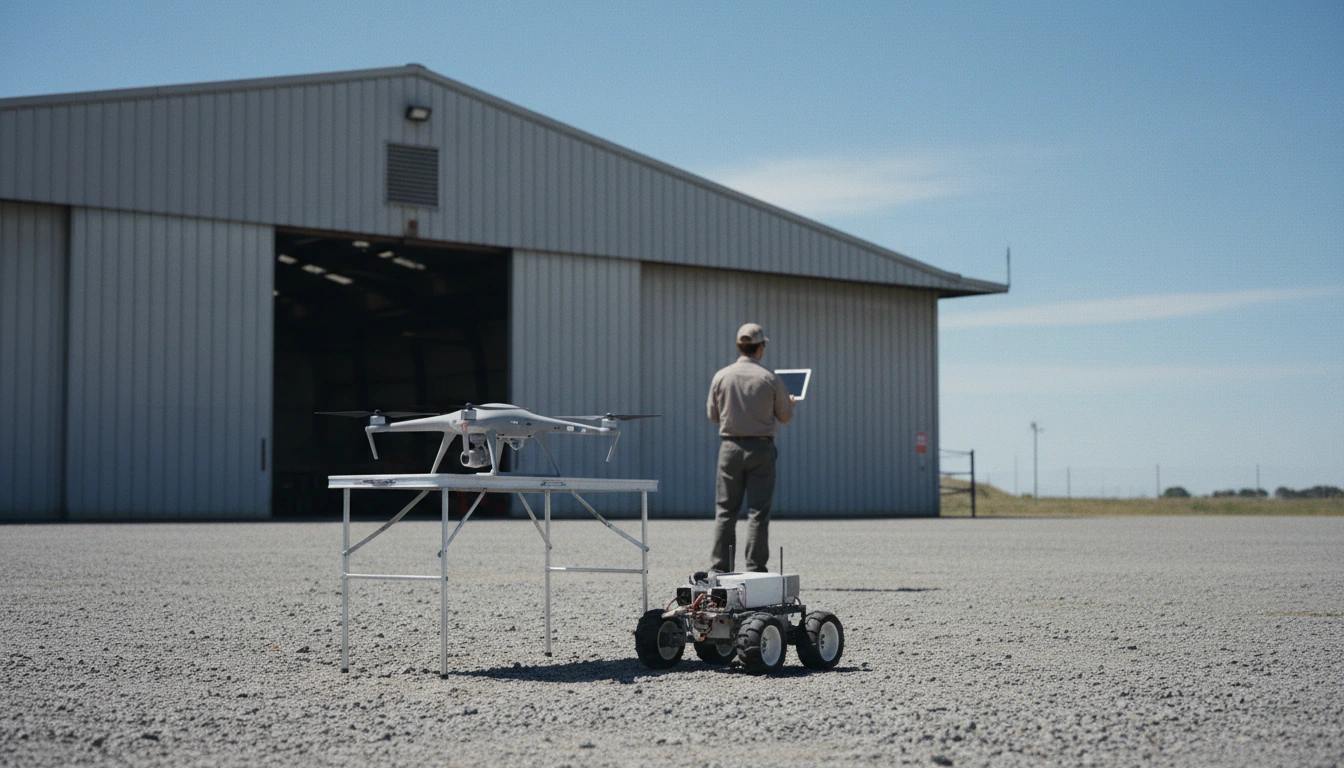
Valkryn, a Washington, D.C. startup that tests how drones, robots and other autonomous military systems actually perform, has emerged from stealth with $17 million in total funding. That includes a $15 million seed round led by Andreessen Horowitz’s American Dynamism fund, with Cantos Ventures, Ambition Capital and Caffeinated Capital participating. The company builds “Battle Lab” test environments and software that record and score each test the same way, and it does not build any of the systems it evaluates.
Quick Take
- The funding: $17 million in total, including a $15 million seed led by a16z American Dynamism.
- The product: Instrumented test environments that replicate realistic conditions and software that automatically scores autonomous systems against government-defined criteria.
- The model: An independent evaluator. Valkryn does not build or sell the systems it tests.
- Traction: Multiple funded contracts with US military test organizations in under 12 months, according to the company.
- The team: Founders and engineers from Palantir, Anduril, SpaceX and Applied Intuition.
In plain English
Robots and drones are increasingly run by software that changes often, so they need to be tested again and again. Valkryn says many military test events still record results in handwritten notes. It builds test sites full of sensors and software that log every decision a robot makes, so results from different tests can be compared directly, much like automated testing in software companies.
What happened
Valkryn announced its launch on November 17. Its Battle Lab technology instruments physical test environments and records how systems and operators perform. Proprietary software produces an auditable record of each test event and scores results automatically. Because every event is measured the same way, results from different programs and test sites can be compared. The company will use the funding to scale its technology and grow its team in Washington, D.C., New York and Los Angeles.
“You’re not testing a single piece of hardware. You’re testing sensors, vehicles, software and operators all interacting in real time,” said Andrew Hoff, co-founder and CTO.
“The software industry learned years ago that embracing continuous testing produces better products, faster,” said Erin Price-Wright, General Partner at a16z.
Background
Evaluation is becoming a field of its own across robotics, from industrial humanoids to autonomous vehicles. Robotics funding is at record levels, as recent rounds such as Genesis AI’s $500 million Series A show. Our Engineering & Robotics section tracks how these systems move from labs into real-world use.
Why it matters
Autonomous systems are only as trustworthy as the evidence behind them. A neutral, data-driven testing layer could make procurement decisions more transparent and help catch failures before deployment. The same idea, independent evaluation instead of vendor self-reporting, is spreading across AI, from frontier model audits to robotics benchmarks.
What’s still open
- Which specific programs and systems Valkryn has tested so far.
- How its scoring criteria are set and whether results will be shared beyond the customer.
- Whether the same approach will be offered to civilian robotics companies.
About the analysis
Researched and written with AI assistance under the editorial responsibility of the i10X News team. The title image is an AI-generated image. Read our AI Use Policy. Spotted an error? Request a correction.
This independent i10x analysis is based on Valkryn’s press release. Contract and deployment claims are company statements and were not independently verified. i10x covers this as a robotics testing story and does not take positions on defense policy.
Sources (plain text, no links):
- Valkryn press release: “Valkryn Emerges from Stealth to Build the Battle Lab for Robotic and Autonomous Warfare” (November 17, 2026)
i10x Perspective
The less glamorous part of robotics, proving that a system works, is turning into a business. Whether in defense, logistics or factories, buyers increasingly want standardized test data instead of demos. Expect more startups to position themselves as the neutral referee. More early stage rounds are on our Startups page.