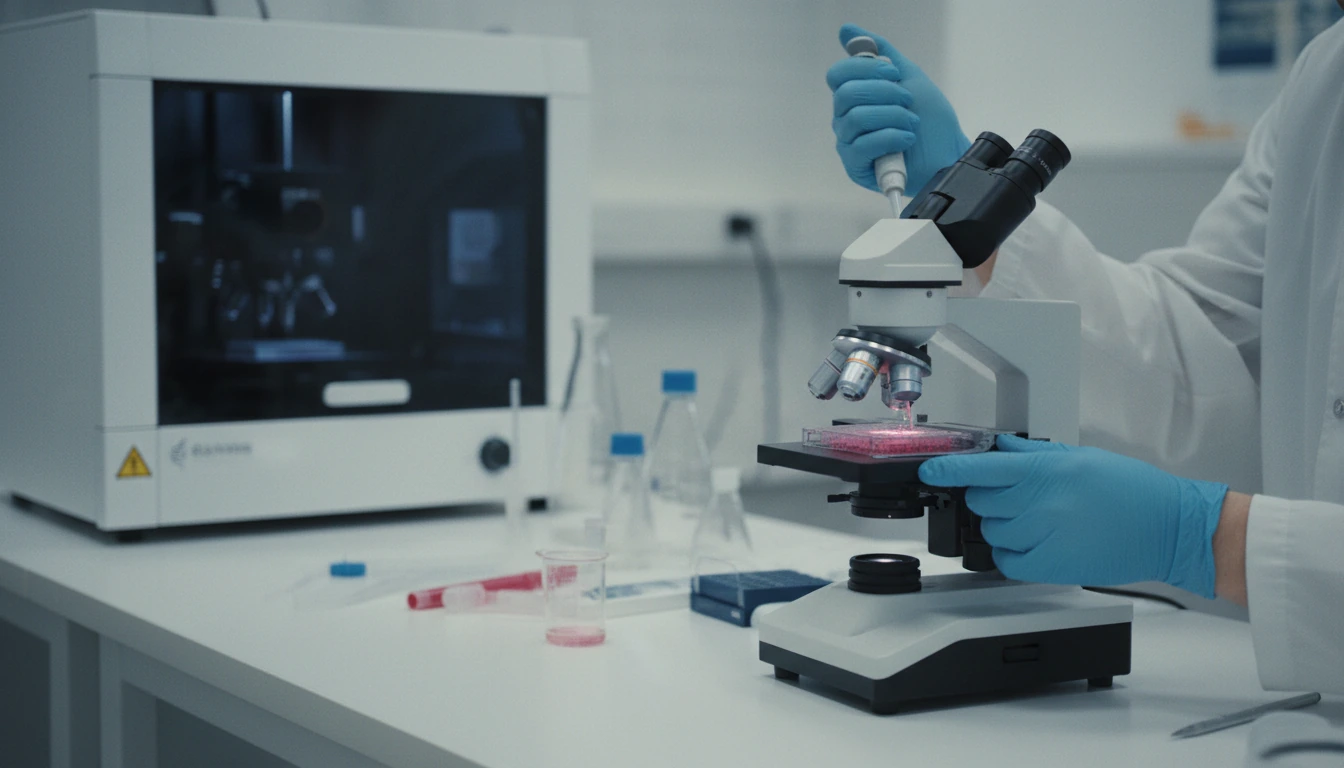
CellType and Inventia Life Science have launched Tumor Context, a new AI benchmark that tests whether models can predict how cancer cells change their gene activity when their cellular neighbors change. The benchmark is part of CellType’s BioSimBench and is graded against fresh lab measurements from engineered 3D tumors that no model has seen. The best model so far, Anthropic’s Claude Fable 5.2, scores 0.76, against an upper limit of 0.97 set by repeating the lab experiment.
Quick Take
- The benchmark: Tumor Context asks models to predict how 50 genes change when fibroblasts or T cells are added to tumor cells.
- The data: Inventia printed the tumors on its RASTRUM 3D bioprinting platform and measured them with bulk RNA sequencing.
- Leaderboard: Claude Fable 5.2 0.76, Gemini 4 Carbon 0.73, Claude Opus 5.5 0.72, GPT-6.1 Sol and GPT-6 Astra 0.72. A simple rule using no lab data scores 0.62.
- Tools help: On a 40-question subset, all four tested models improved when they could use tools.
- Scope today: Three starting cultures from two pancreatic cancer cell lines, PANC-1 and AsPC-1.
In plain English
A tumor is not just cancer cells. It is a neighborhood of different cells that influence each other. CellType’s example: the immune signal CXCL9, which helps draw cancer-killing T cells in, stays almost off with fibroblasts or T cells alone, but jumps to 486 units when both are present. The benchmark asks whether AI models can predict effects like this, a step toward simulating biology instead of testing everything in the lab.
What happened
CellType published the benchmark with four question types: predicting gene changes from a description alone, predicting with each gene’s starting level shown, transferring a measured pattern from one or two other cultures to a new one, and naming which cell type makes each gene’s RNA. Questions are split by gene family so no gene appears in both training and test, and CellType says it runs scripted shortcut strategies against every task, shipping a task only if none of them scores above zero.
Results by model family rise with model size, which CellType reads as evidence that “this biology can be learned”. With a description alone, the best model reaches 0.68; shown each gene’s starting level, it reaches 0.80.
Background
AI for drug discovery is pulling in record money, from Isomorphic Labs’ $5 billion Series C to a wave of biology foundation models. Benchmarks grounded in new wet-lab data are rare, because most public datasets may already be in training sets. Our Health & Medical Research page tracks the field.
Why it matters
Whether a patient responds to immunotherapy depends heavily on which cells surround the tumor. A model that can reliably predict how changing the neighborhood changes the tumor could help researchers choose which experiments to run first. The gap between 0.76 and 0.97 shows today’s frontier models are useful but far from a lab replacement.
What’s still open
- How results will change as more tumor types, drugs and patient-derived cells are added.
- Whether specialized biology models outperform general frontier models on the benchmark.
- How much of the score transfers to real patient tumors.
About the analysis
Researched and written with AI assistance under the editorial responsibility of the i10X News team. The title image is an AI-generated image. Read our AI Use Policy. Spotted an error? Request a correction.
This independent i10x analysis is based on CellType’s Tumor Context benchmark page and its published results. Scores are as reported by CellType.
Sources (plain text, no links):
- CellType: “Tumor Context, BioSimBench” benchmark page and technical report (November 2026)
i10x Perspective
Benchmarks are where the AI biology hype meets measurement. Using newly printed, controlled tumors is a smart answer to data contamination. Expect labs to start citing Tumor Context scores the same way they cite coding benchmarks, and more results in our Benchmarks & Evals section.