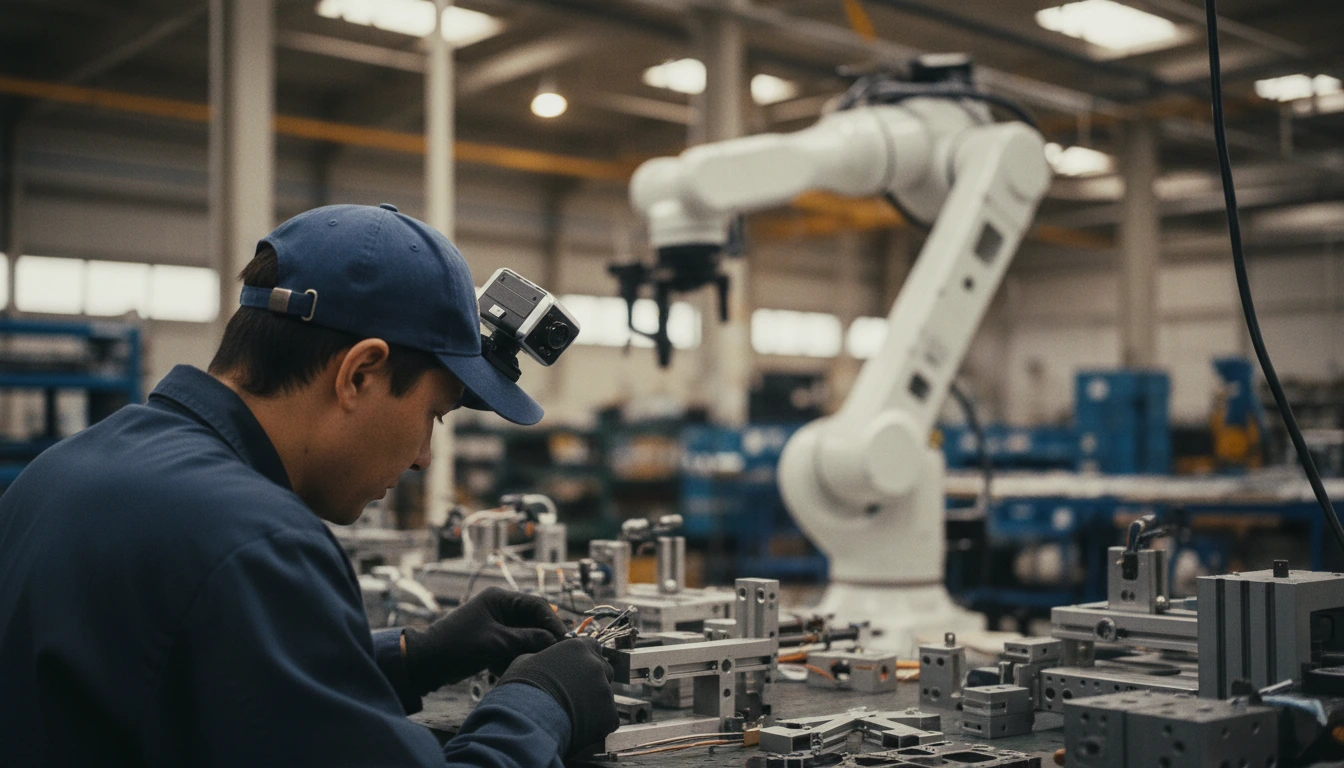
Bengaluru-based Humyn Labs has raised $47 million in a Series A round to build what it calls the research and deployment layer for physical AI. The round combines $26 million in equity led by Accel with $21 million in venture debt led by Lighthouse Canton. The startup records how people perform real jobs in factories, warehouses, farms and homes, and turns that footage into training data for robots and world models.
Quick Take
- The money: $47 million in total, made up of $26 million in equity led by Accel and $21 million in venture debt led by Lighthouse Canton, with Trifecta Capital joining the debt.
- Other equity investors: Prosus Ventures, BeeGlobal, Finserv Intelligence through Bajaj Finance, Bajaj Alts AI Opportunities Fund, Dallas Venture Capital, Lighthouse Canton and Jump Trading.
- The traction: Humyn Labs says it crossed $50 million in annualised revenue within six months of operations.
- The customers: Frontier AI labs, humanoid robotics companies and builders of world models and voice AI.
- The plan: Deployment readiness sites in Brazil, South Korea and India, plus bigger teams in San Francisco, London and Seoul.
In plain English
Robots learn physical jobs by watching how humans do them, but videos from the internet rarely show the exact motions, tools and conditions of a real workplace. Humyn Labs sends people with its own head-worn cameras into real work sites, records how they do specific tasks, and labels the footage so AI models can learn from it. It then helps test robots in the same places to see where they still fall short.
What happened
Humyn Labs announced the Series A on its company blog. It describes three parts of its business: an enrichment engine that turns real-world recordings into labelled, training-ready datasets across sight, sound, motion and touch; deployment readiness work, where it puts robots into the same environments and measures them against how humans do the job; and its own capture hardware, built to each lab’s requirements.
“We bring the model lab and the site operator onto that floor together, so every deployment teaches the next model, and the world’s factories, farms and warehouses become the training set,” said co-founder Ishank Gupta.
“Physical AI will only be as good as the real-world data it learns from,” said co-founder Manish Agarwal. He added that the company aims “to build a USD 1 billion annual revenue business.”
“Physical AI is going to be one of the defining technology shifts of the next decade, and data and deployment are where the real moat will be built,” said Pratik Agarwal, Partner at Accel.
Background
The company was founded in 2026 by Manish Agarwal and Ishank Gupta and runs capture and enrichment operations in more than 20 countries across Latin America, East Asia and South and Southeast Asia. It also publishes BRIDGE, a benchmark series for physical AI covering voice, vision and touch. The round lands a day after Genesis AI raised $500 million for dexterous robots trained with sensor gloves, another bet that real-world human data is the bottleneck.
Why it matters
Robot models are improving fast, but data from real work sites is scarce and expensive to collect. Companies that can record that data at scale, in many countries and under consent, are becoming suppliers to the whole robotics industry. The large venture debt share also shows how this kind of business works: data collectors pay workers quickly but wait for AI lab customers to pay, so they need working capital, not only equity.
What’s still open
- Which labs and robotics companies are paying customers.
- How the company verifies quality and consent across more than 20 countries.
- Whether robots trained on this data perform measurably better on full shifts.
About the analysis
This independent i10x analysis is based on Humyn Labs’ funding announcement. All quotes are taken from that source.
Sources (plain text, no links):
- Humyn Labs blog: “Taking Physical AI From the Lab to the Real World” (Series A announcement, November 2026)
i10x Perspective
Humyn Labs is selling picks and shovels to the humanoid gold rush. If robots really are limited by data rather than models, the companies that own the best records of human work could matter as much as the robot makers. More robot news on our Engineering & Robotics page and in the Robot AI Model Comparison.