Quick Take
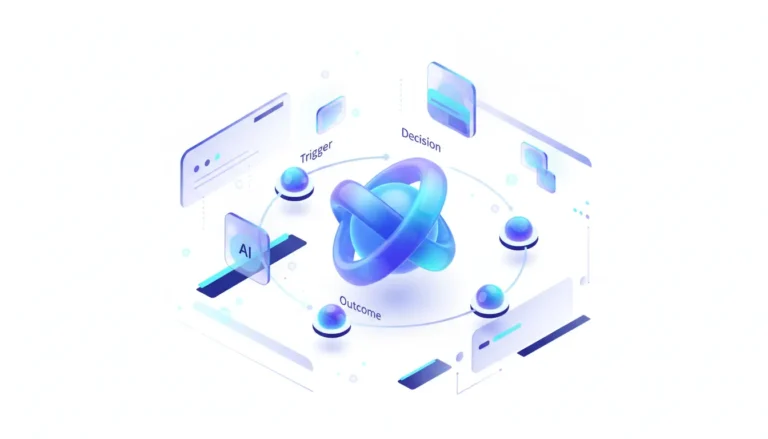
The AI industry is moving fast from passive chatbots to autonomous “AI agents” – systems built to perceive, plan, and carry out complex workflows across enterprise tools on their own.
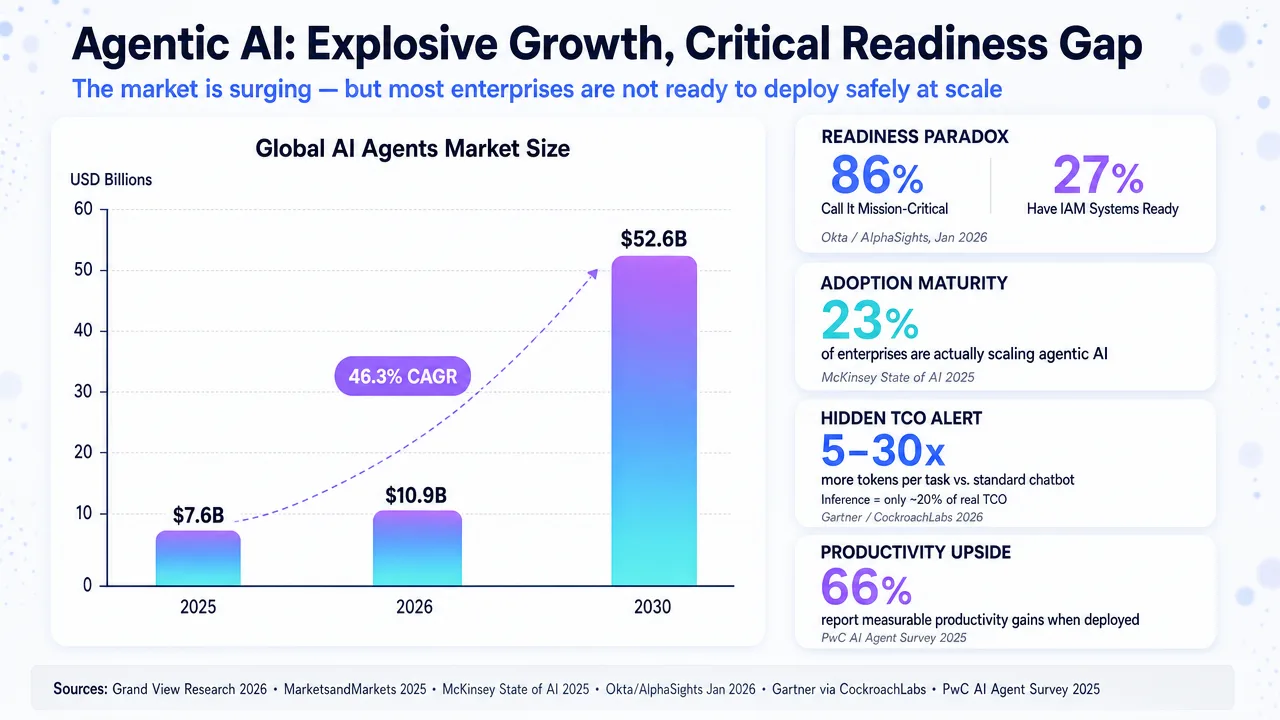
What happened: Hyperscalers and labs including Google, AWS, and Microsoft have shifted their commercial focus to “agentic AI,” rolling out orchestration frameworks that let LLMs trigger API calls, pull from memory stores, and move through enterprise environments without constant human prompts.
Why it matters now: This change from simple text generation to active state changes calls for an entirely new infrastructure layer. Agents burn through far more compute with multi-step thinking tokens, and they reshape the enterprise risk profile in ways most teams have not yet modeled.
Who is most affected: Enterprise decision-makers, cloud IT operators, and developers now have to move from securing basic chat interfaces to designing solid machine-to-machine IAM controls and rollback procedures.
The under-reported angle: The true cost of autonomy. Vendors highlight easy orchestration, yet the hidden TCO – planning tokens, observability overhead, required human oversight, and API idempotency – is cutting into early ROI faster than most forecasts predicted.
Deep Dive
Have you noticed how the “copilot” model suddenly feels limited? The generative AI market has reached a structural boundary. We are watching a clear shift toward AI agents – systems that run on a continuous perceive-plan-act loop. According to Google and Microsoft, it is no longer enough for a model to write a script or draft an email; the same system must now review its own output, execute it, judge the results, and push changes into production.
That said, vendor narratives do not always match what enterprises are actually experiencing. Documentation from AWS Bedrock and Microsoft emphasizes plug-and-play safety and simple integrations. In practice, though, companies hit friction almost immediately: legacy APIs break, authentication scopes prove too broad, and an AI hallucination that triggers a real database command quickly turns into a security incident.
From what I’ve seen, the conversation is therefore moving away from raw model size and toward agent reliability and evaluation. The real bottleneck is not intelligence but guardrails – policy engines strong enough to manage multi-step, multi-agent systems. These setups rely on heavy recursive prompting techniques like ReAct, which means every sub-step triggers network calls, RAG lookups, and repeated context loading. Compute demand rises sharply as a result.
This pressure is creating a fresh build-versus-buy divide. Some teams are assembling open-source stacks and writing their own idempotency patterns plus incident playbooks for runaway agents. Others are leaning toward closed, governed platforms. What both groups are missing is a practical observability layer that can show exactly why an agent chose a given tool and enforce human approval before any sensitive step executes.
In short, agentic AI will not deliver value simply by being attached to existing processes. The organizations that pull ahead will be the ones willing to do the less glamorous work: solid incident runbooks, careful TCO modeling for token-heavy flows, and precise API integration plans.
Stakeholders & Impact
| Stakeholder / Aspect | Impact | Insight |
|---|---|---|
| AI / LLM Providers | High | Revenue models are shifting from tokens per query to tokens per multi-step workflow, which will drive much higher inference demand. |
| Enterprise IT & Cloud Infra | High | Teams need agent-specific IAM controls, observability tooling, and API idempotency safeguards right away. |
| Operations & Knowledge Workers | Medium–High | Roles are changing from prompt engineers to agent wranglers who manage human-in-the-loop approvals. |
| Security & Regulators | Significant | Audits must now cover machine-to-machine actions, autonomy levels, and failure-mode controls under rules such as GDPR or SOX. |
About the analysis
Researched and written with AI assistance under the editorial responsibility of the i10X News team. The title image is an AI-generated illustration. Read our AI Use Policy. Spotted an error? Request a correction.
This is an independent, research-based analysis drawing on technical documentation from the major AI hyperscalers together with enterprise adoption reports. It is intended for CTOs, IT leaders, and AI builders who need a clear view of the economic and technical trade-offs involved in moving from generative models to autonomous systems.
i10x Perspective
Moving from AI copilots to AI agents is not a routine upgrade. It marks a deeper change in the economics of machine intelligence. Once the main constraint shifts from model intelligence to enterprise tool access and reliability, the real competition will play out in the practical details of IAM permissions and data-layer integrations. Over the next five years, expect rapid growth in what might be called Agentic SecOps – a new category of tools and startups focused on monitoring, auditing, and safely containing autonomous machine actions before they reach production systems.