Quick Take
The AI industry is shifting fast from static chat models to autonomous agents—systems that can sense their surroundings, reason in loops, and act through APIs. This change is pushing enterprises to rethink how they evaluate and run AI infrastructure from the ground up.
Summary: Big players and open-source groups, from Microsoft and NVIDIA to LangChain, are all trying to shape the stack that will support these agents. As models move beyond simple replies into active tool use, the whole supply chain is reorganizing around systems that can operate on their own.
What happened: The space has split into different camps. DeepMind is exploring broad multimodal agents, OpenAI has made task-specific GPTs available to everyday users, and larger enterprise teams at places like IBM and Azure are building out production-grade setups. At the same time, frameworks such as LangGraph, AutoGen, and LlamaIndex are competing to handle the orchestration these agents need.
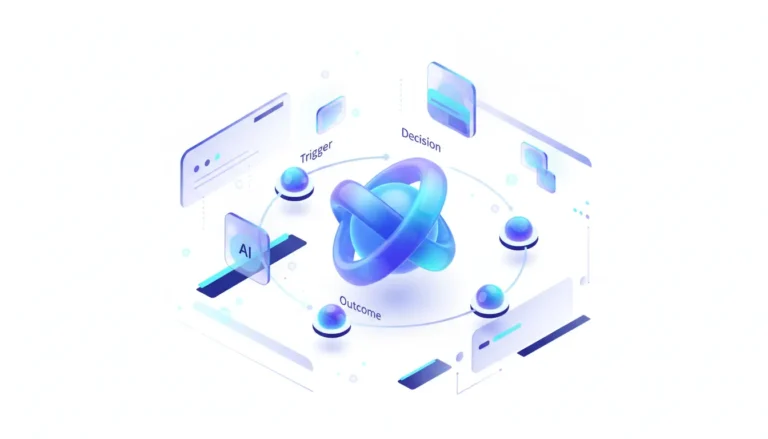
Why it matters now: A regular LLM gives one answer per prompt. An agent, by contrast, keeps cycling through perception, reasoning, and action—using patterns like ReAct or Plan-and-Execute—to call tools and consult memory. That loop drives up token use, adds latency, and changes the infrastructure requirements in ways most teams have not faced before.
Who is most affected: Developers who have to design multi-agent workflows, cloud providers managing the resulting compute load, and risk teams responsible for overseeing decisions that are not entirely predictable.
The under-reported angle: The real barrier to wider adoption is not model intelligence but the lack of solid observability and evaluation standards. Without agreed-upon benchmarks or reliable cost models, running these systems at scale still carries heavy financial and compliance risks.
Deep Dive
To get a clear picture of where agentic AI stands, it helps to look past the textbook definitions and the polished wrappers like custom GPTs. What is changing most is the split between reasoning and execution. Models are no longer just sources of text—they are becoming the thinking layer inside larger software systems. Tools like LangChain and LlamaIndex started as simple connectors but have grown into full orchestration layers that support loops such as ReAct, where an agent thinks, checks vector memory, calls external tools, and repeats until the goal is reached.
That said, the market still sees agency in quite different ways. Research groups like DeepMind are working on generalist agents that can handle multimodal inputs—watching short video clips, for instance, to pick up signals and judge relevance. Meanwhile, hardware and cloud teams at NVIDIA and Microsoft Azure are focused on the practical side: keeping agents running on GPU endpoints, grounding them with retrieval, and adding the controls needed for responsible use. For architects in larger organizations, the pressing questions are how to store an agent’s memory, manage its context window, and keep runaway API calls from driving up costs.
One area that still gets little attention in most guides is production readiness. Plenty of tutorials show how to launch a single agent, yet the harder part is coordinating several of them—using setups like those in AutoGen or CrewAI, where supervisor and worker agents check each other’s work. These arrangements create new kinds of failure. When an agent makes up an API call, the result is not just poor text but an action taken in the real world. Without better tracing of prompts, tool calls, and human review steps, that risk stays hard to manage.
As a result, the move to agents is testing existing infrastructure in new ways. Continuous reasoning loops change the usual calculations around latency and cost. Decisions about edge versus cloud, caching, and routing now matter as much as the underlying model’s strength. The next stage of this race will likely favor teams that can supply evaluation tools, spending controls, and compliance checks strong enough to let agents operate without constant oversight.
Stakeholders & Impact
| Stakeholder / Aspect | Impact | Insight |
|---|---|---|
| AI / LLM Providers | High | Agent loops shift token economics. Persistent system prompts and repeated reasoning steps create much larger API volumes. |
| Infrastructure & Cloud | High | The focus moves from raw inference scaling to memory stores, state handling, and lower latency to keep real-time loops running smoothly. |
| Enterprise Developers | High | Work shifts from prompt tuning toward observability, choosing between frameworks like LangGraph or AutoGen, and planning safe rollback paths. |
| Risk & Compliance | Significant | Agents that read user content or trigger financial and data APIs need fresh governance, detailed logs, and stronger brand-safety measures. |
About the analysis
Researched and written with AI assistance under the editorial responsibility of the i10X News team. The title image is an AI-generated illustration. Read our AI Use Policy. Spotted an error? Request a correction.
This independent analysis looks at the move toward agentic AI by drawing on materials from framework teams like LangChain, research groups such as DeepMind and OpenAI, and cloud providers including Microsoft, IBM, and NVIDIA. It is meant for CTOs, product leads, and MLOps groups that need to weigh the architectural and infrastructure choices involved in running autonomous AI in production.
i10x Perspective
The rise of AI agents signals the close of the purely conversational phase and the start of something more like asynchronous digital work. As these multi-agent setups develop, attention is moving away from simply training larger models and toward the layers that handle orchestration and routing. Over the next five years, what will set one system apart from another is unlikely to be raw model capability. Instead, the deciding factor will be the strength of the supporting infrastructure—the parts that let models plan, retain context, and carry out actions safely inside digital environments.