
MultimodalNvidia
Evidence check
  • Preprint
  • No code released
  • Not independently replicated

VLMs Still Can’t Tell Which Attribute Goes With Which Object — Until Text-Only Finetuning

SABER binding benchmark: an 8B model finetuned on synthetic text alone jumps from 52.5% to 84.2% mean accuracy, with +34.1 points text–image — no visual training data.

Christopher Ort
By Christopher Ort · 2 min read
Share
A jumbled network of lines and labels becoming perfectly aligned by an unseen force.
Illustration: i10X
On this page
  1. Quick Take
  2. What the study shows
  3. Why it matters: composition is reliability
  4. Method in brief
  5. What remains open
  6. Context
  7. What it means for embedding trainers
  8. About the analysis
  9. i10x Perspective
i10X Quick Take

Quick Take

  1. The finding: Attribute–object binding remains a weak spot: models confuse which adjective belongs to which noun across modalities.
  2. Text-only fix: Finetuning an 8B model on synthetic shuffled-caption supervision (no images) raises mean accuracy from 52.5% to 84.2%, with 99.3% text–text accuracy.
  3. Cross-modal transfer: Despite no visual data, gains of 34.1 / 37.8 / 9.4 points appear in text–image, image–text and image–image settings.

Compositional binding — “glowing giraffe” vs “glowing submarine” — still trips vision–language models. OriginAI, NVIDIA and Tel Aviv University introduce SABER, which reassigns fixed object/attribute sets to build hard distractors.
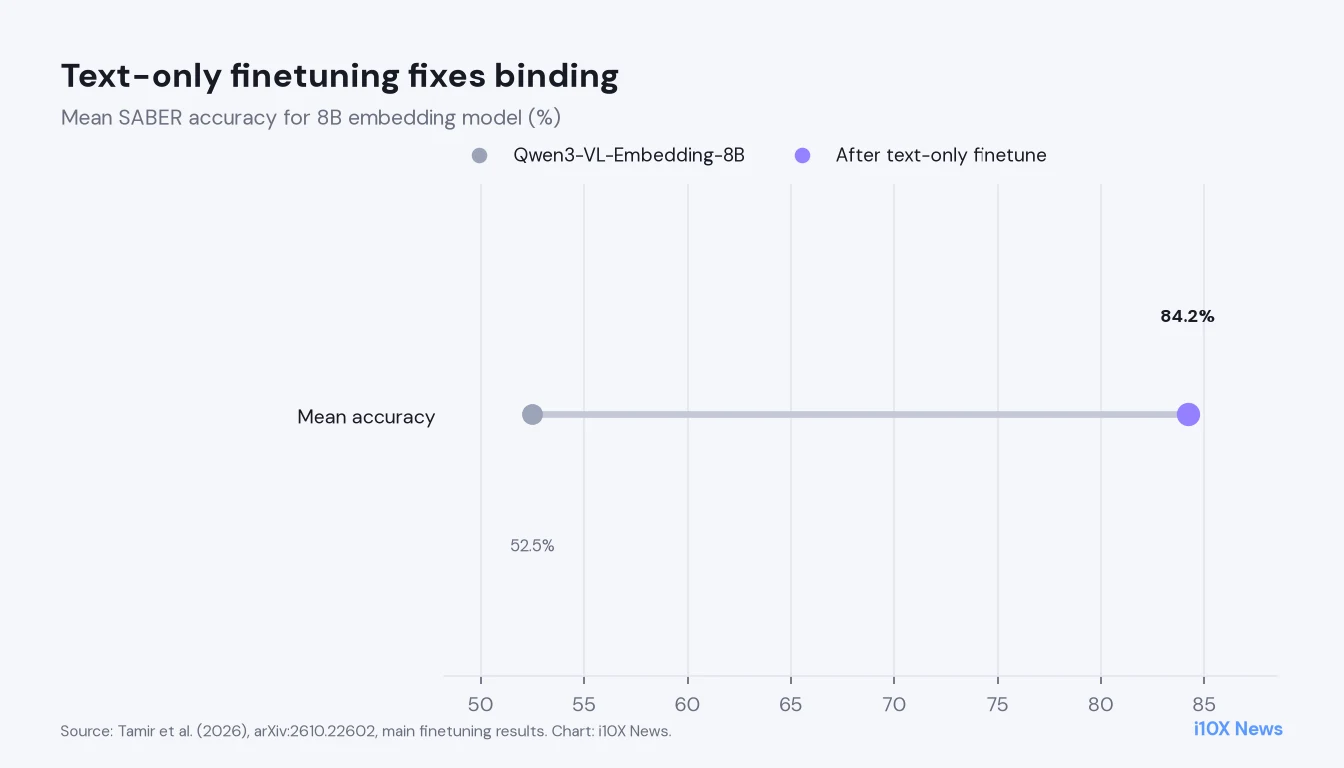
Dumbbell: mean accuracy rises from 52.5 to 84.2 percent after text-only finetuning.
i10X chart based on data from Tamir et al. (2026), arXiv:2610.22602, main finetuning results (CC BY-NC-SA 4.0).

What the study shows

For most non-CLIP models, the correct candidate and three binding-swapped distractors occupy the top four retrieved slots in >90% of queries, so ranking reduces to binding. CLIP ViT-B/32 variants only do so 27–53% of the time.

  • 2B model also improves: Average +15.6 points over its pretrained counterpart.
  • Retrieval mAP: 8B model improves mean mAP by 19.2 points over Qwen3-VL-Embedding-8B.

Why it matters: composition is reliability

Shopping, robotics and captioning fail when attributes attach to the wrong object. A text-only recipe that transfers cross-modally is cheap insurance.

Method in brief

SABER MCQ and retrieval protocols; LoRA adapters on frozen backbones; synthetic text supervision.

What remains open

  • Synthetic shuffles: Real-world binding errors may differ.
  • Model coverage: Strongest gains on Qwen-line embeddings.

Context

Related VLM compositionality in Multimodal.

What it means for embedding trainers

  • Add binding negatives: Shuffled attributes are high-value.
  • Try text-only adaptation: Surprisingly transferable.
  • Audit CLIP-style models: They miss the top-4 binding structure more often.

About the analysis

Researched and written with AI assistance under the editorial responsibility of the i10X News team. The title image is an AI-generated illustration. Read our AI Use Policy. Spotted an error? Request a correction.

This article is based on the full text of the preprint “Stuck on Shuffle: On Attribute-Object Binding in Vision-Language Models” (arXiv:2610.22602v1, submitted October 15, 2026). All numbers are taken from the paper’s text, tables and figures; i10X did not rerun the experiments. The chart was redrawn by i10X from main finetuning results of the paper, which is published under a CC BY-NC-SA 4.0 license.

i10x Perspective

That you can teach vision-language binding without showing a single image is both delightful and slightly worrying. It suggests the failure was linguistic structure in a shared space — and that we have been underusing text to fix multimodal bugs.


Christopher Ort

Christopher Ort

Christopher Ort handles SEO, AI agent workflows and PR & partnerships at i10x.ai, the all-in-one AI workspace built by i10X Global Pte. Ltd. in Singapore. He is a graduate of Friedrich-Alexander-Universität Erlangen-Nürnberg (FAU). He is the author of “The Style Penalty”, a study published on SSRN that analyses 1,576 evaluation decisions by four frontier AI models to show how AI-written CVs fare in automated hiring screens; the research has been covered by heise online and t3n.

Timeline

What happened before

  1. Acquisition

    NVIDIA to acquire Hugging Face for ~$12.9B

    To acquire Hugging Face · $12.9B

    Agreement to acquire Hugging Face for about $12.9B (incl. up to $1B retention equity); expected to close in H1 2027 subject to approvals.

    blogs.nvidia.com (source, opens in a new tab)
  2. Partnership

    NVIDIA guarantees up to $105B for OpenAI’s Ohio data-center campus

    With SB Energy, OpenAI · Compute · $105B

    Residual-value guarantee for OpenAI's 20-year lease of SB Energy's PORTS-Pike campus in Pike County, Ohio: 4.25 GW initially plus a 3.75 GW option, online from 2028. NVIDIA pays only on default; OpenAI must reimburse.

    investor.nvidia.com (source, opens in a new tab)
  3. Release

    Nemotron 3 Ultra

    1M context · open weights

    550B-parameter (55B active) hybrid Mamba-Transformer MoE with open weights.

    developer.nvidia.com (source, opens in a new tab)
  4. Partnership

    NVIDIA invests $2B in Marvell

    With Marvell · Investment · $2B

    cnbc.com (source, opens in a new tab)
  5. Partnership

    NVIDIA invests $2B in Nebius

    With Nebius · Investment · $2B

    investor.nvidia.com (source, opens in a new tab)
Full Nvidia timeline ›

Editor's picks

  1. Anthropic IPO Filing Reveals Extreme AI Safety Risks
  2. Grok Imagine Odyssey Pilot Exposes AI Video Limits
  3. Anthropic Files S-1 for Nasdaq IPO Under Ticker ANT
  4. Jakarta Agentic AI Milestone Delivers Standardized AI Agents for Java
  5. llm-deepseek Serialization Bug Replays Text After Tool Use