
Quick Take
- The finding: TurboVLA (0.2B params) achieves 97.6% average success on LIBERO with 31.2 ms inference and 0.9 GiB VRAM on a consumer RTX 4090 — about 32 Hz.
- Vs heavy VLAs: Higher average success than π0.5 (96.9%) with ~6% of the parameters and 8× faster inference.
- Transfer: A 0.4B variant reaches 88.06% on RoboTwin 2.0, matching or beating larger LLM-centric VLAs.
LLM-centric vision-language-action policies often sit on remote servers at a few hertz. Huazhong University of Science and Technology researchers cut the LLM out of the inner loop so edge devices can update actions every ~31 ms.
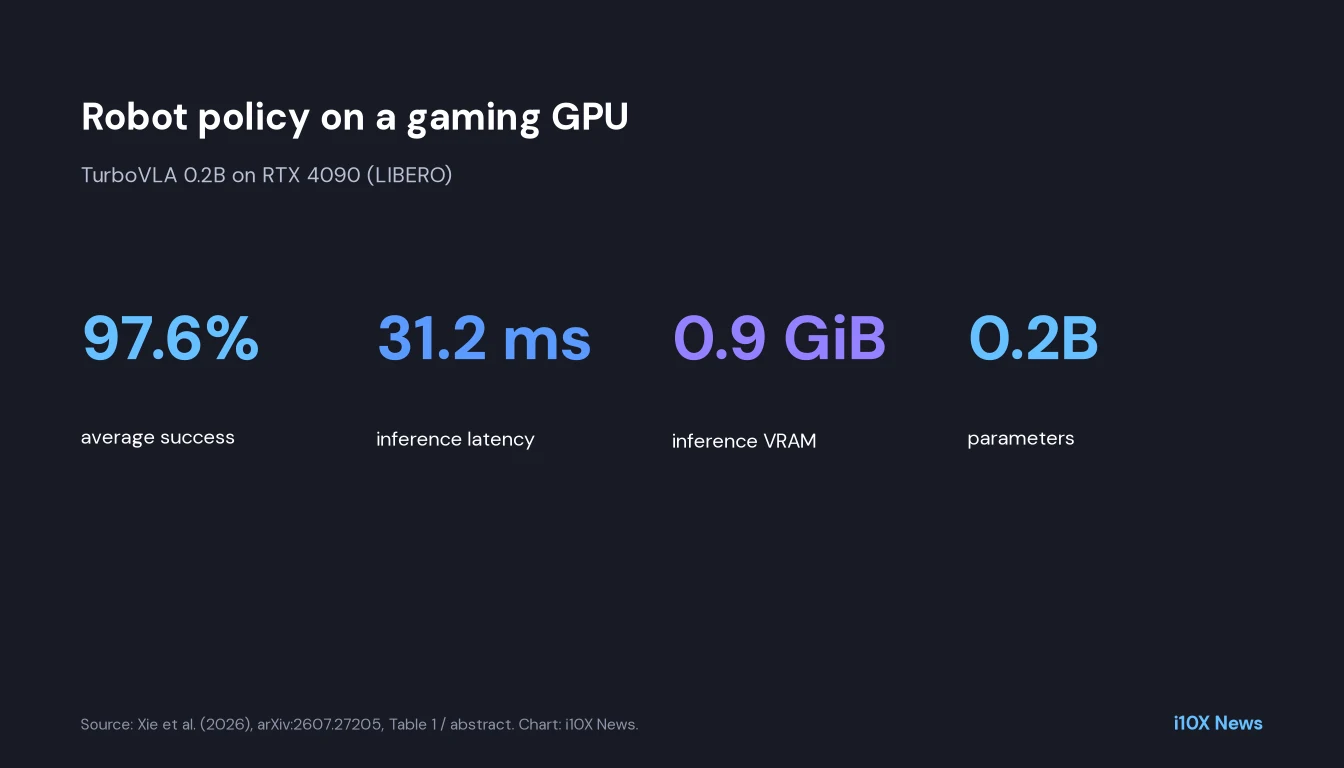
What the study shows
Direct vision-language interaction produces actions without huge remote models. Real-world fine-tuning uses 4×65 teleoperated demos for 12.5k steps from a LIBERO-pretrained init.
- Edge economics: Consumer GPU, <1 GB inference memory, no network round-trip.
- Deployment contrast: Authors contrast 239 ms remote LLM-centric perception vs 31 ms on-device.
Why it matters: robots need local loops
Network-dependent VLAs fail offline and lag physically. Sub-1 GB, 32 Hz policies unlock real edge deployment.
Method in brief
Lightweight VLA without LLM-centric inner loop; LIBERO and RoboTwin 2.0 evals; real-world fine-tune.
What remains open
- Benchmark suites: Sim success may not equal open-world robustness.
- Task coverage: LIBERO/RoboTwin scope.
Context
Related embodied AI in Multimodal.
What it means for robot startups
- Profile Hz and VRAM: Not only success rate.
- Keep LLM out of the control loop: Use it for high-level goals.
- Fine-tune on little demo data: 4×65 trajectories reported.
About the analysis
Researched and written with AI assistance under the editorial responsibility of the i10X News team. The title image is an AI-generated illustration. Read our AI Use Policy. Spotted an error? Request a correction.
This article is based on the full text of the preprint “TurboVLA: Real-Time Vision-Language-Action Model at 32 Hz on an RTX 4090 with <1 GB VRAM” (arXiv:2607.27205v3, submitted July 29, 2026). All numbers are taken from the paper’s text, tables and figures; i10X did not rerun the experiments. The paper is distributed under arXiv’s non-exclusive license, so i10X does not reproduce its figures; the chart was drawn by i10X from numbers reported in Table 1 / abstract.
i10x Perspective
TurboVLA is a reminder that embodiment is a systems problem. 97.6% means little if the policy updates four times a second on a rented A100. Thirty-two hertz on a 4090 is the more radical number.