Quick Take
- The finding: Spatial intelligence — reconstructing 3D structure from 2D images — remains weak in LVLMs. Humans in the paper’s teaser hit 95%, while GPT-5 and Gemini2.5-flash lag far behind on the illustrated item.
- Synthetic curriculum: SpatialBlock-15k offers 15,000 block-stacking problems covering projection, viewpoint transforms and structural combination, with controlled color cues.
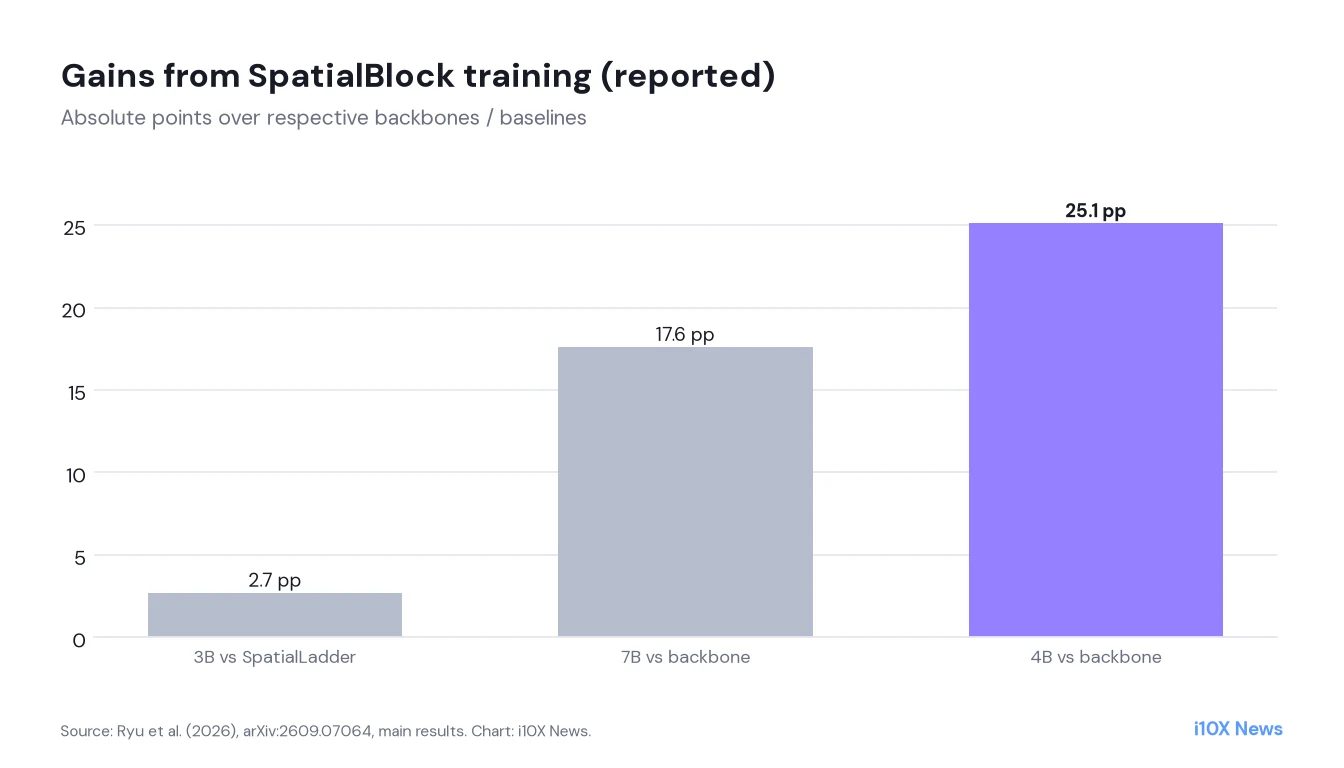
- Transfer: A 4B model reaches 51.3% (+25.1 over backbone), best open-source in the reported comparison; 7B gains 17.6% over its backbone with only 15K samples.
Real-scene spatial QA needs expensive geometric labels. KAIST and AITRICS researchers take a developmental psychology cue: learn spatial foundations on structured block tasks first.
What the study shows
Among Qwen-based models, 3B outperforms SpatialLadder by 2.7% (3.2% in another comparison) with a simpler synthetic-only pipeline; 7B outperforms SpaceR and Spatial-SSRL despite tiny data.
- Visual cues matter: Removing them drops MindCube by 7.9%/7.3% (direct/reason) and MMSI-Bench by 1.9%/4.8%.
- Sample efficiency: 15K synthetic problems punch above real-scene annotation cost.
Why it matters: cheap spatial foundations
If toy blocks teach transferable 3D skills, labs can skip some noisy real-scene annotation.
Method in brief
Synthetic block-stacking dataset; train Qwen-scale LVLMs; evaluate MindCube, MMSI-Bench and related spatial suites.
What remains open
- Synthetic gap: Real scenes remain harder.
- Teaser human 95%: Single illustrative item, not a full human baseline.
Context
Related spatial VLM work in Multimodal.
What it means for multimodal trainers
- Pretrain spatial skills synthetically: Then adapt.
- Keep visual cues ablating: They still help.
- Compare sample efficiency: 15K can beat heavier pipelines.
About the analysis
Researched and written with AI assistance under the editorial responsibility of the i10X News team. The title image is an AI-generated illustration. Read our AI Use Policy. Spotted an error? Request a correction.
This article is based on the full text of the preprint “SpatialBlock: Enhancing Spatial Intelligence in LVLMs via Synthetic Block-Stacking Problem” (arXiv:2609.07064v1, submitted September 7, 2026). All numbers are taken from the paper’s text, tables and figures; i10X did not rerun the experiments. The chart was redrawn by i10X from main results of the paper, which is published under a CC BY 4.0 license.
i10x Perspective
Children learn space with blocks long before street scenes. SpatialBlock suggests LVLMs might too — and that 15,000 carefully designed toys can out-teach noisier real geometry labels.