
Quick Take
A recent comment from an Nvidia executive points to a strange new dynamic in the labor market: AI agents seem to prefer reading AI-generated resumes, especially if they share the same underlying language model. I’ve noticed how quickly these patterns emerge once the tools scale.
The digital recruitment market is rapidly shifting away from traditional keyword-based Applicant Tracking Systems (ATS) toward LLM-native screening. This transition is sparking a new optimization race, focusing on how synthetic text created by job seekers is interpreted by evaluating AI models.
What happened is straightforward enough. That Nvidia executive recently suggested resumes generated by AI might fare better when parsed by AI hiring systems, which introduces the controversial idea of model-family bias in employment screening. Why it matters now is that we’re seeing a fundamental infrastructure shift from basic keyword matching to semantic, context-aware AI agents. Candidates and employers are increasingly caught in this automated loop where AI writes text specifically for other AI to consume.
Job seekers trying to optimize for invisible algorithms feel the pinch most, along with HR tech vendors updating legacy platforms and enterprise recruiters relying on LLMs to handle massive applicant pipelines without running into compliance headaches.
The under-reported angle involves cross-model symmetry. An unproven but highly plausible scenario is unfolding where a resume written by an OpenAI model inherently appeals to an OpenAI-based corporate screening tool. It comes down to shared semantic weights, predictable token structuring, and aligned rhetorical patterns.
🧠 Deep Dive
Have you ever wondered why so many resumes start sounding eerily similar these days? The digital hiring ecosystem is undergoing a quiet but radical infrastructure overhaul. A quick glance at the current market reveals a flood of resume builders – from commercial heavyweights like Canva and Zety to specialized tools like Rezi and Jobscan – all promising to help candidates “beat the bot.” But the bot has fundamentally changed. The legacy strategy of keyword stuffing and exact-phrase matching is colliding with a new reality: HR departments are actively integrating LLMs capable of semantic reasoning, narrative evaluation, and context extraction.
This shift brings the Nvidia executive’s recent observation sharply into focus. If a candidate uses ChatGPT to write their experience bullet points, and an employer uses a GPT-4-powered API to evaluate them, we enter a closed loop of AI-to-AI communication. The concept of “model-family compatibility” suggests that an evaluating LLM intrinsically recognizes and rewards its own linguistic patterns, formatting preferences, and transition states, grading them as more logical or professional than human-written text.
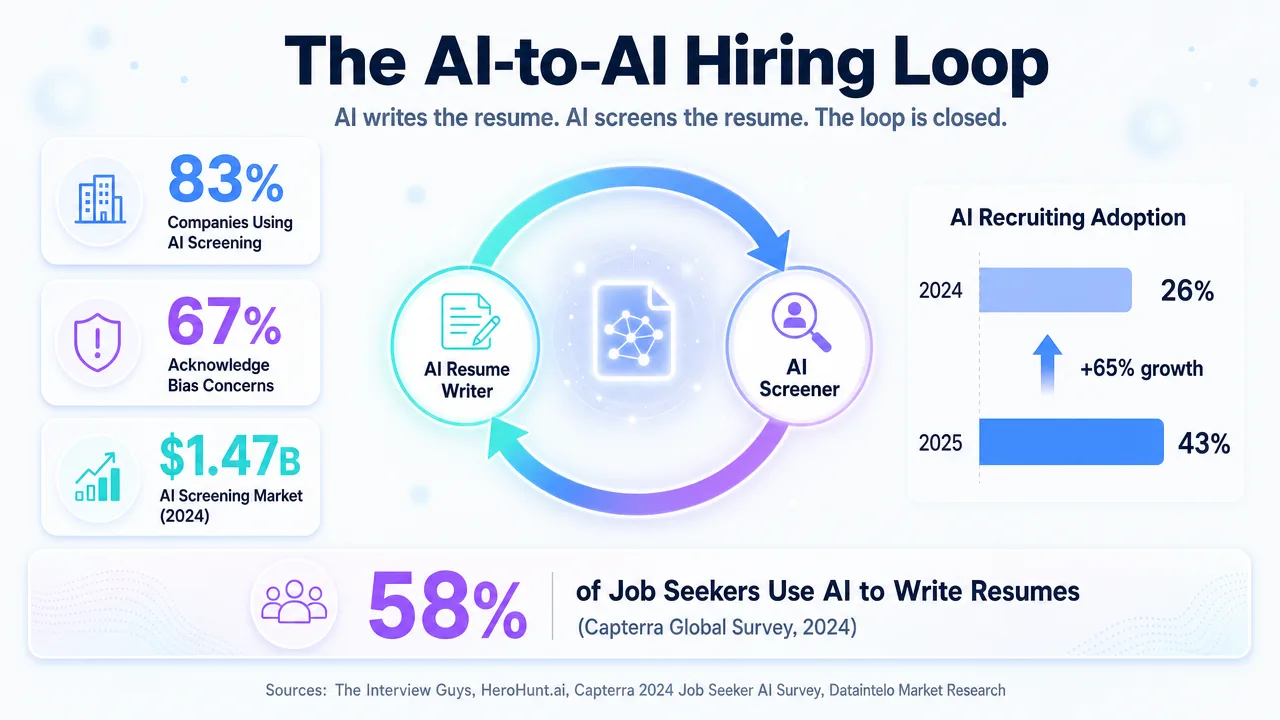
From what I’ve seen, current commercial tools are largely addressing yesterday’s pain points. Platforms still emphasize ATS-friendly formatting and JD keyword match rates. Yet there’s a gaping void in the market when it comes to LLM-screener optimization. Traditional resume “hacks” like invisible white text or aggressive keyword lists actually penalize candidates when ingested by modern LLMs. Unlike legacy parsers, large language models assess the cohesion of a narrative, weighing frameworks like the STAR method far more elegantly than simple word counts.
Beneath this algorithmic arms race lies a tangled web of data and compliance risks. As candidates feed highly detailed career histories into AI builders, the risk of Personally Identifiable Information (PII) leakage into model training data surges. At the same time, regulators like the EEOC are scrutinizing AI hiring tools for built-in biases. If AI screeners arbitrarily favor applicants who utilize premium, specific LLM writing tools, it introduces a digitized socioeconomic barrier disguised as algorithmic efficiency.
In the end the traditional resume keeps transforming into a machine-readable artifact – a structured API payload wrapped in a PDF. As developers and HR vendors push the limits of automated screening, the actual text of a resume loses some of its value as a proxy for human capability. Instead it becomes a highly optimized token sequence designed to trigger maximum resonance within the target company’s intelligence infrastructure.
📊 Stakeholders & Impact
| Stakeholder / Aspect | Impact | Insight |
|---|---|---|
| AI / LLM Providers | Medium | Indirectly creating a synthetic feedback loop; rising scrutiny over “model-family bias” in text generation and evaluation. |
| HR Tech & ATS Platforms | High | Legacy platforms must rebuild keyword-matching engines into complex LLM evaluation frameworks to stay relevant. |
| Job Seekers / Candidates | High | Forced to pivot optimization strategies from keyword density to model-friendly narrative structures, risking PII exposure. |
| Regulators & Policy (EEOC) | Significant | Expanding oversight to ensure AI screening agents don’t institutionalize bias against human-written or non-AI-assisted formats. |
✍️ About the analysis
Researched and written with AI assistance under the editorial responsibility of the i10X News team. The title image is an AI-generated illustration. Read our AI Use Policy. Spotted an error? Request a correction.
This independent, research-based analysis tracks the evolution of AI resume screening by synthesizing current web intent, competitor landing pages from Zety, Resume.io, and Jobscan, plus recent executive signals. It is designed for HR tech developers, engineering managers, and strategic job seekers who need to understand the underlying mechanics of automated hiring architectures.
🔭 i10x Perspective
The resume is dead; long live the synthetic talent payload. We are witnessing the complete automation of the hiring handshake, where generative models draft applications specifically optimized for evaluating models to read. This AI-to-AI loop will ultimately break the utility of text-based hiring entirely, inevitably forcing the broader tech and corporate ecosystem to pivot toward verified cryptographic credentialing, GitHub integrations, and sandbox-based skill assessments over the next decade.