
“With ‘agentic AI’ stressing data center architectures, a mysterious rumor of an Nvidia ‘Vera CPU‘ is forcing the market to realize that GPUs alone can no longer carry the weight of massive intelligence infrastructure.”
Quick Take
- Summary: The AI infrastructure space is suddenly alive with chatter about unverified reports that Nvidia has already delivered something called the “Vera CPU” straight to heavyweights like OpenAI, Anthropic, and SpaceXAI. Whether “Vera” turns out to be a codename, a custom take on the Grace line, or simply loose talk, it points to one practical reality. The bigger AI labs now need CPUs that can keep autonomous agents running smoothly, not just more raw GPU power.
- What happened: Financial outlets and forums have been circulating claims that Nvidia started shipping an unannounced “Vera CPU” to support agentic AI workloads. Official material from Nvidia, however, keeps pointing back to its existing Arm-based Grace family—the Grace Superchip, Grace Hopper (GH200), and Grace Blackwell (GB200). Hardware folks have also noted the mix-up with the open-source “VeeR” RISC-V core from the CHIPS Alliance.
- Why it matters now: We’re moving past the single-prompt chat era. Agentic systems run continuously, juggling tools, memory states, and background tasks. That shift moves the real constraint from pure GPU throughput to how tightly CPU and GPU stay coordinated on memory and latency.
- Who is most affected:
- Data-center architects mapping out next deployments
- Cloud teams sizing racks
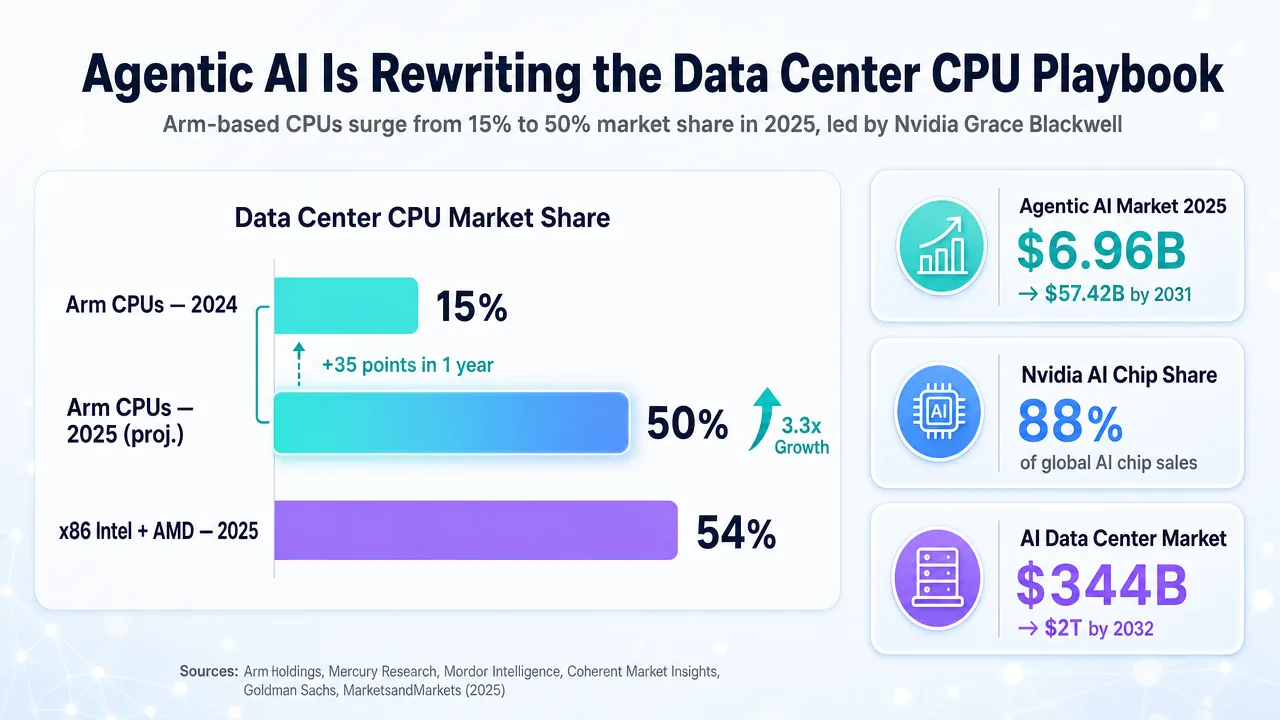
- The x86 incumbents (Intel Xeon, AMD EPYC) that could lose ground if Nvidia locks down the CPU side of AI servers as well
- The under-reported angle: While everyone debates whether “Vera” even exists, Nvidia’s larger move is already clear. Its Arm-based CPUs, linked through NVLink-C2C, are intended to handle the full orchestration layer rather than sit beside GPUs as simple helpers.
Deep Dive
Have you ever watched a promising AI demo suddenly stall once it tries to juggle more than one live task at a time? That friction is exactly what the “Vera CPU” chatter is really about.
From what I’ve seen reviewing the last week’s reports, secondary financial sources claimed Nvidia quietly placed “Vera” systems with OpenAI, Anthropic, and Oracle. The engineering community remains split. Some suspect an internal code name for a specially binned Grace part aimed at dense agent workloads; others trace the name to a collision with the open-source Cores-VeeR-EL2 RISC-V work. Nvidia itself stays quiet on the topic and continues to reference only the Grace architecture and Blackwell generation.
Debunking the rumor is less useful than noticing why the story spread so fast. AI teams are running into a genuine architectural limit. As labs like OpenAI and Anthropic steer toward agentic workflows—agents that browse, code in sandboxes, and coordinate dozens of services at once—the classic GPU-heavy server layout starts to show cracks. Training still loves raw GPU clusters. Running unpredictable agents all day, though, exposes limits in CPU I/O, memory bandwidth, and cache coherency.
That is exactly why Nvidia built the Grace CPU Superchip and its successors, Grace Hopper and Grace Blackwell. Traditional x86 CPUs lose cycles moving data across PCIe links. Pairing an Arm Neoverse V2 core directly with GPUs over NVLink-C2C removes much of that tax. Whether “Vera” is simply industry shorthand for a large GB200 rollout or something newer, the intended job—scaling agent orchestration—matches Nvidia’s public direction.
For engineers choosing hardware, the calculation has changed. Picking a data-center CPU used to mean weighing Intel Xeon against AMD EPYC or a cloud provider’s own Arm part. Now the question includes whether an Nvidia coherent complex would cut latency on embedding lookups, agent queues, and state tracking. If the answer keeps coming back yes, the x86 share of AI racks shrinks accordingly.
The “Vera” story, in short, acts as an early warning for the supply chain. CTOs and architects are searching for working blueprints on how to arrange the routing layer for agentic systems. As AI moves from generating answers to taking sustained action, the CPU has become relevant again—and Nvidia clearly plans to own that tier.