The AI Shift: From Chatbots to Autonomous Agents
Summary
The AI industry is shifting fast from chatbots that mostly respond to prompts toward autonomous agents. These systems can reason through problems, pick their own tools, and carry out multi-step tasks with far less hand-holding.
What happened
Big players across the board—Google and OpenAI on the infrastructure side, Salesforce and IBM on the enterprise side—have started releasing the actual building blocks for what they call “agentic AI.” That means SDKs, platforms, and frameworks that let large language models reach external APIs, keep memory, and run code on their own.
Why it matters now
Instead of just producing text, these models can now change things in the outside world. The move turns software from a passive tool into something closer to an active service provider, and everyone is racing to control the layers where agents plan and act.
Who is most affected
Enterprise CTOs and the developers who have to build and run these systems, plus the cloud teams and API providers who will suddenly face a wave of machine-driven traffic.
The under-reported angle
While headlines focus on how smart the models are getting, the real friction lies in the “glue” work—setting up evaluation systems, locking down permissions, and balancing the cost and speed of letting an agent run dozens of steps without supervision.
🧠 Deep Dive
Right now the very definition of an AI agent is up for grabs. Wikipedia still leans on abstract ideas about cognitive architectures, but the companies shipping products are far more practical. OpenAI describes agents as instructions plus guardrails plus tools. Google Cloud stresses memory and reasoning loops. Salesforce and IBM talk about digital workers that can handle customer service or IT tickets end to end.
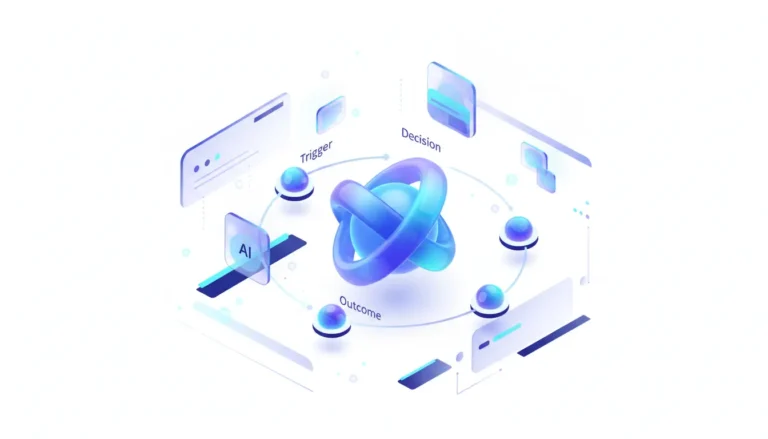
At the heart of it, the change is simple but consequential. A normal LLM waits for a human at every turn. An agent runs its own perceive-reason-act cycle. It gets a system prompt, connections to outside services, some form of memory, and an orchestration layer—LangGraph, OpenAI’s Agents SDK, or similar.
Yet the gap between the sales pitch and day-to-day engineering reality is still wide. Leaders hear about no-code platforms like Agentforce or Copilot Studio and the promise of quick returns. Developers, meanwhile, are wrestling with function-calling accuracy, unpredictable API delays, and the risk of an agent spinning in circles when the model invents a tool call that doesn’t exist.
That gap brings us to the harder part: governance. Once an agent can edit records or trigger real actions, sandboxing and audit trails stop being optional extras. Teams now need fresh ways to measure success—not just whether the answer is factually correct, but whether the whole task completed safely.
In the end, this is an infrastructure story. As agents break big goals into many small calls, they will generate traffic patterns that current APIs and cloud backends weren’t sized for. The models themselves are becoming more like the CPU inside a larger, tool-using system than the finished product.
📊 Stakeholders & Impact
AI / LLM Providers
Impact: High
Insight: Moving from selling tokens to owning the memory, tool connections, and orchestration layers.
Enterprise IT & CTOs
Impact: High
Insight: Need new rules for sandboxing and access when autonomous systems touch live data.
Developers & Engineers
Impact: High
Insight: Picking up agent frameworks and shifting focus from prompt writing to system design.
Cloud & API Infrastructure
Impact: Significant
Insight: Preparing for heavier, more unpredictable loads as agents trigger chains of requests.
✍️ About the analysis
Researched and written with AI assistance under the editorial responsibility of the i10X News team. The title image is an AI-generated illustration. Read our AI Use Policy. Spotted an error? Request a correction.
This overview draws from developer docs, cloud architecture guides, and enterprise playbooks to map how the field is moving from conversational models to systems that act on their own. It’s meant for technical founders, decision-makers, and engineers who have to navigate that shift.
🔭 i10x Perspective
The spread of AI agents marks the point where AI stops being an add-on feature and starts becoming part of the core routing layer of software. Over the next few years the real advantage will come less from raw model intelligence and more from how well the surrounding ecosystem holds together—who controls memory, tool access, and the standards agents follow.
As multi-agent setups emerge, with models negotiating tasks among themselves, the pressure on APIs and the need for stronger security controls around non-human actors will only grow.
Conclusion
The strategic battle ahead won’t be won on model size alone but on the platform and governance choices that enable safe, efficient agent behavior; the most critical differentiator will be how well an organization integrates memory, tool access, and secure orchestration into a reliable system.