
Anthropic Launches Claude Fable 5: Premium Pricing for Frontier Reasoning
Summary
Anthropic has unveiled Claude Fable 5, calling it their strongest generally available model yet.
What happened
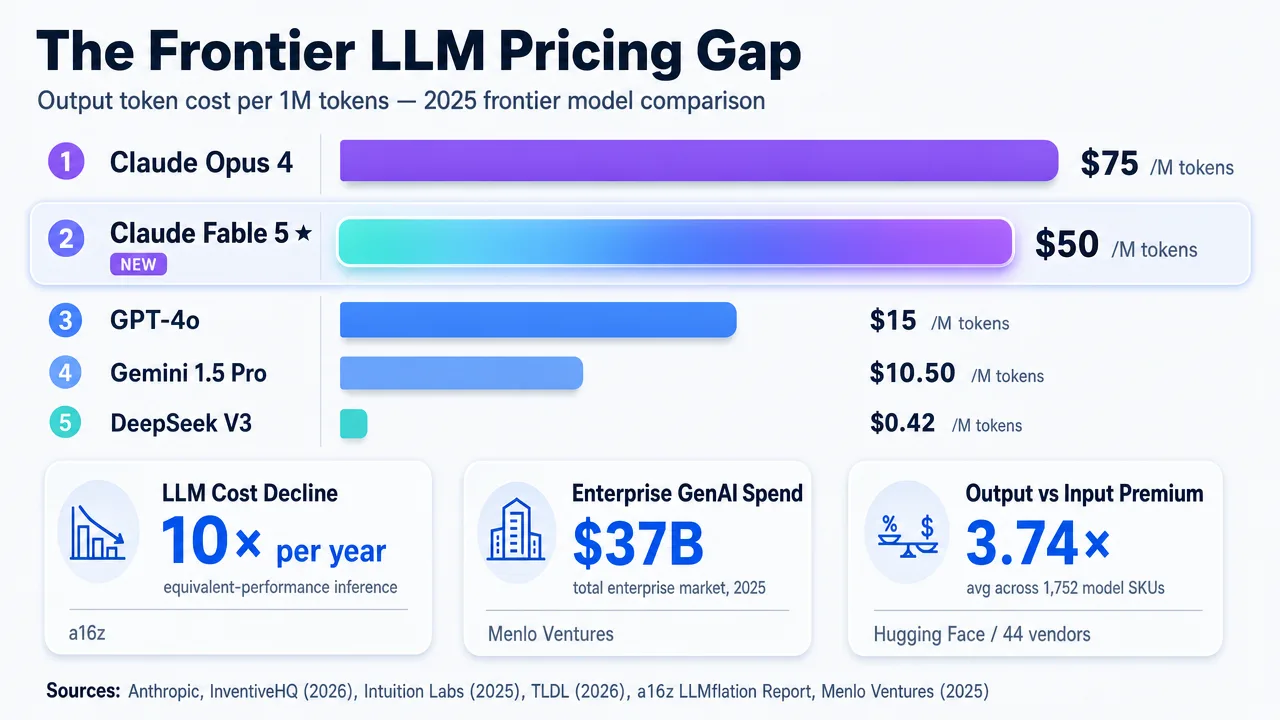
After months of smaller tweaks from various labs, Claude Fable 5 is now broadly available under a premium pricing model—$10 per million input tokens and $50 per million output tokens. The positioning is clear: it targets demanding enterprise reasoning tasks and agentic workflows that can justify the cost.
Why it matters now
While the rest of the market pushes inference prices toward zero, Anthropic is making a deliberate stand at the high end. This directly challenges OpenAI’s reasoning-focused releases and Google’s Gemini line for the top spot in raw capability.
Who is most affected
Enterprise architects and AI engineers building multi-step agents, plus CTOs who suddenly need to revisit their API budgets.
The under-reported angle
The PR story centers on bringing advanced reasoning to more users, yet the pricing tells a narrower tale. At those output rates, prompt caching, careful routing, and tight architectural choices stop being nice-to-haves and become requirements for any real deployment.
Deep Dive
Anthropic’s move with Claude Fable 5 signals a clear choice to prioritize frontier-level performance over broad accessibility. Early coverage has largely echoed the company’s framing of a widely useful upgrade, but the numbers point to something more specialized. This is a model built for high-stakes enterprise work where accuracy on complex chains of reasoning matters more than per-token cost.
The first practical hurdle shows up in the mismatch between launch claims and day-to-day integration realities. Swapping in Fable 5 without adjustments risks serious overspending because output tokens are so expensive. Right now there’s limited public, reproducible data on how it behaves across code generation, retrieval-augmented setups, or tool-use patterns, so teams lack clear migration paths for managing total cost of ownership.
That shifts the conversation from raw benchmarks to engineering trade-offs. Developers will need tighter prompt strategies—few-shot examples, stricter system instructions, and deliberate constraints—to keep responses concise without losing quality. Teams are also watching for rate-limit behavior, latency under sustained load, and overall throughput, since those details decide whether the model fits real-time apps or stays limited to offline batch processing.
In practice this release highlights a split that’s been widening for a while. Lightweight distilled models are moving onto devices for low-latency interactions, while the heaviest systems remain anchored in the cloud and require serious compute resources. For Anthropic to hold the premium tier against GPT-4o, o3, and Gemini, consistent API reliability, enterprise-grade SLAs, and transparent safety processes will matter as much as the intelligence claims themselves.
Stakeholders & Impact
| Stakeholder / Aspect | Impact | Insight |
|---|---|---|
| AI / LLM Providers | High | Shifts the competitive baseline; forces OpenAI and Google to respond transparently to Fable 5’s capability claims in reasoning. |
| Enterprise CTOs | High | The $50/M output pricing forces an immediate TCO recalculation and a pivot toward prompt caching and model routing. |
| AI Developers | High | Requires new prompt patterns and empirical evaluation of tool-use and latency before migrating production workflows. |
| Cloud Infrastructure (AWS/GCP) | Medium | Serving Fable 5 at scale implies massive GPU capacity requirements, stressing data center throughput and rack power density. |
About the analysis
Researched and written with AI assistance under the editorial responsibility of the i10X News team. The title image is an AI-generated illustration. Read our AI Use Policy. Spotted an error? Request a correction.
This is an independent, research-based analysis synthesizing market signals, competitor framing, and AI ecosystem metrics surrounding the Claude Fable 5 launch. It is designed to help engineering managers, CTOs, and AI developers look past high-level PR to understand the tangible integration, operational, and financial realities of deploying frontier models.
i10x Perspective
Claude Fable 5 represents Anthropic’s wager that genuine advances in reasoning still command a premium price, even as cheaper and open-weight options keep driving standard inference costs down. From what I’ve seen in similar launches, narrative alone won’t carry this positioning. The real test will be whether developers get the supporting tools, predictable rate limits, and latency characteristics needed for production use. Over the next year teams that pair this level of capability with disciplined caching and routing practices will likely shape how enterprise agentic systems actually get built.