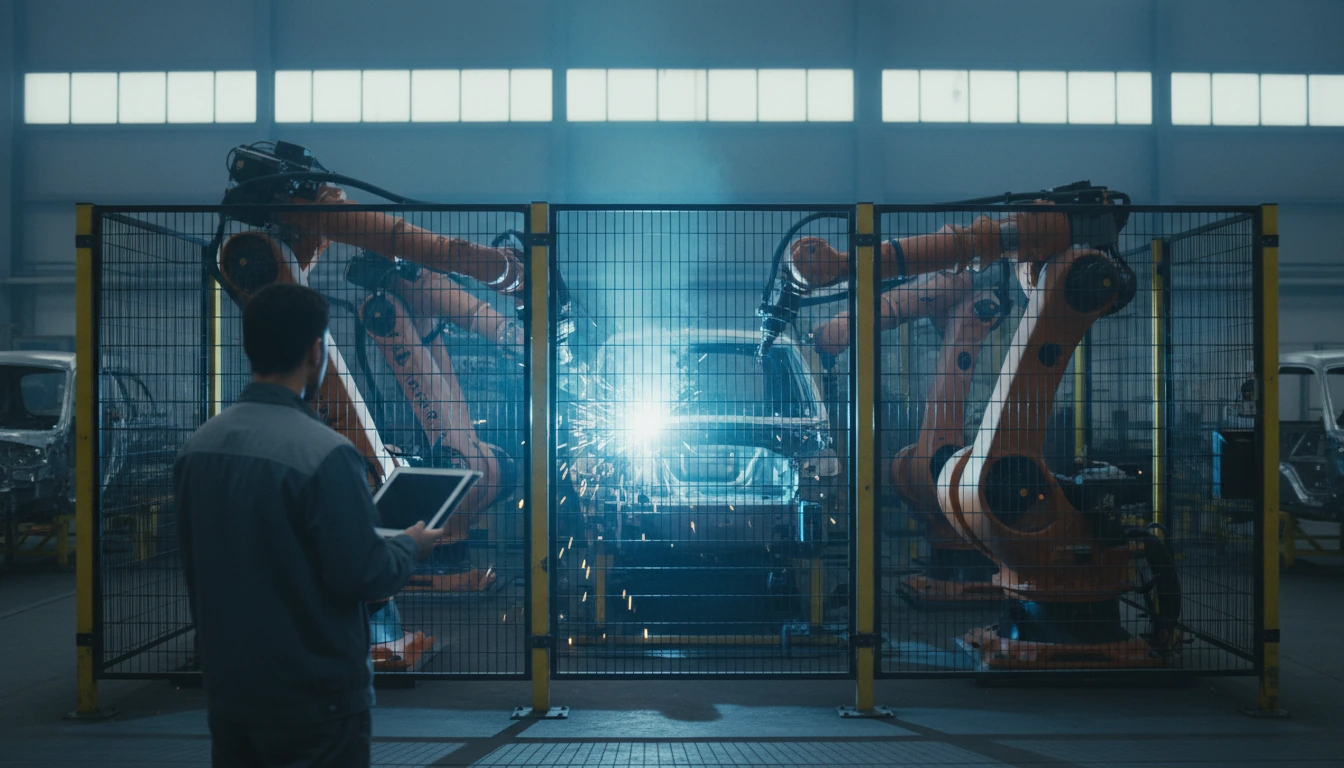
Amazon Web Services has announced Physical AI Production Designer, a solution that uses AI agents to plan robotic production cells, write the control code for them and test that code on virtual copies of the real controllers. AWS says it can help teams plan, validate and optimize a cell “in hours instead of weeks,” a task that the global manufacturer it built the solution with says could take up to eight weeks per cell.
Quick Take
- What it is: A new AWS solution, built on services including Amazon Bedrock, for manufacturing and automation engineers.
- How it works: Engineers define the task from existing product lifecycle management (PLM) data. AI agents plan the cell, generate vendor-native PLC and robot code and validate it on the vendors’ virtual controllers.
- The pain point: A single car body line can include up to 50 robotic cells, each with several arms that must be programmed and interlocked individually.
- The customer estimate: With the manufacturer, AWS says the planning cycle is estimated to shrink from 24 to 15 months, and tighter computed interlocks could raise cell throughput by more than 10%.
- Human in charge: Engineers review the plan in 3D and approve it; only proven changes are promoted to the physical line.
In plain English
Every robot in a factory needs a program that tells it exactly how to move and when to wait for its neighbors, so arms do not collide. Today, specialists write that code by hand for each robot brand, and much of it is only fixed once the robots are installed. AWS wants AI agents to write the first version, test it on a perfect digital copy of the controllers in the cloud and hand engineers a result that already works before anything moves on the shop floor.
What happened
AWS published the announcement on its industries blog on November 18 as the first post in a series. The authors write that “an agent drives the engineering modules to produce a cell scene, a motion plan with its interlock map, and the native PLC and robot code,” after which “the engineer then reviews in 3D and approves.”
AWS stresses that code generation alone is not enough: “Without testing against a physical model, compiled code can still violate an interlock and cause equipment collisions.” That is why the solution runs the generated programs on vendors’ virtual controllers. For cells with frequent changeovers, it also offers a path to train and validate learned robot policies on the same virtual cells.
Background
AWS cites a projection that up to 1.9 million US manufacturing roles may go unfilled by 2033, with automation engineers among the hardest to hire. Robotics teams are tackling the same bottleneck from other angles, for example with standards for robot intelligence and new sources of training data, tracked in our State of AI in Engineering & Robotics report.
Why it matters
Factory automation is often slowed less by the robots themselves than by the engineering time needed to program them. If agents can produce vendor-native code that has already passed closed-loop tests, plants could change products and variants far more often. It is also a clear example of agentic AI moving from office software into physical production.
What’s still open
- Which manufacturer AWS built the solution with, and when results from a live line will be published.
- Which robot and PLC vendors’ virtual controllers are supported at launch.
- How pricing works beyond paying for validation capacity while it runs.
About the analysis
Researched and written with AI assistance under the editorial responsibility of the i10X News team. The title image is an AI-generated image. Read our AI Use Policy. Spotted an error? Request a correction.
This independent i10x analysis is based on the AWS for Industries blog post announcing the solution. All quotes and figures are taken from that source; the efficiency figures are estimates from AWS’s work with one manufacturer.
Sources (plain text, no links):
- AWS for Industries blog: “Physical AI Production Designer: Cell Programming from Weeks to Hours” (November 18, 2026)
i10x Perspective
The most valuable agents may not chat at all. Writing safe robot code for a multi-vendor line is exactly the kind of tedious, high-stakes work where agents plus simulation can pay off. More on our Agents page and the Engineering & Robotics page.