Quick Take
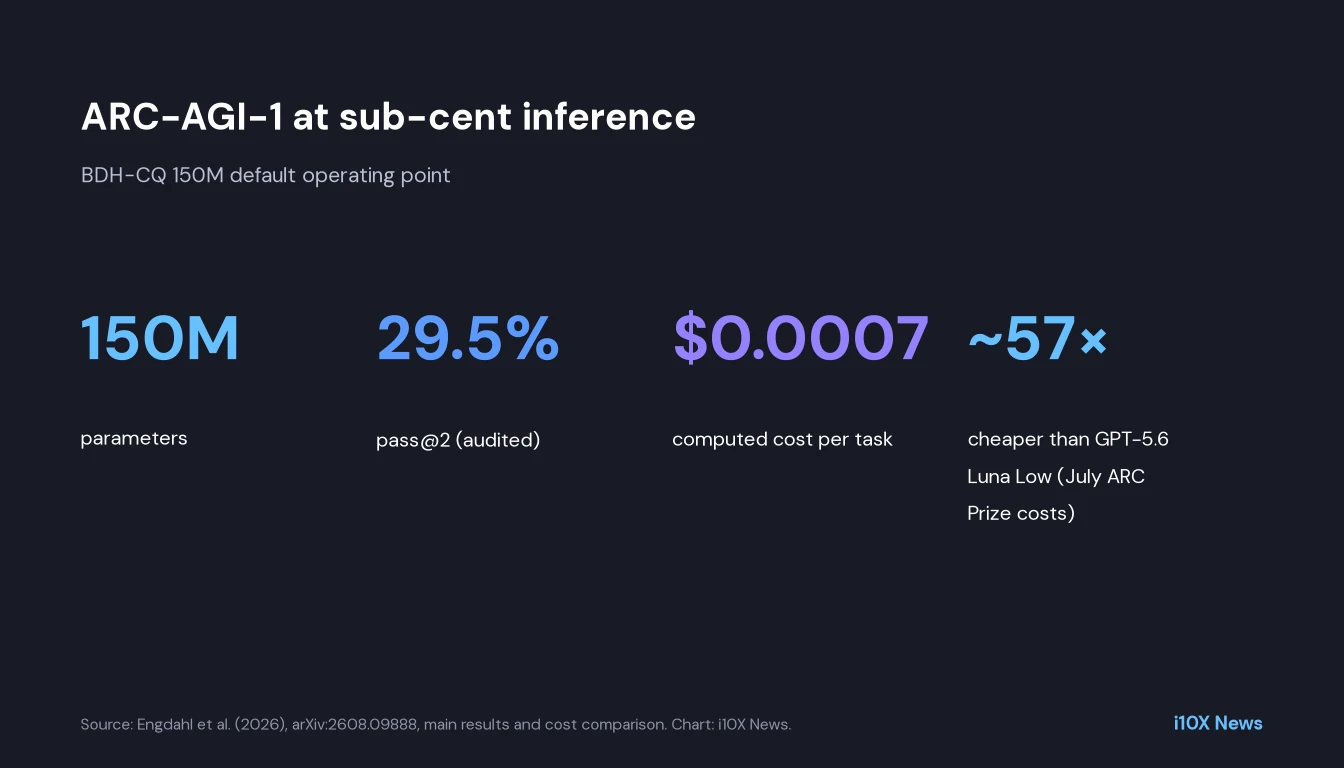
- The finding: A 150M-parameter BDH-CQ configuration scores 29.5% pass@2 on public ARC-AGI-1 at a computed $0.00070 per task.
- Pareto break: That operating point breaks the previously reported ARC-AGI-1 cost–accuracy frontier.
- Independently checked: A black-box audit by Bielik and NYU co-authors reproduced the 29.5% pass@2 score.
ARC-AGI rewards systems that learn a transformation from few demos. Pathway researchers introduce BDH-CQ: demos update a recurrent memory, then the model solves the query through iterative latent computation without verbalizing chain-of-thought.
What the study shows
Default point: ~0.85 H200 GPU-seconds per task; at $3/H200-hour that is $0.00070. Versus ARC Prize July 2026 costs, about 57× cheaper than GPT-5.6 Luna (Low) at 34.2% / $0.040 — or ~11× after OpenAI’s later 80% API price cut.
- Controlled ARC-like interventions: Probe what is learned from demos, consistency of the inferred transform, and hard concepts.
- Small-N family profiles: With ten tasks per family, Wilson intervals are wide — treat concept scores as descriptive.
Why it matters: accuracy per dollar
Frontier LLMs can score higher on ARC but at cents per task. BDH-CQ targets the cheap high-volume regime.
Method in brief
Recurrent latent reasoning without verbal CoT; cost from H200-seconds; independent black-box audit.
What remains open
- Computed vs billed cost: Uses assumed H200 hourly rate.
- Public eval set: Private ARC leaderboard may differ.
Context
Related efficient reasoning in Reasoning and Efficiency & Training.
What it means for ARC-style systems
- Consider latent recurrence: Not only long CoT.
- Publish $/task: Pareto charts need both axes.
- Invite audits: Reproduction builds trust.
About the analysis
Researched and written with AI assistance under the editorial responsibility of the i10X News team. The title image is an AI-generated illustration. Read our AI Use Policy. Spotted an error? Request a correction.
This article is based on the full text of the preprint “BDH-CQ: In-Context Learning with Recurrent Latent Reasoning” (arXiv:2608.09888v1, submitted August 10, 2026). All numbers are taken from the paper’s text, tables and figures; i10X did not rerun the experiments. The paper is distributed under arXiv’s non-exclusive license, so i10X does not reproduce its figures; the chart was drawn by i10X from numbers reported in main results and cost comparison.
i10x Perspective
29.5% will not win the ARC prize — but at under a tenth of a cent it redraws the efficiency frontier. That is a different kind of SOTA, and a useful one.