Quick Take
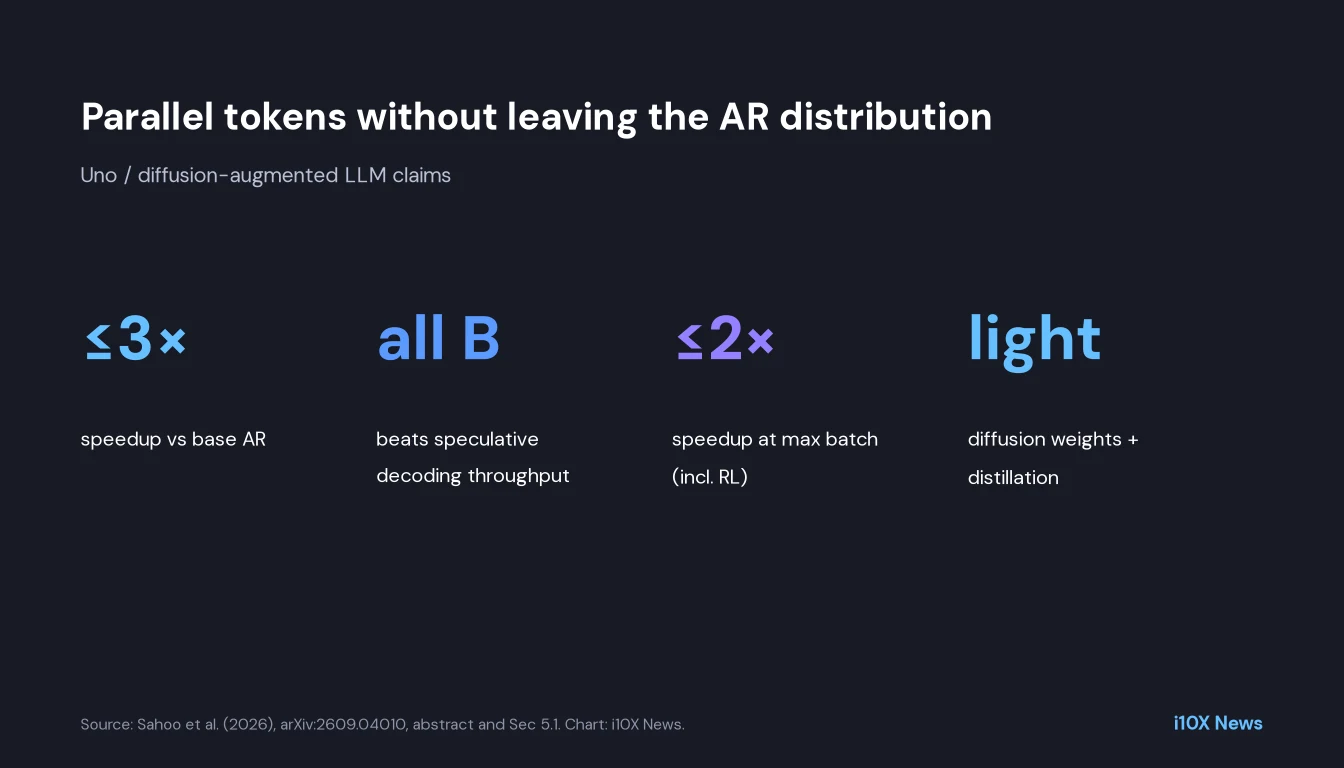
- The finding: Diffusion-augmented LLMs keep an AR distribution but draw multiple tokens in parallel via lightweight diffusion weights trained by Diffusion Distillation.
- Throughput: Uno exceeds leading speculative-decoding methods at every batch size and reaches up to 3× speedups over the base AR model, including at max device batch.
- Training too: Up to 2× speedup at the largest AR-supported batch size for inference and end-to-end RL training.
Autoregressive decoding is sequential and slow. Researchers from the Institute of Foundation Models, UIUC, Cornell Tech, Harvard and Cerebras introduce models that still define an AR distribution — so quality targets stay the same — while using discrete diffusion to emit several tokens at once.
What the study shows
AR weights train with standard next-token prediction; diffusion weights are a light add-on. Ψ-Spec samplers enable lossless acceleration and test-time scaling at fixed context without a separate draft model. Pretraining recipes span 21.9T tokens at 8K up through staged extensions to 512K.
- Negligible distillation overhead: Diffusion Distillation slots into existing pipelines.
- No separate drafter: Unlike speculative decoding’s draft+verify stack.
Why it matters: lossless is the bar
Many accelerators trade quality. Keeping the AR distribution makes “faster” mean the same model, not a cheaper approximation.
Method in brief
Decoupled AR and diffusion parameters; Ψ-Spec sampling family; throughput vs speculative decoding across batch sizes.
What remains open
- Hardware/batch specifics: Peak speedups depend on device limits.
- Implementation maturity: New class of models — tooling still catching up.
Context
Related decoding acceleration in Efficiency & Training.
What it means for serving and RL
- Consider diffusion heads: Especially when speculative decoding saturates.
- Accelerate RL rollouts: 2× at max batch is training-relevant.
- Demand lossless checks: Match AR distribution, not only BLEU.
About the analysis
Researched and written with AI assistance under the editorial responsibility of the i10X News team. The title image is an AI-generated illustration. Read our AI Use Policy. Spotted an error? Request a correction.
This article is based on the full text of the preprint “Unlocking Lossless Speedups in LLMs via Discrete Diffusion” (arXiv:2609.04010v1, submitted September 3, 2026). All numbers are taken from the paper’s text, tables and figures; i10X did not rerun the experiments. The chart was redrawn by i10X from abstract and Sec 5.1 of the paper, which is published under a CC BY 4.0 license.
i10x Perspective
Speculative decoding made parallelism mainstream by verifying drafts. Diffusion-augmented LLMs ask whether the draft should live inside the same model. If the 3× claims generalize, the sequential tax on LLM decoding finally has a serious in-distribution rival.