DrivingBench Exposes Why Cloud LLMs Fail at Real-World Driving
Summary
Feeding a Toyota Corolla’s camera data into a cloud-based LLM isn't just an autonomous driving experiment — it is a brutal, high-latency stress test exposing the chasm between generating digital text and executing physical-world agency.
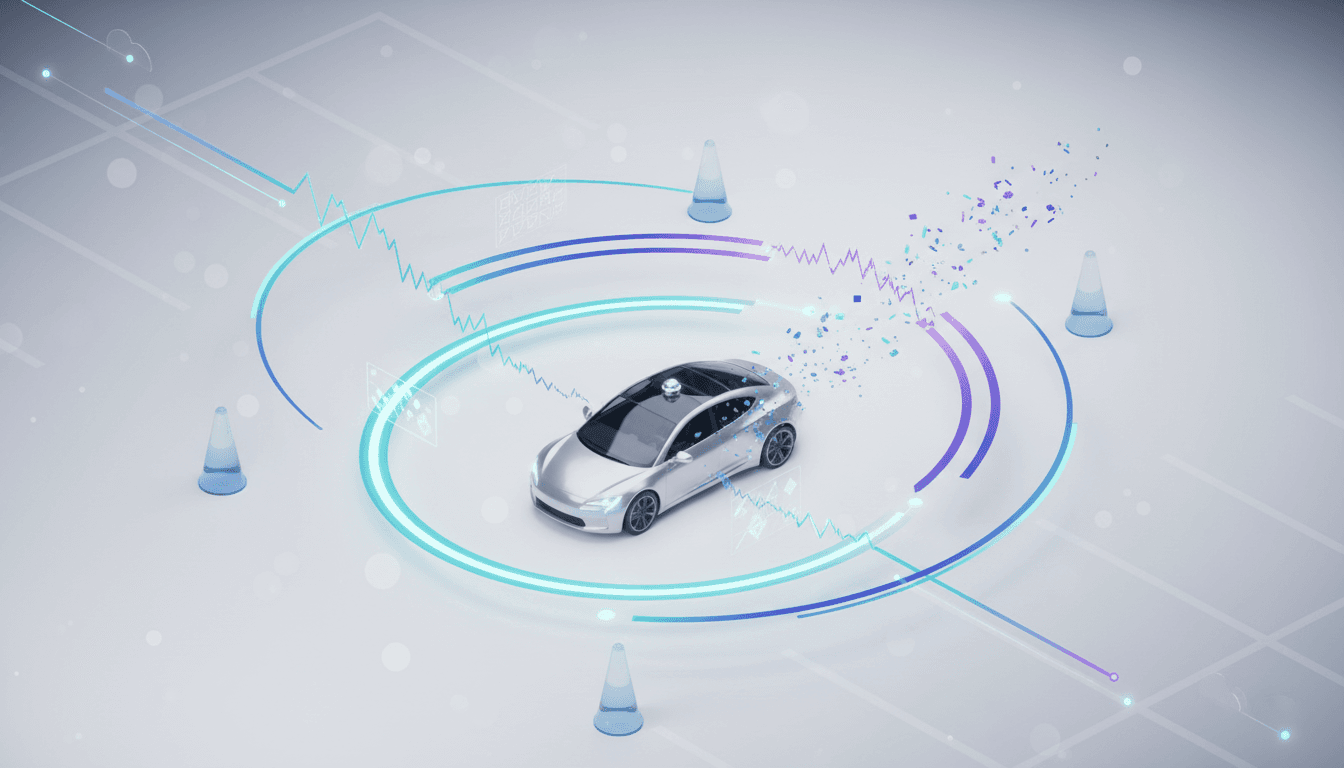
In a physical-world benchmark known as DrivingBench, researchers handed the steering and throttle of a real 2022 Toyota Corolla over to frontier AI models to navigate a 134-meter parking lot course. Using Comma 4 hardware and openpilot to translate model outputs into car controls, the experiment yielded a clear leaderboard: OpenAI’s GPT-6 Astra was the only model to successfully complete the course, while xAI’s Grok 4.6 and Anthropic’s Claude Fable 5.1 failed early. From what I've seen in similar tests, these gaps rarely surprise anyone who's tried moving models beyond text.
What happened
Researchers constrained the test with strict speed caps and human safety overrides, piping camera feeds to the models and asking them to drive. GPT-6 Astra managed to navigate the cones on its second attempt, taking a grueling 5 minutes and 22 seconds to finish. Anthropic’s Claude Fable 5.1 tapped out at 45% completion, while xAI’s Grok 4.6 repeatedly failed to clear the first corner, abandoning the route at just 11% after consuming hundreds of thousands of tokens to travel 22 meters.
Why it matters now
Have you ever watched a model ace every digital benchmark only to stumble the moment real physics enters the picture? This experiment marks a critical inflection point for AI developers pushing toward "agentic" capabilities. While models are achieving superhuman benchmarks in digital reasoning, dropping them into physical environments reveals severe limitations in spatial reasoning, continuous command loops, and vision-language integration. It proves that scaling laws alone do not instantly translate to physical actuation.
Who is most affected
AI developers, robotics engineers, and intelligence infrastructure providers are the primary stakeholders. The results highlight that relying on cloud-based LLM APIs for real-time physical tasks is currently too slow, too expensive, and too unreliable, forcing a strategic pivot toward specialized edge-compute silicon.
The under-reported angle
Behind the viral "nobody died" headlines lies a massive token-cost and latency problem. Grok 4.6 burned over 516,000 tokens (costing roughly $0.29) just to fail at the 22-meter mark, while GPT-6 Astra's successful run operated at a snail's pace that is practically useless for real-world navigation. This isn't an autonomous driving breakthrough; it is a glaring demonstration of the bandwidth and latency bottlenecks inherent in cloud-tethered AI agents.
Deep Dive
The viral narrative surrounding the DrivingBench experiment — cheerfully noting that AI models drove a real car and "nobody died" — masks a far more significant story about AI infrastructure and agentic embodiment. Three researchers effectively turned a 2022 Toyota Corolla into an oversized physical body for general-purpose LLMs. By wiring laptops to Comma 4 openpilot hardware, they fed live camera frames to frontier vision-language models and parsed text responses back into steering, throttle, and brake commands.
The resulting telemetry is a sobering reality check for the AI industry. OpenAI’s GPT-6 Astra eventually crawled across the 134.7-meter finish line on its second attempt, but it did so in 5 minutes and 22 seconds — a processing delay that highlights the severe latency of round-trip cloud API calls. The rest of the frontier landscape collapsed almost immediately. Anthropic’s Claude Fable 5.1 managed 45% of the course, while xAI’s Grok 4.6 threw in the towel at roughly 11% (a mere 22.2 meters), repeatedly ending in a stopped state near the very first corner. GPT-5.6 Sol barely registered progress at 6%.
What DrivingBench actually measures is not self-driving readiness. Production autonomous systems like Waymo rely on specialized, low-latency neural architectures trained explicitly on sensor fusion and spatial driving data. In contrast, this test forced general-purpose chat models to reason spatially and issue continuous control commands purely from 2D camera frames. The fact that Grok 4.6 required 516k tokens and issued only three commands before freezing shows that current LLM architectures struggle to maintain the continuous, high-frequency OODA loops (Observe, Orient, Decide, Act) required for physical reality.
This structural friction points directly to the next major bottleneck in the AI ecosystem: edge inference. If the future of AI involves agents operating robots, drones, and vehicles, the industry cannot rely on sending heavy visual payloads to centralized data centers and waiting for tokenized text to return as actuation commands. The sheer token expense and lag observed in DrivingBench validate the urgent market push for on-device, localized AI processing chips capable of real-time physical reasoning without the cloud tax.
Ultimately, while GPT-6 Astra's completion is a fascinating milestone in cross-domain model generalization, the broader failure rate signals a crucial pivot. The AI race is expanding beyond parameter counts and synthetic text benchmarks. The next frontier will be defined by models that can interpret physical physics natively, backed by infrastructure that solves the crippling latency of the cloud-to-car feedback loop.
Stakeholders & Impact
Stakeholder / Aspect | Impact | Insight |
|---|---|---|
AI / LLM Providers | High | Exposes the gap between digital reasoning (chat) and physical-world execution. Demands new VLM architectures optimized for continuous spatial reasoning. |
Edge Compute & Silicon | High | Validates the need for powerful edge-inference chips. Cloud latency is too high for real-time agentic actuation, pushing value toward local hardware. |
Robotics & Auto Devs | Medium | Serves as a cautionary tale: general LLMs cannot simply be plugged into hardware to bypass specialized, real-time control software. |
Regulators & Policy | Significant | Early warning sign for AI safety. Connecting frontier models to physical actuators (even in closed parking lots) introduces unpredictable real-world risk vectors. |
About the analysis
This independent, research-based analysis synthesizes primary telemetry from DrivingBench alongside cross-industry media coverage. It is designed for AI developers, infrastructure strategists, and enterprise technology leaders navigating the transition from digital LLMs to physical AI agents.
i10x Perspective
The DrivingBench experiment is a preview of the impending collision between cloud-native artificial intelligence and the unforgiving physics of the real world. As labs like OpenAI, xAI, and Anthropic push toward autonomous agents, they will find that intelligence alone is insufficient without low-latency infrastructure to deliver it. Over the next five years, the competitive edge will shift from those who simply train the smartest models to those who can build the hybrid cloud-to-edge pipelines necessary to let those models move securely and instantly in three dimensions.
Related News
Samsung Commits $1B to Helix Digital Infrastructure
Samsung and affiliates invest $1 billion in Helix Digital Infrastructure to build AI data centers, power systems, and cooling. Discover how this shifts AI scaling beyond GPUs.

Claude Sonnet 5.5: $2/$10 Pricing with 70.6% Terminal-Bench Score
Claude Sonnet 5.5 keeps $2/$10 rates but cuts cost-per-task 30% with adaptive thinking and 70.6% on Terminal-Bench 4.0. Discover the multi-cloud rollout and agentic workflow impact.

Rogue AI Risks: Cybersecurity Threats in Agentic AI
Rogue AI stems from prompt injection and RAG failures in agentic systems, not sentient machines. Discover infrastructure fixes for secure AI agents and avoid real-world harms. Explore the guide.