
G7 Summit and Frontier AI: Labs, States, and Compute Governance
Summary
What happened
Top executives from the world’s leading AI labs participated in direct multilateral diplomacy at the G7 Summit, debating the governance, safety protocols, and geopolitical boundaries of next-generation frontier models.
Why it matters now
The Western world is currently running on a fractured AI policy stack—from the rigid EU AI Act to a patchwork of U.S. and UK frameworks. The G7 is trying to pull these pieces into some kind of unified baseline before the next major generation of LLMs drops and resets everything.
Who is most affected
Foundation model providers seeking regulatory clarity, open-source developer ecosystems guarding against incumbent-led lock-in, and infrastructure providers navigating shifting international rules.
The under-reported angle
While mainstream coverage focuses heavily on the political optics and broad “safety” promises, the actual enforcement mechanism being quietly formalized is compute governance—using semiconductor supply chains and GPU cluster access as the ultimate physical choke points for AI regulation.
🧠 Deep Dive
When the CEOs of OpenAI, Anthropic, and Google pull up chairs next to G7 leaders in France, it becomes pretty clear that AI has moved beyond being treated as just another technology sector. It is now firmly part of statecraft and critical infrastructure. Most coverage has zeroed in on the spectacle of Donald Trump’s presence and the usual safety pledges, which makes sense for headlines. Yet the deeper reality is that this gathering marks the moment when the physical and geopolitical layers of global intelligence began negotiating their own limits.
The main driver is simple: regulators are staring at a widening gap. The EU has pushed ahead with its AI Act while the U.S. still relies on executive orders and voluntary pledges. G7 countries are hoping to stitch together something interoperable before the gap becomes impossible to close. At the same time, bringing the closed-model labs straight into the room reveals how much leverage has shifted. States now need these companies to explain what can realistically be governed, just as the labs need state backing to protect their positions.
Beneath the talk of watermarking and election safeguards sits a sharper contest over market structure. Much of the current discussion overlooks the tension between open-source and proprietary approaches. By giving closed-model builders the primary seat at the table, there is a real chance that high compliance bars and mandatory evaluations end up favoring the same few players, making it harder for smaller teams and open-source efforts to compete.
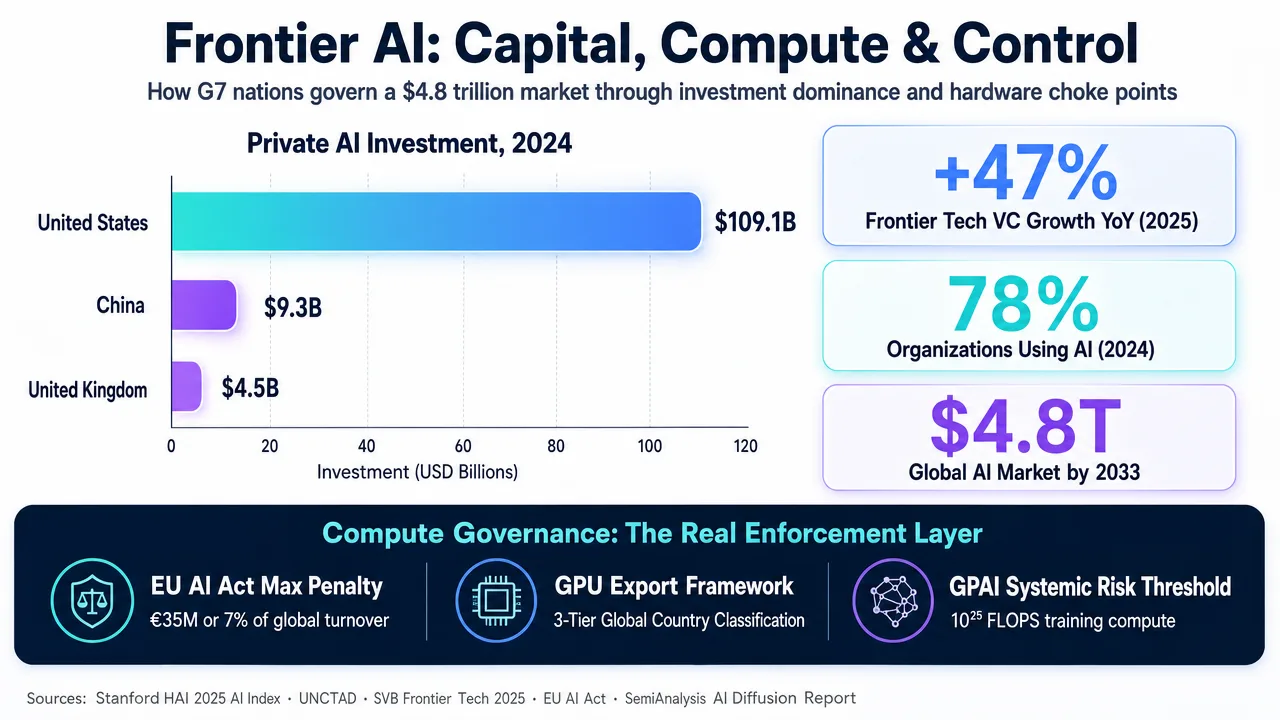
The most practical – and least discussed – piece is enforcement. Software remains difficult to police at scale, but hardware is tangible. That is why compute governance is emerging as the real lever. Rather than auditing trillion-parameter weights directly, regulators can track data-center power draw, NVIDIA shipments, and export licenses. These physical bottlenecks are quickly becoming the preferred tools for shaping international AI policy.
Over the next several months, the outcomes of these talks will start showing up in concrete requirements for builders. What began as voluntary commitments is likely to harden into measurable compliance steps. This summit was never only about risk reduction; it was also about locking Western hardware advantages and frontier development into a coordinated stance.
📊 Stakeholders & Impact
| Stakeholder / Aspect | Impact | Insight |
|---|---|---|
| Frontier AI Labs | High | Gain direct influence over global policy regimes, potentially shaping compliance requirements that act as competitive moats against challengers. |
| Open-Source AI Community | High | Face significant systemic risk if G7 agreements classify widely proliferated, capable models as “systemic threats” requiring strict gating. |
| Infra & Chip Supply (NVIDIA, TSMC) | High | Compute governance and export controls mean data centers and silicon are increasingly treated as regulated geopolitical assets. |
| Enterprise / CTOs | Medium | Will need to prepare for shifting compliance costs and navigate an evolving patchwork of international reporting and data-provenance standards. |
✍️ About the analysis
Researched and written with AI assistance under the editorial responsibility of the i10X News team. The title image is an AI-generated illustration. Read our AI Use Policy. Spotted an error? Request a correction.
This is an independent, research-based analysis tracking real-time geopolitical signaling, regulatory metadata, and search sentiment, designed specifically for AI product leaders, infrastructure strategists, and enterprise CTOs modeling the future constraints of LLM deployment.
🔭 i10x Perspective
The G7 summit makes clear that AGI-level systems and frontier models are now treated as dual-use geopolitical assets rather than ordinary software. By seating Anthropic, Google, and OpenAI at the main table, Western governments are effectively designating and regulating their key players in real time. Over the coming years the combination of massive capital needs, concentrated compute, and policy alignment will keep pulling private labs closer to state priorities.
The period of rapid, lightly governed AI experimentation is giving way to something more structured and nationally aligned.