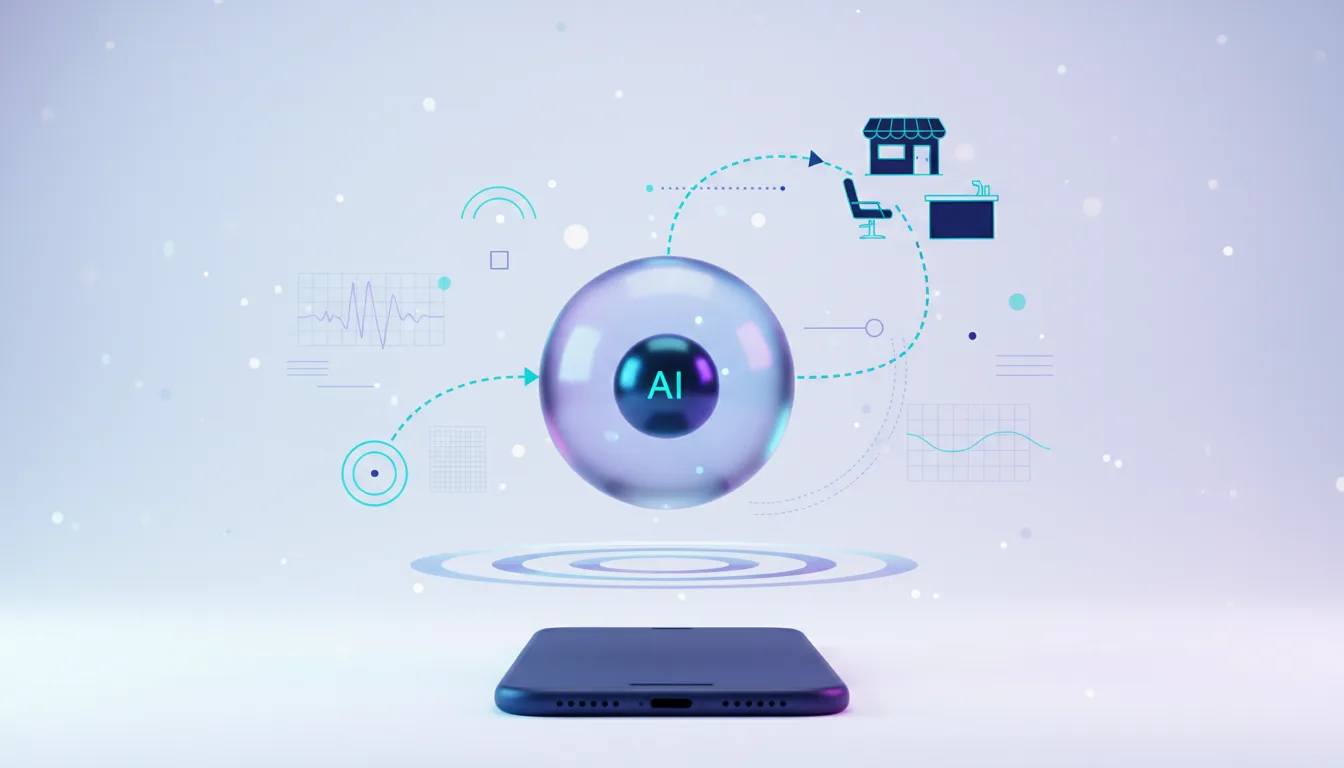
Google is crossing the frontier from passive chatbots to active voice agents with “Call for Me”, a new feature that lets the Gemini LLM autonomously call businesses on behalf of Pixel 11 users to handle routine tasks and inquiries.
Quick Take
- Summary: Google is rolling out an experimental feature called “Call for Me” that allows its Gemini AI to place phone calls to businesses, navigate conversations, and relay outcomes back to the user. Initially restricted to US-based Pixel 11 owners with a paid Gemini subscription, the tool includes strict privacy guardrails, live monitoring, and manual takeover options.
- What happened: Through the Phone by Google beta, Gemini can now act as an autonomous voice agent. Users provide a prompt—such as checking inventory or booking a reservation—and Gemini confirms the data it will share before dialing. The LLM executes the call while providing a real-time transcript, allowing users to monitor the exchange or seamlessly interrupt and take over the line.
- Why it matters now: This marks a major commercial milestone in the shift from conversational AI to agentic AI. By allowing an LLM to interact directly with the legacy, unformatted analog world (the public telephone network), Google is testing both real-time multimodal inference capabilities and public tolerance for AI-generated synthetic voices conducting everyday commerce.
- Who is most affected: Everyday consumers gain significant time savings, while Small and Medium Businesses (SMBs) will now find themselves unwittingly interacting with LLMs. Apple, Meta, and OpenAI will be closely watching the rollout as the race for real-world agentic deployment accelerates.
- The under-reported angle: While consumer tech coverage focuses on the convenience for Pixel owners, the massive downstream friction point is on the receiving end. There are currently no standardized etiquette protocols, disclosure mandates, or API routing mechanisms for local businesses to efficiently handle—or intelligently deflect—a sudden influx of AI-originated inbound calls.
Deep Dive
Have you ever wondered what happens when an AI steps out of the screen and picks up the phone? The release of Gemini’s “Call for Me” feature is not just a smartphone OS update; it is a live stress test for agentic AI. For years, LLMs have been confined to browser tabs, IDEs, and app sandboxes. By granting Gemini the ability to initiate outbound calls and dynamically navigate human conversations, Google is bridging the gap between digital intelligence and legacy physical infrastructure. The phone network is essentially serving as a massive, analog API for the real world—allowing Gemini to interact with local businesses that lack digital booking systems or modern integrations.
This rollout also acts as a strategic indicator of the immense compute requirements underlying real-time voice agents. It is not a coincidence that “Call for Me” is highly gated—available only to users with the latest Pixel 11 hardware and a premium Gemini Advanced subscription. This ecosystem lock-in points to the heavy, low-latency inference demands required to process natural language, synthesize voice, and react to unpredictable human responses (or IVR loops) without the awkward latency that typically plagues cloud-based voice bots. Google is leveraging its proprietary silicon and premium tier to subsidize the high cost of this inference.
If this concept sounds familiar, it is the spiritual successor to Google Duplex, the highly controversial 2018 experiment that mimicked human disfluencies (“umms” and “ahhs”) to trick operators. Google has clearly learned from the Duplex backlash. The current competitor coverage and Google’s own support documentation heavily emphasize rigid, almost bureaucratic privacy guardrails. Users are forced through pre-call consent flows confirming exactly what data Gemini is authorized to share, and they are given real-time monitoring and “takeover” controls. Transparency is the new default, driven by an era of heightened regulatory scrutiny around AI impersonation and two-party consent laws.
Yet, a glaring gap remains in the ecosystem’s readiness: the SMB recipient. While consumer-facing PR highlights the time saved for the caller, local restaurants, salons, and clinics are entirely unprepared for a surge of LLM-driven inquiries. How do businesses identify an AI agent? How do they handle hallucinations or miscommunications over the phone? As adoption scales, this friction will inevitably drive a new sub-industry in AI-native telephony, where local businesses deploy their own AI receptionists to negotiate directly with consumer LLMs, effectively cutting human dialogue out of routine commerce entirely. From what I’ve seen, that shift feels closer than most expect.
Stakeholders & Impact
| Stakeholder / Aspect | Impact | Insight |
|---|---|---|
| AI / LLM Providers | High | Google is setting the baseline for agentic real-world interaction, forcing OpenAI and Apple to accelerate their own autonomous voice capabilities. |
| Local Businesses (SMBs) | High | Expected to face a new operational paradigm. Staff must learn to interact with AI agents, driving eventual demand for “AI-to-AI” booking protocols. |
| Pixel Users / Consumers | Medium | High utility for time-saving and accessibility (e.g., phone anxiety), though gated behind expensive hardware and subscription tiers. |
| Regulators & Telecom | Significant | Triggers immediate questions around two-party consent, synthetic voice disclosures, and potential spam/network congestion from automated LLM agents. |
About the analysis
Researched and written with AI assistance under the editorial responsibility of the i10X News team. The title image is an AI-generated illustration. Read our AI Use Policy. Spotted an error? Request a correction.
This independent, research-based analysis is synthesized from current official Google Support documentation, privacy guidelines, and tech industry reporting. It is designed for AI developers, product managers, and infrastructure strategists tracking the evolution from conversational models to autonomous digital agents.
i10x Perspective
Gemini’s “Call for Me” signals the beginning of the end for the traditional human-to-human transactional phone call. We are watching LLMs transition from tools that draft our emails to agents that execute our errands in real time. Over the next five years, the most fascinating AI infrastructure challenge won’t just be generating the voice—it will be building the digital routing layers so that consumer agents like Gemini can seamlessly handshake with enterprise agents, bypassing the human ear entirely.