Quick Take
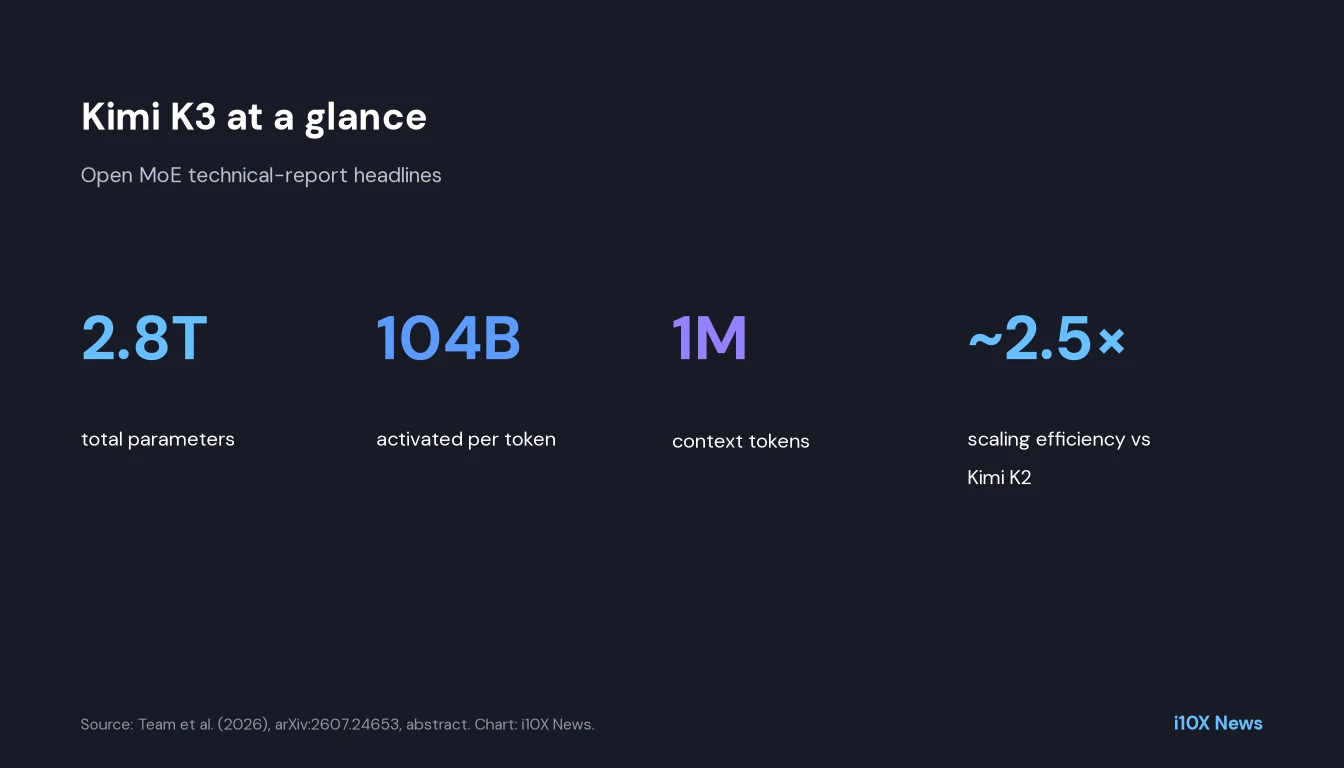
- The finding: Kimi K3 is a 2.8T-parameter MoE with 104B activated parameters, native vision and a 1M-token context window.
- Scaling win: Kimi Delta Attention, Attention Residuals, Stable LatentMoE (16 of 896 experts) and refined recipes yield about 2.5× overall scaling efficiency versus Kimi K2.
- Where it stands: Authors say it reaches frontier-level open performance but still trails Claude Fable 5 and GPT-5.6 Sol overall.
Moonshot’s Kimi team releases the K3 technical report: a trillion-scale open MoE aimed at long-horizon coding, agents, knowledge, reasoning and vision.
What the study shows
Infrastructure co-design covers KDA training, balanced expert-parallelism, million-token agentic RL with persistent rollout/sandbox state, and deployment innovations. Post-training uses RL across general, agentic and coding domains with multiple reasoning-effort levels.
- Vision affordability: 2×2 pixel-shuffle cuts visual tokens 4×, supporting up to 3584×3584 within 1M context.
- Optimizer: Per-head Muon for matrix parameters, following K2.
- OOD scaling curves: Held-out OOD validation shows the ~2.5× efficiency claim.
Why it matters: open scale with systems co-design
Frontier open models increasingly live or die on training/serving systems as much as architecture. K3 foregrounds that stack.
Method in brief
Architectural + data + RL + infra co-design; extensive author evaluations.
What remains open
- Vendor report: Independent benches may differ.
- Still behind top closed models: Authors acknowledge the gap to Claude Fable 5 and GPT-5.6 Sol.
Context
Related open MoE reports in Efficiency & Training.
What it means for open-weight users
- Plan for 1M-context agents: Infra must match.
- Use multi-effort decoding: Post-training exposes effort levels.
- Benchmark against closed SOTA: Do not stop at open-only leaderboards.
About the analysis
Researched and written with AI assistance under the editorial responsibility of the i10X News team. The title image is an AI-generated illustration. Read our AI Use Policy. Spotted an error? Request a correction.
This article is based on the full text of the preprint “Kimi K3: Open Frontier Intelligence” (arXiv:2607.24653v2, submitted July 27, 2026). All numbers are taken from the paper’s text, tables and figures; i10X did not rerun the experiments. The chart was redrawn by i10X from abstract of the paper, which is published under a CC BY-NC-ND 4.0 license.
i10x Perspective
K3’s most interesting number may be 2.5× — not another leaderboard row, but a claim that architecture plus systems made each FLOP go further than K2. That is the open-frontier race that actually matters for labs without infinite clusters.