
LLM Market: From Benchmark Superiority to Cost Efficiency
Summary
The LLM market is undergoing massive structural compression, shifting the battleground from peak benchmark superiority to aggressive cost efficiency and unit economics. As providers like DeepSeek introduce disruptive pricing models against OpenAI’s ChatGPT and Google’s Gemini, the focus is pivoting entirely toward normalized quality-per-dollar metrics and multi-model routing.
What happened
A three-way pricing war has solidified between closed-ecosystem giants (OpenAI, Google) and aggressive, highly optimized challengers (DeepSeek). While official pricing pages tout increasingly cheaper per-million-token rates, aggregator platforms like OpenRouter are facilitating a new era where developers programmatically switch models based on live cost and latency matrices.
Why it matters now
Intelligence is being commoditized into a raw utility. For AI startups and enterprise infrastructure groups, compute cost is the ultimate barrier to scale. The ability to deploy generative AI no longer relies on simply accessing the smartest model, but on perfectly matching workload complexity—like RAG (Retrieval-Augmented Generation), batch ETL, or autonomous agents—to the cheapest model capable of clearing the required cognitive threshold.
Who is most affected
CTOs, AI FinOps teams, and backend developers are directly on the frontlines. At the same time, AI infrastructure providers and cloud hyper-scalers are forced to rethink their deployment strategies as token margins compress.
The under-reported angle
Hidden overhead is destroying enterprise ROI. While the industry fixates on base token costs, actual systemic costs—driven by function-calling inflation, long-context retrieval overhead, unmeasured latency disruptions, and prompt retries—are massively inflating infrastructure bills beyond what standard pricing sheets suggest.
🧠 Deep Dive
The commercialization of Large Language Models has officially entered its FinOps era. We’ve moved past the initial shock-and-awe of absolute capabilities (like GSM8K or MMLU scores) and into the grueling reality of API economics. As DeepSeek aggressively undercuts the baseline costs established by OpenAI and Google, the fundamental question for enterprises has shifted: how do you normalize model benchmarks not by pure intelligence, but by quality-per-dollar?
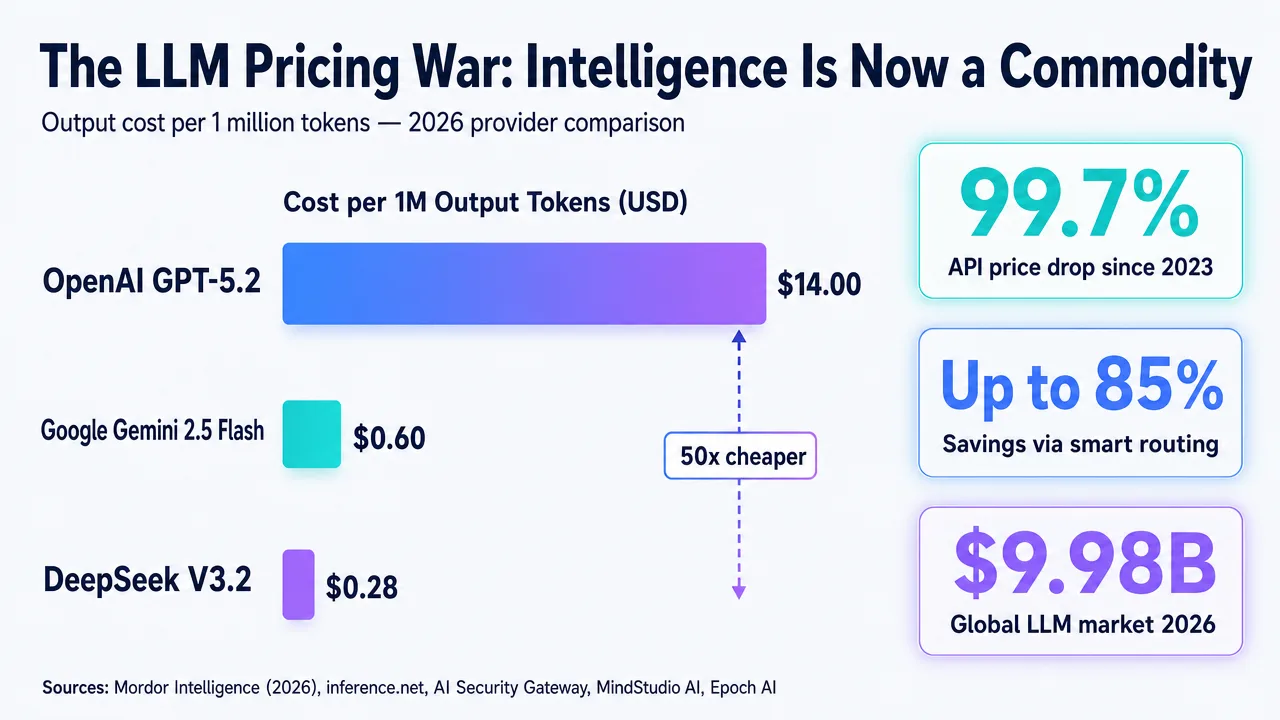
If you look across the fragmented landscape of official provider documentation—from OpenAI’s tier systems to Gemini’s Vertex AI quotas—the actual Total Cost of Ownership (TCO) is often obscured. Frontline developers are realizing that advertised per-million-token rates are only a fraction of the story. Modern AI architectures rely on agentic loops and deep Retrieval-Augmented Generation, which introduce vicious hidden costs. Context window inflation, high retry rates for failed JSON outputs, and the latency-driven throughput loss of long-context streaming are actively destroying expected unit economics.
This friction has fueled the explosion of aggregator layers like OpenRouter, which treat AI models less like distinct software products and more like a fluid commodities exchange. Engineering teams are increasingly adopting adapter layers and programmatic routing to escape vendor lock-in. Instead of defaulting to GPT-4 or Gemini Pro for every task, modern pipelines dynamically route simple data-extraction tasks to cheaper, open-weight equivalents, while reserving premium, high-latency models strictly for complex reasoning.
That said, this multi-vendor reality introduces massive compliance and SLA (Service Level Agreement) blind spots. Procurement teams are struggling to build unified decision matrices that balance token pricing against data retention policies, PII handling, and guaranteed uptime. A model that is 10x cheaper per token is a liability if its rate limits cause severe queueing delays in a customer-facing production environment.
Ultimately, this pricing war shapes the underlying hardware and infrastructure race. As models become cheaper, utilization spikes, placing immense strain on data center capacity, GPU supply, and grid power. The ultimate winners in this ecosystem will not necessarily be the ones with the largest parameter count, but the developers who master throughput engineering—leveraging batch inference, optimal context utilization, and ruthless cost segmentation to build sustainable AI applications.
Stakeholders & Impact
- AI / LLM Providers | Impact: High | Insight: Forced into a margin-compression war; competitive moats are shifting from raw capability to ecosystem integration and inference efficiency.
- Enterprise FinOps & CTOs | Impact: High | Insight: Must implement strict workload-specific playbooks to avoid runaway costs driven by hidden token inflation and long-context abuse.
- Developers & Engineers | Impact: High | Insight: Architectural changes are mandatory: adopting multi-model adapter layers, dynamic routing, and batch inference to optimize quality-per-dollar.
- Hyperscalers & Hardware | Impact: Medium–High | Insight: Plunging token costs drive massive increases in API volume, keeping demand for GPU compute and data center capacity near maximum limits.
About the analysis
Researched and written with AI assistance under the editorial responsibility of the i10X News team. The title image is an AI-generated illustration. Read our AI Use Policy. Spotted an error? Request a correction.
This is an independent, research-based analysis synthesizing current market pricing dynamics, API documentation, and aggregator routing behaviors across major AI providers. It is designed for CTOs, AI FinOps teams, and engineering leaders who are constructing scalable, cost-efficient LLM pipelines.
i10x Perspective
From what I’ve seen, we’re watching the rapid utility-ification of artificial intelligence. As pricing structures collapse toward the marginal cost of compute, the defensive moats of OpenAI and Google will depend entirely on workflow lock-in—driving users into their broader data and cloud ecosystems. In the next five years, the concept of manually selecting a single AI model will feel archaic; intelligence will be routed automatically through infrastructure layers optimizing for price, latency, and compliance in real-time. The core tension to watch is whether open-weight challengers can sustain this race to the bottom, or if inference economics will eventually consolidate the market back into the hands of the largest compute monopolies.