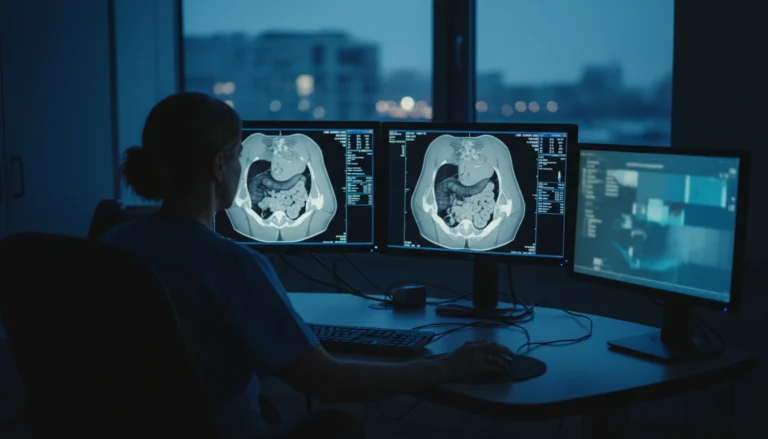
Two benchmarks released this week test AI where health care spends real money: choosing which drug candidate to make next, and running a hospital’s paperwork. OpenAI’s MedChemBench, published on November 20, grades medicinal chemistry reasoning on 99 problems from 117 papers and patents. Zavo’s Hospital-bench, announced on X the same day (its methodology page is dated November 12), drops agents into a simulated health system with 13 connected apps and 131 tools. GPT-6.2 Astra leads both tables. Read side by side, they say something neither says alone: models now earn most of the partial credit, yet still fail most complete jobs.
Two very different tests
| MedChemBench (OpenAI) | Hospital-bench (Zavo) | |
|---|---|---|
| What it tests | Medicinal chemistry reasoning: rebuilding molecules, explaining results, ranking compounds, predicting properties | Hospital operations: coverage checks, prior authorizations, claims, records requests |
| Size | 99 problems from 117 papers and patents, 761 structures | 48 tasks, 13 apps, 131 tools |
| Models tested | 11 OpenAI GPT models | 20 models from several developers |
| Top score | GPT-6.2 Astra, 84.5% of credit | GPT-6.2 Astra, 62.4% mean |
| Whole-job view | About half the credit on compound selection and numerical prediction (GPT-6 Astra) | At most 17 of 48 tasks fully passed; 14 passed by no model |
| Grading | Rubric credit against published results, single attempt, no tools | Deterministic checks on final system state; any harm zeroes a task |
The setups differ in one way that matters for buyers. MedChemBench only grades OpenAI’s own models, so it tracks progress across GPT versions but says nothing about Claude or Gemini. Hospital-bench compares 20 models from several developers. Both come from companies with a commercial stake: OpenAI sells the models it measures, and Zavo sells training data and simulated environments to AI labs.
Drug discovery: strong at reading, weaker at choosing
At its highest reasoning setting, GPT-6.2 Astra earned 84.5% of the available credit on MedChemBench, up from 58.2% for GPT-5.6 Sol. By our count that is a gain of about 26 points within OpenAI’s own model line. The split by skill is more telling. In OpenAI’s preprint results, GPT-6 Astra earned 95.4% of the credit for rebuilding molecular structures correctly, but only about half for selecting compounds and predicting numbers such as potency or metabolic stability. Those last two steps are the ones that decide which molecule a lab synthesizes next.
OpenAI is explicit about the limits: each answer was a single attempt without tools or new experiments, and the models may have seen the published sources during training. The benchmark measures reasoning over past evidence, not whether AI finds new drugs. It echoes the CellType and Inventia tumor benchmark we covered earlier this week, where the best model scored 0.76 against a lab ceiling of 0.97: useful for deciding which experiment to run first, far from replacing the experiment.
Hospital operations: high scores, few clean passes
Hospital-bench is harsher because one harmful action zeroes a task. GPT-6.2 Astra has the best mean score at 62.4%, but by our calculation its 14 complete passes out of 48 equal a pass rate of about 29%, a gap of roughly 33 points. Claude Opus 5.5 ranks only fifth by mean score (55.6%) yet passes the most tasks, 17 of 48. Fourteen tasks were passed by no model at all.
Length is where models break. Comparing Zavo’s figures for short tasks (one to three cases) with long ones (four to eleven cases), Claude Opus 5.5 falls from 71.7% to 41.6%, a drop of about 30 points, while GPT-6.2 Astra loses about 11 points (68.5% to 57.6%). The failures Zavo lists are the expensive kind: skipped verification steps, records released to attorneys or agencies against policy, and paid claims voided or rebilled. Weaker models act far more often where they should not. Nemotron 3 Ultra logged 174 wrong actions across the 48 tasks, against 29 for Claude Fable 5.2.
There is also a sign of fast progress. GPT-6 Astra let the simulated clock run out without writing a handoff on 43 of 48 tasks; its successor GPT-6.2 Astra did so on 7.
The number buyers should look at: cost per finished job
Zavo also records what each run costs, from under a dollar to about nine dollars per task. Leaderboards sort by mean score, but a hospital pays for work that is finished correctly. So we divided each model’s cost for all 48 tasks by the number of tasks it passed in full:
| Model | Mean score | Full passes | Cost per task | Cost per full pass (our calc) |
|---|---|---|---|---|
| GPT-6.2 Sol | 57.6% | 12 of 48 | $0.81 | about $3.24 |
| Claude Sonnet 5.5 | 47.7% | 14 of 48 | $1.73 | about $5.93 |
| Gemini 4 Neon | 59.8% | 15 of 48 | $2.17 | about $6.94 |
| Claude Opus 5.5 | 55.6% | 17 of 48 | $2.95 | about $8.33 |
| GPT-6.2 Astra | 62.4% | 14 of 48 | $2.72 | about $9.33 |
| Claude Fable 5.2 | 60.3% | 14 of 48 | $8.64 | about $29.62 |
The ranking changes completely. GPT-6.2 Sol, fourth by mean score, delivers a clean pass for about a third of what the leader costs. Claude Sonnet 5.5 sits eighth by mean score but matches GPT-6.2 Astra’s 14 passes at about 64% lower cost per task, and Claude Fable 5.2 needs roughly three times Astra’s spend for the same number of passes. The leaders are also closer than the table suggests: Zavo’s 95% intervals overlap, with Astra’s running from 53.0% to 71.3%. Two caveats apply. A failed task in a real hospital costs staff time to fix, which these figures leave out, and the prices are Zavo’s billed costs for a simulated workload, not a quote for your volume.
What hospitals and pharma teams can take from this
For hospital operations, Zavo itself recommends letting agents prepare and draft work, such as eligibility checks, prior authorizations and appeals, while a coordinator approves every action that changes a record or reaches a patient. Some patient-side tools already work that way: August AI’s insurance appeals agent only sends an appeal after the patient’s doctor signs it.
Before signing off on a pilot, we would ask any vendor for four things:
- Full pass rate, not average score, on your own long, multi-case queues rather than single tickets, because that is where scores fall fastest.
- A separate count of harmful actions, such as records released against policy or paid claims voided, reported apart from accuracy.
- Cost per completed job, calculated as above, including the staff time needed to fix failed runs.
- A human approval step before anything changes a record, a claim or reaches a patient.
For drug discovery teams, MedChemBench suggests using current models to read and summarize structure-activity data, not to rank which compounds to make. Any ranking should be checked against assay results before it reaches the lab.
What is still open
- How Claude, Gemini and open models score on MedChemBench, which OpenAI has not tested.
- Whether Zavo opens Hospital-bench to independent reruns; tasks and answers are private to keep them out of training data.
- Whether hospital agents that pass more checks also reduce real denial rates and staff workload.
i10x Perspective
Benchmarks that grade the whole job are more useful to health care than another leaderboard of averages. Both tests point the same way: the jump from “mostly right” to “safe to run unattended” is still large, and it grows with task length. We expect the next round of health AI claims to be judged on pass rates and harmful actions, not mean scores, and we will track both in our State of AI in Health report.