Quick Take
- What happened: Nano Banana 2 — a new, unannounced AI image generation model — has surfaced as a free-tier offering inside the Artlist ecosystem. Early reports suggest it runs on Google’s Gemini architecture under the hood.
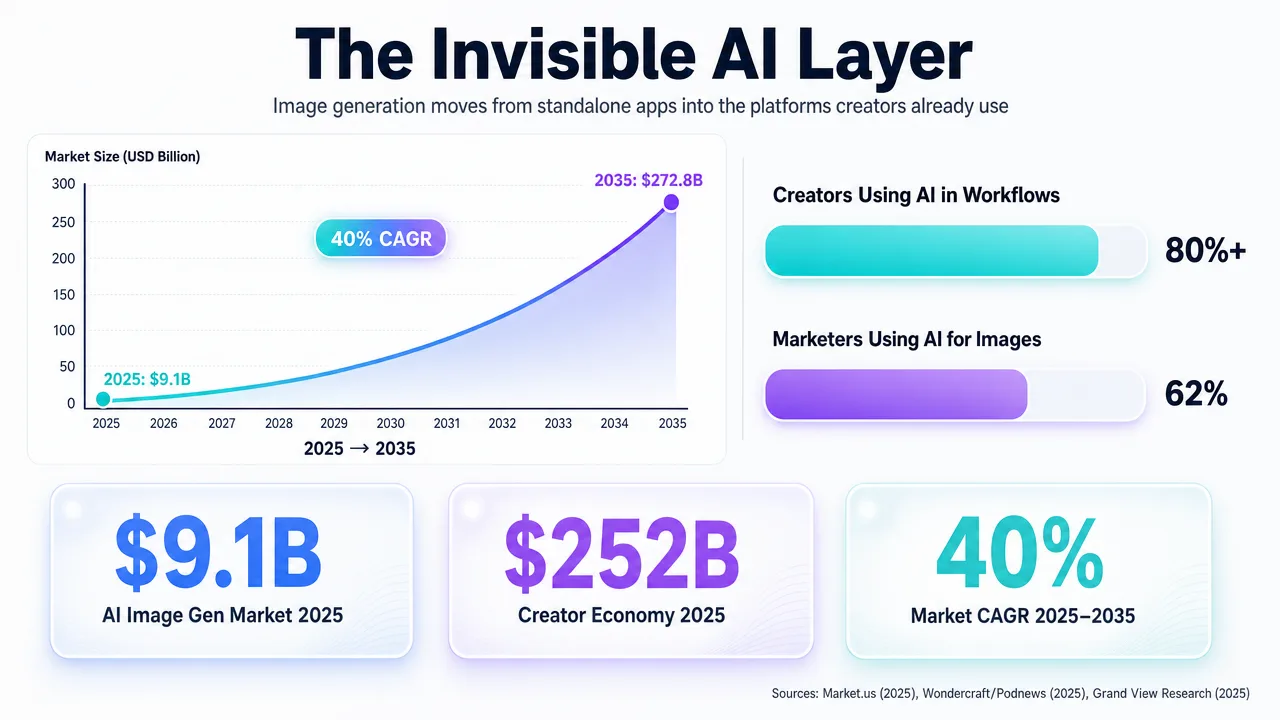
- Why it matters now: Standalone tools like Midjourney and DALL-E 3 are running into heavier competition on distribution. When high-quality models get baked directly into platforms creators already pay for, the cost of running them disappears from view and AI starts feeling like just another utility in the workflow rather than another subscription to track.
- Who is most affected: Digital creators, budget-conscious designers, and the model providers themselves—Google, OpenAI, and others—who are trying to license their foundational tech to big platform players.
- The under-reported angle: Almost no solid documentation exists yet on Nano Banana 2‘s actual capabilities, prompt controls, or commercial licensing terms. That gap between convenient access and real clarity on IP and architecture is larger than most coverage admits.
Deep Dive
Have you ever opened a platform you use daily only to find a new AI feature quietly waiting there? The battle over visual AI is moving away from standalone Discord servers and dedicated apps and straight into the creative tools people already live inside. Nano Banana 2 showing up on Artlist — a major stock media platform — is a clear example of that shift. Coverage so far stays pretty thin, mostly users wondering whether Artlist even has a free AI tier, yet the move points to something bigger: foundational models becoming native parts of the creator economy.
Early signals suggest Nano Banana 2 functions as a wrapper or a tuned version of Google’s Gemini stack. If that’s accurate, it marks a meaningful B2B licensing bet for Google. Running an image generator “for free” inside an existing subscription forces serious cost control. Generative visual inference stays expensive, so Nano Banana 2 has to stay lightweight, fast on latency, and efficient on GPUs or the numbers simply don’t work for Artlist.
That said, the current release still feels like a black box. There’s no public capabilities matrix, no benchmarks against Stable Diffusion or DALL-E 3, and no details on safety filters or how to integrate it via API. For anyone who needs seed control, inpainting, or reliable negative prompting, the tool stays limited to quick ideation for now.
The legal side looks just as thin. Creators turning text prompts into commercial assets have no clear guidance on licensing, usage rights, or IP compliance. If someone generates campaign work on the free tier, questions around brand safety, copyrighted artifacts, and data retention stay unanswered. From what I’ve seen with similar quiet rollouts, that uncertainty tends to surface only after teams have already started relying on the output.
Ultimately Nano Banana 2 shows the tension between handing AI tools to everyone and meeting the stricter demands of professional workflows. Crossing from free novelty to dependable production tool will require transparent changelogs, solid quality examples, and commercial rights that actually match how digital teams operate.
Stakeholders & Impact
| Stakeholder / Aspect | Impact | Insight |
|---|---|---|
| Creator Platforms (e.g., Artlist) | High | Native AI features help keep users around, but they bring heavy compute costs and tricky API relationships. |
| Foundational Model Providers | Medium–High | Licensing Gemini-style architecture to outside platforms shows the API-as-a-service model gaining traction. |
| Independent Creators | Medium | Free-tier image generation is now within reach, yet unclear IP rights and missing advanced controls limit serious use. |
| Enterprise / Agencies | Low (Currently) | Without precise licensing, commercial rights, and safety benchmarks, most teams will treat broad adoption as too risky. |
About the analysis
Researched and written with AI assistance under the editorial responsibility of the i10X News team. The title image is an AI-generated illustration. Read our AI Use Policy. Spotted an error? Request a correction.
This independent analysis pulls together emerging search patterns, platform details, and gaps in competitor coverage to assess how embedded models like Nano Banana 2 are landing. It is written for AI infrastructure strategists, digital creators, and API product managers who track how generative tools are moving into creative pipelines worldwide.
i10x Perspective
The arrival of models like Nano Banana 2 points toward an “invisible era” for generative AI, where text-to-image features become ordinary system components rather than standalone apps. As architectures like Gemini push inference costs down, every major content platform will likely ship its own fine-tuned wrapper. The winners won’t only be the teams building the strongest models—they’ll be the infrastructure players who slip those models into the exact places creators already work.