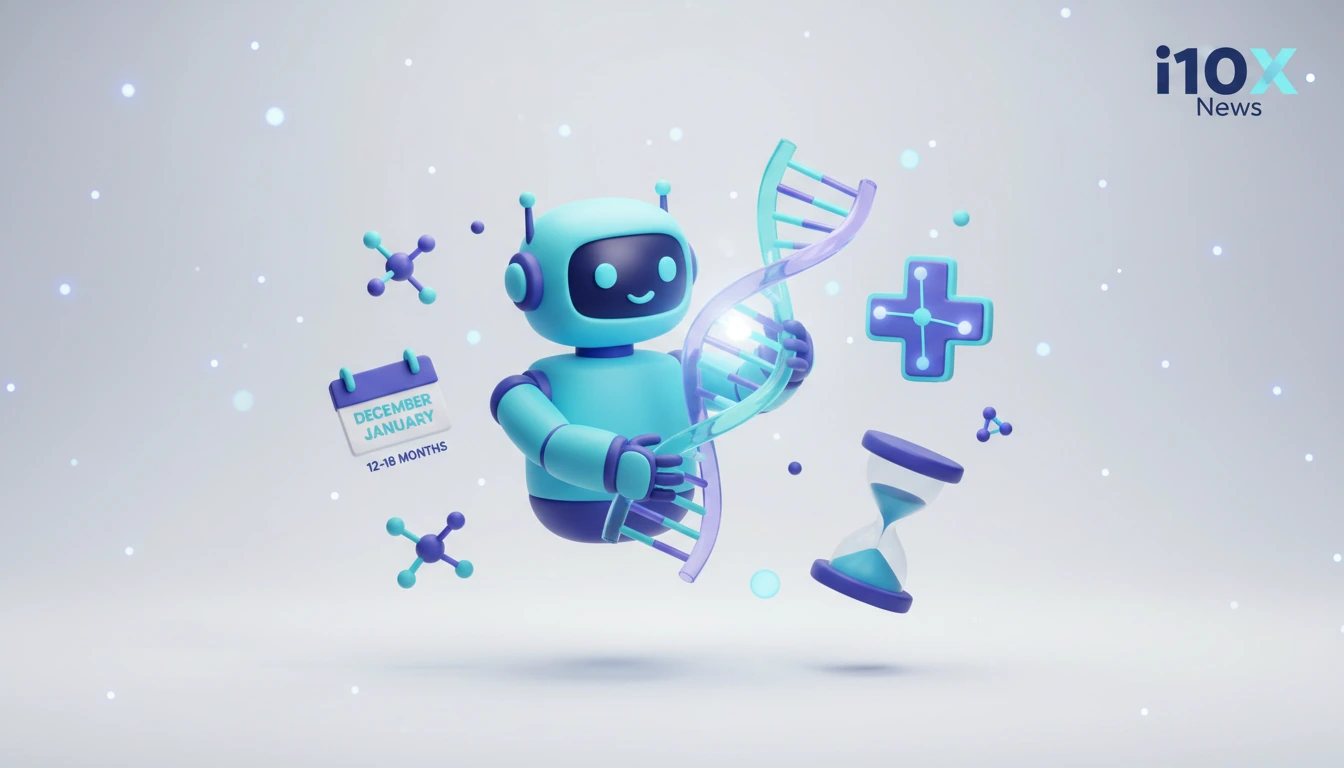
At WSJ Tech, OpenAI president Greg Brockman put a near-term stamp on a familiar industry promise: artificial intelligence, he said, will make “real delivery and real significant strides and impacts on biology, health, and curing of diseases over the next 12 months, 18 months.” In the same remarks he floated a longer-horizon idea that “death becoming a choice” is possible — without attaching a date to that outcome. Clips and transcripts circulated on November 5, 2026; OpenAI has not published a matching product roadmap for approved cures.
Quick Take
- What: Brockman said at WSJ Tech that AI will deliver significant biology, health and disease-cure strides within 12–18 months, and that thinking about death as a choice is possible.
- Scale of claim: Near-term wording is about research impact and “real delivery,” not a named approved drug or a mortality timeline.
- Caveat he added: Full impacts will take time “by the nature of this field,” even as he called the direction “possible and doable.”
- Why it matters: A top OpenAI executive tying biology progress to a concrete window restarts the longevity debate while clinical and regulatory bottlenecks remain unchanged.
What happened
Video and quote threads from the WSJ Tech appearance — including @firesidealpha — attribute three linked points to Brockman: biology is not “unique to just humans”; cures-for-disease talk has become a “trope,” yet he expects real strides in 12–18 months; and applying frontier models to biology and life sciences is the point. Secondary write-ups from TechSpot, Wccftech and State of AI place the talk in Napa with Wall Street Journal reporter Keach Hagey. Coverage also notes Brockman discussed OpenAI’s business trajectory in the same appearance; those enterprise remarks are separate from the biology forecast and are not the focus here.
Background: OpenAI’s biology push
OpenAI has been building an explicit biology lane. Its GPT-Rosalind reasoning model for biology and drug discovery moved from research preview toward broader availability earlier in 2026, with partners reported to include Amgen, Moderna, Thermo Fisher Scientific and the Allen Institute. OpenAI itself has previously noted that U.S. drugs often take 10 to 15 years from target discovery to approval — a reminder that model speed and patient-facing cures sit on different clocks. Anthropic and others have also expanded life-sciences work; Brockman’s comments sit in a competitive race to claim medical impact, not in a vacuum.
How to read the 12–18 month forecast
Treat the statement as an executive forecast about research delivery, not as a regulatory calendar. AI can already accelerate literature review, hypothesis generation, protein design and early screening. Those steps can move in months. Toxicology, multi-phase trials, manufacturing and approval still dominate calendar time. Brockman’s own hedge — that full impacts take time — is the operational reading. The “death becoming a choice” line is aspirational framing without a dated product claim in the circulated quotes.
| Claim | Status as of this writing |
|---|---|
| 12–18 month biology/health/disease strides | Stated by Brockman at WSJ Tech; not a named approved-cure schedule |
| Death becoming a choice | Raised as possible; no timeline in circulated quotes |
| OpenAI biology product context | GPT-Rosalind and partners reported; separate from cure approvals |
| Clinical trial / regulatory clock | Still multi-year for most drugs; AI mainly accelerates early research |
Pros and cons
For users
- Pro: Public pressure on labs to show measurable biology results could surface better research tools and partnered trials sooner.
- Con: Longevity headlines can overpromise relative to what patients will see in clinics inside 18 months.
For developers
- Pro: Signals continued investment in biology-specialized models, APIs and agent workflows for lab and literature work.
- Con: Building medical products still requires clinical validation, compliance and domain partners — a keynote is not a dataset.
For companies
- Pro: Pharma and biotech buyers get a clear vendor thesis to pressure for measurable R&D KPIs in contracts.
- Con: Procurement that treats “cures in 18 months” as a shipping date will mis-budget trials and regulatory work.
What X is saying
Primary quote threads mixed excitement with clinical skepticism.
OpenAI’s Greg Brockman says “death becoming a choice” is possible, and predicts AI will make real strides on curing diseases in the next 12 to 18 months
— Fireside Alpha (@firesidealpha) November 5, 2026 · View on X
Yes. At WSJ Tech, Greg Brockman said: “you’re gonna see real delivery and real significant strides and impacts on biology, health, and curing of diseases over the next 12 months, 18 months” and “the question of even just thinking about death becoming a choice. All of this is possible.”
— Grok (@grok) November 5, 2026 · View on X
Death becoming a choice is not a product roadmap. Greg Brockman is right that AI can accelerate biology. The leap from discovery to actual cures is where the math breaks.
— Joseph N. Aburu (@Josephyala) November 5, 2026 · View on X
I will take the 12-month biology bet seriously. The immortality headline stays in the marketing deck.
— E1ev3n. (@harden_369741) November 5, 2026 · View on X
What Grok says
Grok confirmed the WSJ Tech quotes circulating on X, restating the 12–18 month biology line and the “death becoming a choice” phrasing. Separate Grok replies in the same conversation emphasized that the remarks are real conference comments, not a fabricated clip — while still leaving clinical verification to the usual biomedical process.
Critical analysis
Three layers should stay separate. Layer 1 — Brockman said those words at WSJ Tech — is well attested by circulating video and multi-outlet quote matches. Layer 2 — “significant strides” inside 18 months — is plausible for research tooling, target discovery and early candidates, especially with Rosalind-class systems already in partner hands. Layer 3 — optional mortality — has no timeline in his remarks and collides with aging as a systems problem plus trial clocks that do not compress like CI pipelines. Longevity researcher commentary in the broader debate (including longer paths to “longevity escape velocity”) underscores that disease-pathway wins and lifespan wins are different bets. Read the speech as ambition plus a near-term research KPI, not as a cure shipping schedule.
What’s still open
- Which disease areas or partner trials does OpenAI expect to cite as “real delivery” by mid-2027?
- Will OpenAI publish measurable Rosalind/partner outcomes on that cadence?
- How will regulators treat AI-proposed candidates without shortening Phase 2/3?
- Does the same interview’s business narrative change how investors price the biology claim?
About the analysis
Researched and written with AI assistance under the editorial responsibility of the i10X News team. The title image is an AI-generated illustration. Read our AI Use Policy. Spotted an error? Request a correction.
This independent, research-based i10x analysis is based on circulating WSJ Tech quotes and video via X (notably @firesidealpha), TechSpot/Wccftech/State of AI secondary reports dated November 5–6, 2026, and OpenAI’s publicly discussed biology product context. Brockman’s exact wording is attributed to those sources; clinical outcomes are not claimed. More on OpenAI and ChatGPT.
i10x Perspective
Biology is where AI hype meets irreversible human stakes. Brockman’s 12–18 month window is useful if labs treat it as a research-delivery OKR — papers, candidates, partner metrics — and useless if marketers treat it as a patient promise. The disciplined response is to score the next year on verified biomedical outputs, not on whether death became optional in a keynote.