Perplexity’s pivot into a foundational business intelligence layer
Summary
Perplexity is rapidly pivoting from a consumer-grade “ChatGPT alternative” into a foundational business intelligence layer. That shift signals something bigger about how AI models will eventually tap into proprietary enterprise data.
- What happened: Beyond its recent massive funding rounds to scale its AI answer engine, Perplexity has secured deep integration partnerships with enterprise giants like Intuit, embedding its Retrieval-Augmented Generation (RAG) capabilities directly into QuickBooks and Mailchimp.
- Why it matters now: The AI search war is no longer just about displacing Google on the open web. It is about owning the workflow. By combining highly cited web search with proprietary financial and marketing data, Perplexity is proving that the winning LLM applications will be those that reduce tool-switching and operate inside existing business ecosystems.
- Who is most affected: SMBs, CTOs, enterprise SaaS platforms, and competing AI providers (like OpenAI and Google) who are racing to establish secure, compliant data pipelines between LLMs and sensitive corporate environments.
- The under-reported angle: While mainstream tech media fixates on consumer subscription pricing and chatbot comparisons, the real story is data governance. Integrating an AI engine into a company’s accounting software turns LLM deployment from a novelty into a high-stakes compliance, security, and SSO challenge that most businesses are currently unprepared for.
🧠 Deep Dive
Have you ever watched an AI confidently invent facts and wondered how anyone could trust it with real work? Perplexity began as a streamlined solution to that exact hallucination problem. By pioneering a consumer-friendly Retrieval-Augmented Generation (RAG) architecture that forces the model to cite its sources, it quickly captured the attention of researchers, students, and power users.
From what I’ve seen, though, a closer look at the evolving competitive landscape reveals a much more aggressive enterprise roadmap. The company is actively moving beyond public web queries to become the default operating copilot for business finance and marketing.
The clearest signal of this pivot is the recent Intuit partnership. While consumer reviews (like those from PCMag) evaluate Perplexity purely against ChatGPT in terms of daily web research, industry moves indicate a B2B Trojan horse strategy. By integrating with QuickBooks and Mailchimp, Perplexity isn’t just summarizing the internet – it’s analyzing walled-garden financial ledgers and campaign analytics. This allows SMBs to theoretically “close the books” or generate marketing briefs in a fraction of the time, bridging the gap between external market research and internal operational data.
This integration exposes a massive, unaddressed gap in the current AI market: secure, role-based data governance for SMBs. It’s one thing to ask an AI about historical events. It is entirely another to let it query your company’s real-time cash flow. As Perplexity pushes its “Pro” and “Teams” tiers, the narrative must shift from feature sets to compliance frameworks. Enterprise buyers now require architecture diagrams, data retention policies, and SSO controls to ensure that an answering engine doesn’t inadvertently expose PII or sensitive financial metrics across departments.
Furthermore, this strategy fundamentally redefines the AI search battleground. TechCrunch and Wikipedia track Perplexity’s funding and underlying model updates (often leveraging APIs from OpenAI or Anthropic alongside its own routing tech). Yet the underlying compute and inference costs of running a global, real-time RAG engine are astronomical. To justify these infrastructure costs, Perplexity must secure sticky, high-value enterprise contracts.
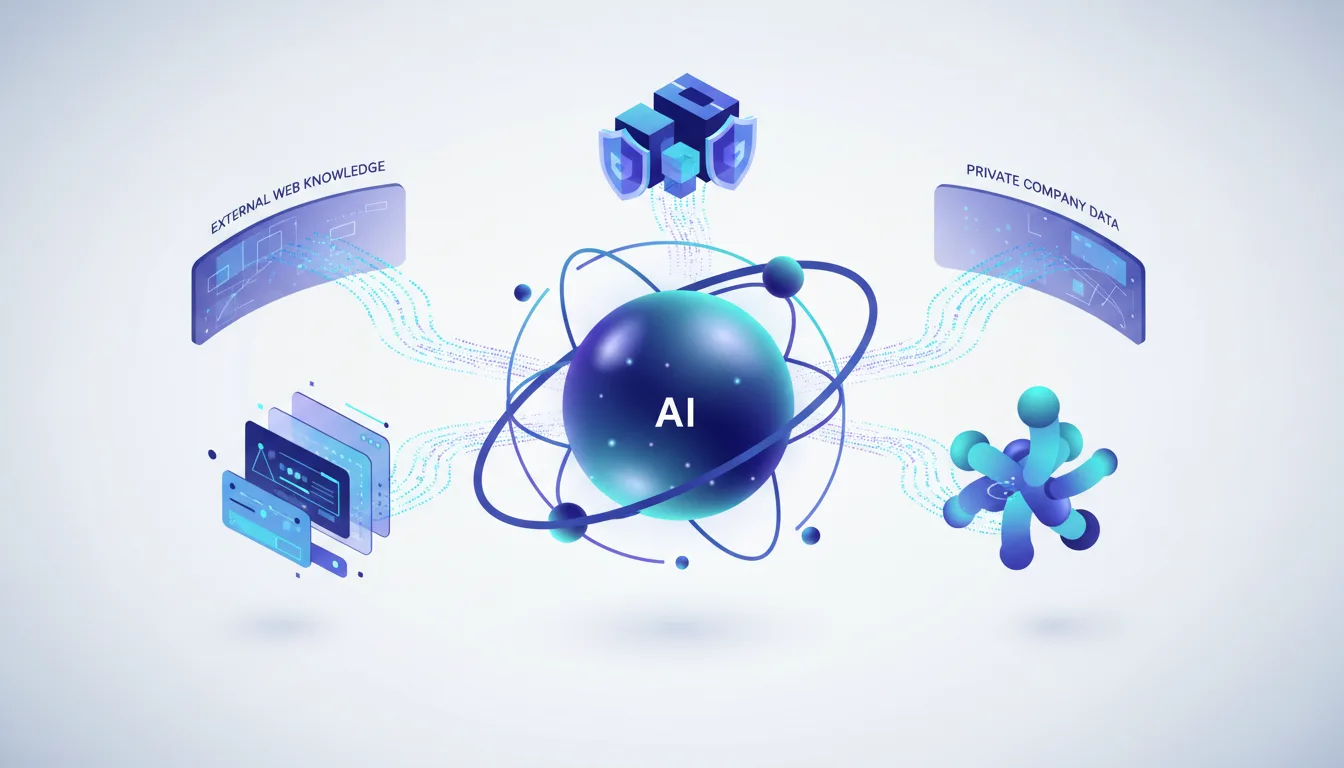
Ultimately, this is a stress test for the future of AI search infrastructure. Can an independent layer sit between foundational models and enterprise data lakes, providing cited, actionable answers without violating strict privacy guardrails? If Perplexity succeeds, it proves that the future of intelligence is modular – where the answer engine lives natively where the work is done, rather than acting as a destination site you have to open in a new tab.
📊 Stakeholders & Impact
| Stakeholder / Aspect | Impact | Insight |
|---|---|---|
| AI / LLM Providers | High | Validates RAG as the primary mechanism for both public search and proprietary data interrogation, shifting focus from raw model size to routing and retrieval efficiency. |
| Enterprise SaaS (e.g., Intuit) | High | Forces legacy software platforms to decide whether to build in-house AI infrastructure or partner with specialized answer engines to maintain workflow dominance. |
| SMBs & Knowledge Workers | Medium–High | Promises dramatic reductions in research time and faster operational workflows, provided they can navigate the initial setup and prompt engineering. |
| IT Admins & Regulators | Significant | Introduces complex new challenges around API access scopes, data retention, and compliance (e.g., GDPR/CCPA) when financial data meets AI models. |
✍️ About the analysis
Researched and written with AI assistance under the editorial responsibility of the i10X News team. The title image is an AI-generated illustration. Read our AI Use Policy. Spotted an error? Request a correction.
This independent, research-based analysis synthesizes product documentation, market reviews, community sentiment, and recent partnership data to provide actionable intelligence for CTOs, product managers, and enterprise decision-makers navigating the AI integration landscape.
🔭 i10x Perspective
The standalone AI chatbot is a transitional interface. The endgame of the LLM era is invisible, deeply integrated intelligence – where RAG engines bypass the open web to securely query a company’s private financial and operational ledgers. As Perplexity encroaches on Google’s traditional search monopoly, its ultimate moat won’t be consumer preference, but rather the B2B API integrations and compliance architectures that make switching to a competitor mathematically and operationally impossible. Watch closely how data privacy regulators respond when “searching the web” merges with “searching the balance sheet.”
the future of intelligence is modular – where the answer engine lives natively where the work is done.