Raspberry Pi AI HAT+ 2: 40 TOPS Hailo NPU for Edge AI
⚡ Quick Take
"While hyperscalers build gigawatt data centers to train frontier models, the deployment battle is rapidly shifting to the extreme edge, where cheap, hardware-accelerated boards are becoming the ultimate AI micro-orchestrators."
With the rollout of dedicated AI accelerator HATs powered by Hailo NPUs, Raspberry Pi is quietly transforming from an educational computer into a legitimate edge infrastructure node capable of running local generative AI and orchestrating complex LLM agent workflows.
Summary: Raspberry Pi has aggressively expanded its hardware ecosystem for artificial intelligence, rolling out the AI Kit, AI Camera, and the new AI HAT+ 2. By introducing up to 40 TOPS of INT4 neural processing acceleration directly to the Raspberry Pi 5, the platform is transitioning from a hobbyist board to a highly capable edge inference hub for local language and vision models.
What happened: The Raspberry Pi Foundation introduced official hardware add-ons featuring Hailo NPUs, specifically designed to accelerate local machine learning. Alongside detailed documentation for running Ollama and local vision-language models (VLMs), this hardware allows real-time computer vision and generative AI workloads to run natively on the Pi 5 without relying exclusively on cloud computing.
Why it matters now: As AI shifts from simple web interfaces to agentic workflows that require real-world context, developers need cheap, local hardware to process sensor and camera data. Pushing inference to the edge reduces latency, slashes cloud API costs, and solves massive privacy concerns for industrial IoT, robotics, and smart home deployments.
Who is most affected: Edge developers, embedded system engineers, and IoT architects are the immediate beneficiaries. Furthermore, challenger chipmakers like Hailo are gaining a vital foothold in the consumer and prosumer edge, bypassing Nvidia’s monopoly on larger-scale enterprise inference.
The under-reported angle: Most coverage focuses on using the Pi as a standalone "local AI supercomputer" or hypes the "$35 AI agent" myth. The more powerful, realistic architecture being adopted by developers is a hybrid orchestrator model: using the Pi's local NPU for wake words, real-time vision, and privacy-sensitive data, while routing heavy reasoning tasks to cloud-based LLM APIs.
🧠 Deep Dive
Have you ever noticed how the biggest AI stories always seem to center on those enormous data-center builds? The infrastructure race is currently defined by massive scale—Nvidia H100 clusters, nuclear-powered data centers, and multi-billion-parameter models. Yet an equally critical battle is happening at the extreme edge of the network. Raspberry Pi’s recent hardware blitz—most notably the AI Kit and the generative AI-focused AI HAT+ 2—signals a decisive pivot. By integrating Hailo’s neural processing units, the foundation is moving its platform beyond basic Python scripts and into serious, low-latency edge inference territory.
From what I've seen reviewing the official documentation, there's a heavy emphasis on running local workloads such as computer vision pipelines and Ollama for local LLMs. The appeal is clear: it promises an escape from recurring cloud AI subscription fees and guarantees absolute data privacy. For robotics builders and industrial prototypers, a Raspberry Pi 5 equipped with a Hailo-10H chip delivering up to 40 TOPS means an autonomous system can process video feeds, recognize objects, and execute local decision loops without needing an active gigabit internet connection.
That said, there is a distinct gap between the marketing of a "local AI device" and the practical reality of edge deployment. A Raspberry Pi, even with an NPU add-on, is fundamentally constrained by thermal throttling and limited memory bandwidth. Forcing large generative models onto the board often results in slow inference times. Consequently, the most sophisticated developers are not treating the Pi as a cloud replacement, but rather as an AI orchestrator.
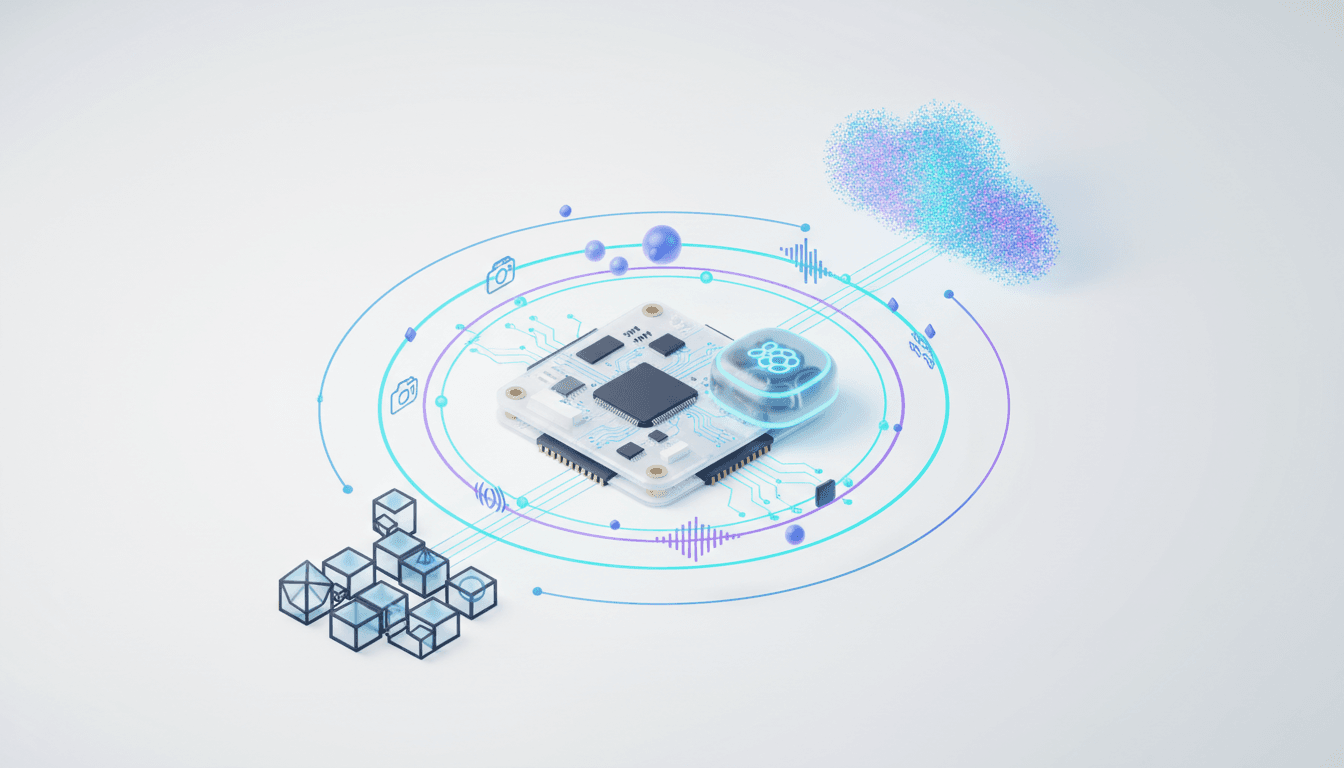
In this hybrid architecture, the Raspberry Pi serves as the "sensory node." It utilizes its NPU to run small, efficient local models for immediate tasks—wake word detection, facial recognition, and local tool calling. Once high-level reasoning is required, the Pi securely queries a cloud API like OpenAI’s GPT-4o or Anthropic’s Claude. This orchestrator approach represents a highly efficient distribution of intelligence: relying on the edge for immediate, private perception, and the cloud for deep cognitive processing.
Ultimately, this ecosystem shift holds major implications for AI chip distribution. By embedding Hailo’s accelerators into a standardized, universally accessible platform like Raspberry Pi, the market is establishing a new baseline for embedded AI. It proves that the future of intelligent agents will require billions of cheap, physical deployment nodes—democratizing edge AI while simultaneously driving a massive new volume of highly contextualized traffic to cloud LLMs.
📊 Stakeholders & Impact
Stakeholder / Aspect | Impact | Insight |
|---|---|---|
AI / LLM Providers | Medium | Hybrid AI edge architectures turn Raspberry Pis into automated routing hubs, generating a steady stream of highly specific, tool-driven API calls to cloud models. |
Edge Infra & Chipmakers | High | Companies like Hailo secure massive developer mindshare, establishing their NPUs as the default hardware standard for embedded AI inference. |
IoT & Robotics Developers | High | Drastically lowers the barrier to entry and the bill-of-materials cost for building vision-capable autonomous systems and local smart home agents. |
Consumers / Residents | Medium | Accelerates the arrival of fully private, localized AI agents that don't constantly stream audio or video to remote servers. |
✍️ About the analysis
This independent, research-based analysis maps the current state of Raspberry Pi's AI ecosystem by evaluating official product architectures, developer documentation, and current edge computing trends. It is designed for CTOs, hardware developers, and AI infrastructure strategists aiming to understand the evolving relationship between local inference hardware and cloud-based reasoning.
🔭 i10x Perspective
The proliferation of AI-accelerated Raspberry Pis serves as an early indicator of how intelligence infrastructure will eventually bifurcate. While hyperscalers continue to centralize massive reasoning engines in the cloud, the physical world requires a decentralized network of cheap, capable sensory nodes to act as the "eyes and ears" of those models. Over the next five years, observers should watch the tension between local capability and cloud dependency—specifically, whether hyperscalers attempt to commoditize these edge hardware ecosystems, or simply compete to become the default API for millions of hybrid micro-orchestrators.
Related News

OpenAI Codex Repositioned as Multi-Agent Engineering Partner
OpenAI Codex now powers multi-agent workflows across desktop, CLI, and cloud. Learn how the shift impacts engineers, governance, and dev tooling. Explore the guide.
LLM Optimization: Visibility vs Inference Cost Management
LLM optimization spans marketing for AI visibility and engineering for inference costs. Discover how multi-model routing cuts expenses up to 85% while maintaining quality. Explore the full analysis.
AI Safety Shifts to Defense-in-Depth for Autonomous Agents
Cloud giants embed automated reasoning and watermarking into AI infrastructure as agents replace chatbots. Discover why zero-trust, permission-aware safeguards are now essential for enterprise deployment. Explore the guide.