
Summary
The AI industry is quietly moving away from general knowledge benchmarks like MMLU. Instead, teams are turning to applied, cost-aware, and domain-specific evaluations that line up more closely with actual business results.
What happened
Standardized LLM leaderboards are splitting apart. Academic groups keep tracking theoretical ceilings with BIG-bench and MMLU, yet developers are shifting toward crowdsourced Elo ratings from LMSYS and narrowly focused, KPI-driven tests—things like financial portfolio decision frameworks.
Why it matters now
As enterprise AI leaves the pilot phase and enters production, raw “intelligence” no longer cuts it. Decision makers want a fuller picture that includes latency, inference costs, RAG citation faithfulness, and even carbon footprint. These factors ultimately decide real-world ROI and shape infrastructure choices.
Who is most affected
Enterprise CTOs and engineering managers who have to pick the right model for their budgets, plus the AI providers—OpenAI, Anthropic, Google among them—who now need to steer training toward applied reliability rather than academic high scores.
The under-reported angle
General-purpose benchmarks can create a false sense of security. Newer evaluations show that acing a bar-exam-style test does not predict how a model will handle dynamic data drift, complex agentic tool use, or risk-adjusted financial reasoning without hallucinating.
Deep Dive
Have you ever watched two models post nearly identical MMLU scores only to behave completely differently once real users start chatting with them? The era of chasing a single MMLU high score is fading fast. For the past couple of years the field ran on a straightforward assumption: higher marks on static academic tests meant a smarter model. That assumption is cracking. The gap between what those tests reward and what production systems actually need has grown too wide to ignore.
Traditional benchmarks—BIG-bench, MMLU—keep pushing saturation. They were never built to capture the back-and-forth nature of conversational work. In their place, crowdsourced arenas such as LMSYS Chatbot Arena have gained traction by letting people vote in head-to-head matchups. The resulting Elo ratings capture “vibes” and multi-turn coherence better than any multiple-choice exam. Even so, human preference alone does not guarantee factual accuracy or operational safety when real money or regulated data is on the line.
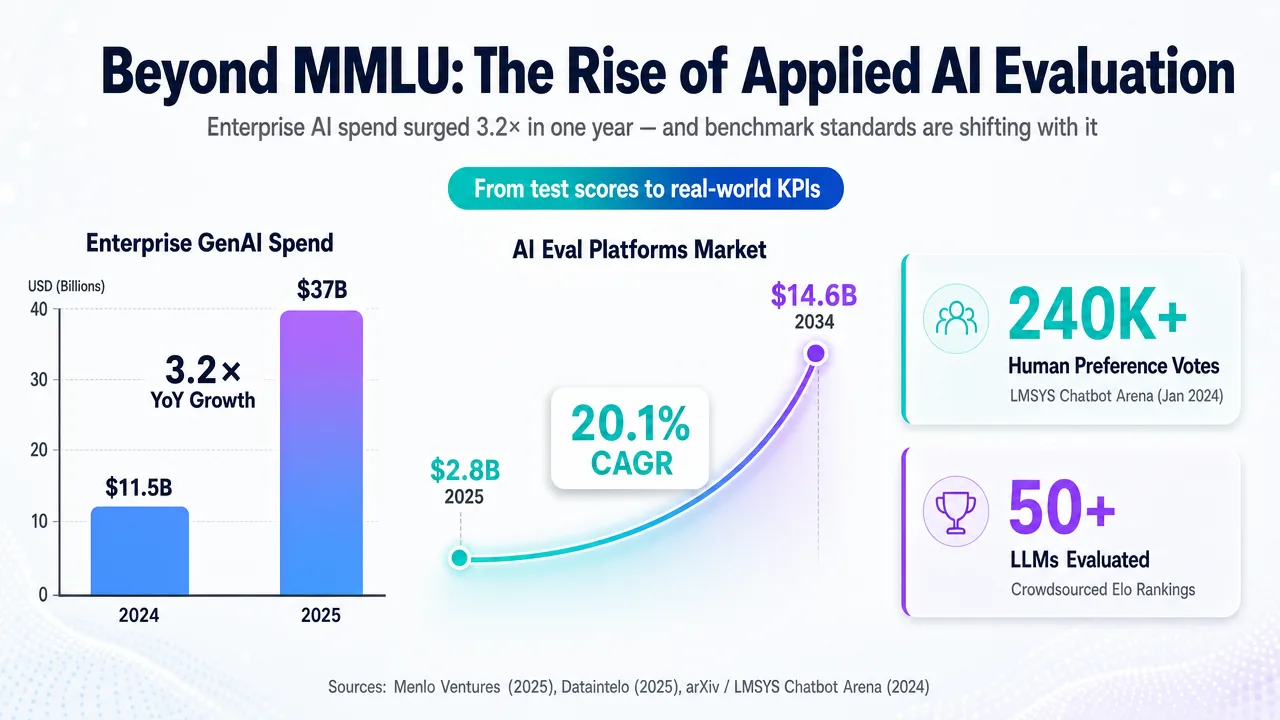
Because of this, the sharper turn is toward applied, domain-specific benchmarks. Developers have begun to test models strictly on tasks like executing financial portfolio decisions. These evaluations skip word-prediction scores altogether and instead measure concrete outcomes: risk-adjusted returns, how well constraints are respected, and reasoning across time-sensitive datasets where news arrives daily.
At the same time, hardware realities are pushing new modules into the benchmarking mix. No one evaluates models in a vacuum anymore. Platforms are starting to combine cost, latency, and quality into single matrices—how many tokens per dollar, throughput on H100s versus L4s, and even the associated carbon cost. CTOs are asking for exactly this kind of visibility before they commit budget.
All of this points toward an agentic future. Evaluation is moving from “read-and-reply” to “plan-and-execute” under stress. The missing pieces developers are racing to add revolve around RAG faithfulness, multi-agent hand-offs, and tool reliability when conditions turn adversarial. The models that pull ahead will not simply post strong test numbers; they will carry guardrails that hold up across messy, multi-step workflows.
Stakeholders & Impact
| Stakeholder / Aspect | Impact | Insight |
|---|---|---|
| AI / LLM Providers | High | Training objectives must shift from academic benchmarks to human-preference Elo and clearly defined business KPIs. |
| Enterprise CTOs & Devs | High | Model selection now hinges on domain-specific risk, token costs, and latency rather than parameter count alone. |
| Infra & Cloud Vendors | Significant | Demand is rising for frameworks that fold hardware efficiency and ML-related CO2 footprint straight into the leaderboard. |
| Regulators & Compliance | Medium–High | Frameworks like Stanford HELM are gaining weight as objective ways to probe safety, PII handling, and bias before models reach regulated sectors. |
About the analysis
Researched and written with AI assistance under the editorial responsibility of the i10X News team. The title image is an AI-generated illustration. Read our AI Use Policy. Spotted an error? Request a correction.
This independent analysis follows the changing landscape of AI model evaluation. It draws on data from open-source leaderboards, academic methodology centers, and emerging enterprise benchmarks—material intended for CTOs, AI/ML engineering managers, and infrastructure architects who must balance model choice, cost realities, and production deployment.
i10x Perspective
The idea that a single generalized “intelligence” score tells us what we need to know is a trap the industry is finally leaving behind. Over the next five years, as AI shifts from simple API calls to autonomous action layers, the decisive benchmark will look less like a reasoning quiz and more like a corporate P&L statement. It will weigh the cost of inference against the economic value actually created. In that environment the winners will not only build strong models; they will also give users transparent proof that those models remain reliable when they operate continuously in the wild.