Agent ResearchMoonshot AI
Evidence check
  • Preprint
  • No code released
  • Not independently replicated

Even Top Agents Finish Only ~30% of Real Startup Product Workflows

StartupBench, built from market-validated AI products: Kimi-K3 and GPT-5.6-sol average ~73.6% partial scores, but no model completes one-third of tasks under the ≥90 success bar.

Christopher Ort
By Christopher Ort · 2 min read
Share
AI agent in a startup environment, completing only a small portion of a product development workflow.
Illustration: i10X
On this page
  1. Quick Take
  2. What the study shows
  3. Why it matters: market demand ≠ solved
  4. Method in brief
  5. What remains open
  6. Context
  7. What it means for agent product teams
  8. About the analysis
  9. i10x Perspective
i10X Quick Take

Quick Take

  1. The finding: Under a unified harness, even the strongest model successfully completes only about 30% of StartupBench tasks.
  2. High partial, low finish: Kimi-K3 and GPT-5.6-sol average 73.67% and 73.61% overall scores, yet none completes even one-third of tasks at the strict ≥90 acceptance criterion.
  3. What fails: Complex instruction following and domain expertise are major failure sources; Finance is hardest (54.48% average).

Most agent benches invent tasks. ByteDance Seed, Nanjing University and collaborators start from AI startup products with demonstrated adoption, study their workflows and users, then turn those into deliverable-oriented tasks with fine-grained rubrics.
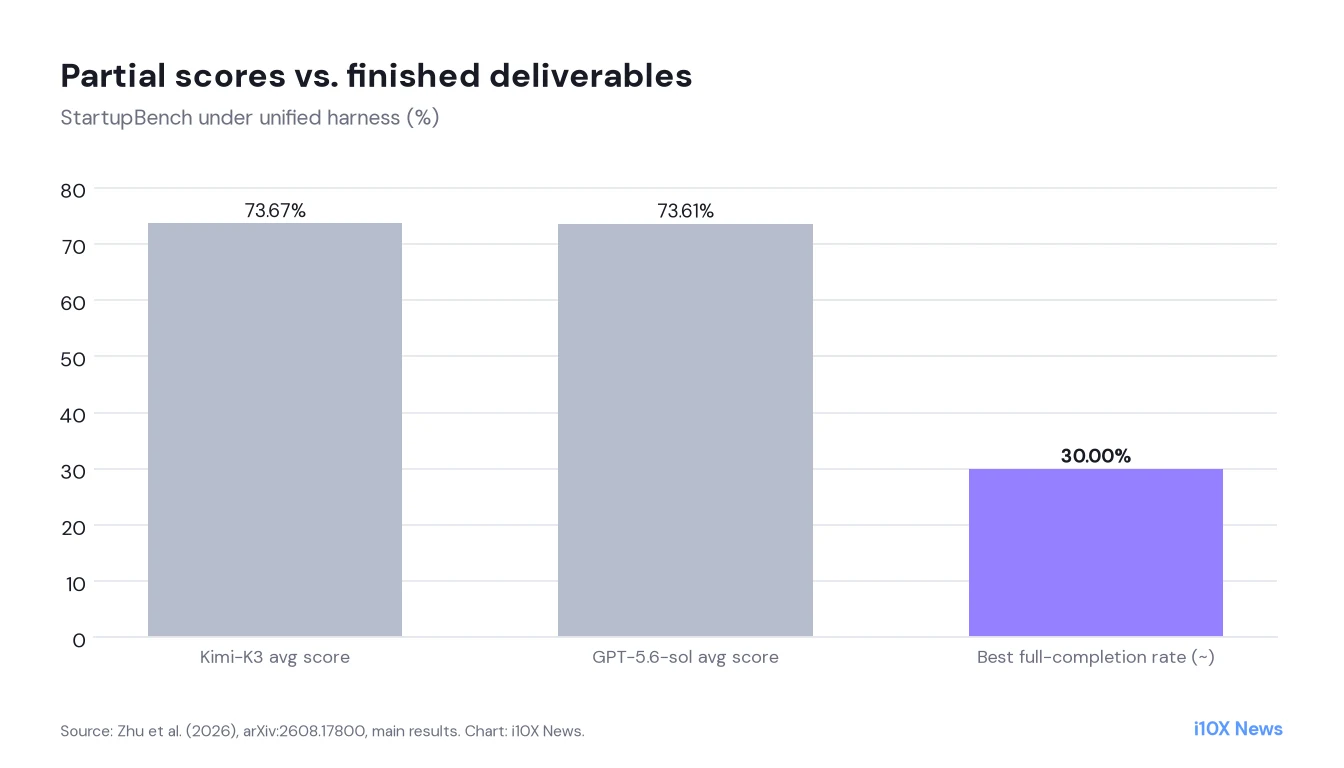
Column chart: Kimi-K3 73.67 and GPT-5.6-sol 73.61 average scores versus roughly 30 percent full completion.
i10X chart based on data from Zhu et al. (2026), arXiv:2608.17800, main results (CC BY-NC-ND 4.0).

What the study shows

Models run under one harness with three independent runs and 95% bootstrap CIs (10,000 resamples). An automatic evaluator agrees with experts on 92.78% of rubric judgments and 92.84% of success decisions.

  • Core rubrics are hardest: Average satisfaction falls from 68.67% (Auxiliary) to 65.89% (Important) to 63.45% (Core).
  • Format still slips: On 56 tasks with explicit output-format requirements, success ranges from 97.6% down to 86.3% — no model is perfect.
  • Partial progress is common: Agents make substantial progress without producing professionally usable deliverables.

Why it matters: market demand ≠ solved

If paying customers already buy a workflow, that is a strong signal of value. StartupBench shows agents still cannot reliably finish those workflows end-to-end.

Method in brief

Market-validated product workflows translated into rubric-scored deliverables; automatic judge validated against experts.

What remains open

  • Product sample: Grounded in selected AI startups; not all domains.
  • Harness fixed: Unified harness may favor some models.

Context

Related E2E agent benches in Agents and Benchmarks & Evals.

What it means for agent product teams

  • Optimize for Core rubrics: That is where scores drop.
  • Ship partial carefully: High averages can hide unfinished deliverables.
  • Invest in domain packs: Finance lags badly.

About the analysis

Researched and written with AI assistance under the editorial responsibility of the i10X News team. The title image is an AI-generated illustration. Read our AI Use Policy. Spotted an error? Request a correction.

This article is based on the full text of the preprint “StartupBench: Benchmarking General-Purpose Agents on Market-Validated End-to-End Workflows” (arXiv:2608.17800v1, submitted August 18, 2026). All numbers are taken from the paper’s text, tables and figures; i10X did not rerun the experiments. The chart was redrawn by i10X from main results of the paper, which is published under a CC BY-NC-ND 4.0 license.

i10x Perspective

StartupBench’s methodological bet pays off: start from what the market already wants, then ask if agents can finish it. Approximately 30% says not yet — and the ~74% averages explain why demos look better than deployments.


Christopher Ort

Christopher Ort

Christopher Ort handles SEO, AI agent workflows and PR & partnerships at i10x.ai, the all-in-one AI workspace built by i10X Global Pte. Ltd. in Singapore. He is a graduate of Friedrich-Alexander-Universität Erlangen-Nürnberg (FAU). He is the author of “The Style Penalty”, a study published on SSRN that analyses 1,576 evaluation decisions by four frontier AI models to show how AI-written CVs fare in automated hiring screens; the research has been covered by heise online and t3n.

Timeline

What happened before

  1. Funding

    Moonshot AI raises $3.5B at $35B valuation*

    Round led by National AI Industry Investment Fund · $3.5B at $35B valuation

    Reported $3.5B at about $35B, led by China's state-backed National AI Industry Investment Fund (Bloomberg). Straits Times reported a higher ~$45B valuation; not confirmed by Moonshot.

    bloomberg.com (source, opens in a new tab)
  2. Release

    Kimi K3

    1M context · $3 / $15 per 1M tokens

    2.8T-parameter multimodal MoE with a 1M-token context; open weights followed on Jul 27, 2026.

    kimi.ai (source, opens in a new tab)
  3. Release

    Kimi K2.7 Code

    262K context · $0.95 / $4 per 1M tokens

    platform.kimi.ai (source, opens in a new tab)
  4. Funding

    Moonshot AI raises $2B at $20B valuation in Meituan-led round

    Round led by Meituan (Long-Z) · $2B at $20B valuation

    bloomberg.com (source, opens in a new tab)
  5. Release

    Kimi K2.6

    262K context · $0.95 / $4 per 1M tokens

    platform.kimi.ai (source, opens in a new tab)
Full Moonshot AI timeline ›

Editor's picks

  1. Anthropic IPO Filing Reveals Extreme AI Safety Risks
  2. Grok Imagine Odyssey Pilot Exposes AI Video Limits
  3. Anthropic Files S-1 for Nasdaq IPO Under Ticker ANT
  4. Jakarta Agentic AI Milestone Delivers Standardized AI Agents for Java
  5. llm-deepseek Serialization Bug Replays Text After Tool Use