Tesla has pushed the delivery timeline for its Optimus humanoid robot to late 2027, according to CEO Elon Musk on the company’s Q3 2026 earnings call. The delay centers on three persistent engineering challenges: the robot’s hands, overall durability, and AI architecture. Musk said Tesla expects to resolve these issues around the end of next year, at which point the company plans to begin delivering Tesla Optimus units to industrial customers outside Tesla for dangerous, repetitive, or around-the-clock work.
The announcement came as Tesla cut its annual capital expenditure guidance by $5 billion, from more than $25 billion to $20 billion, reflecting slower-than-expected progress on its shift toward artificial intelligence and robotics. Third-quarter capex of $4.7 billion fell well short of the $7.9 billion analysts had forecast, and was down $1 billion from the prior quarter.
Quick Take
- What happened: Tesla moved Optimus robot deliveries to late 2027, citing unresolved hand design, durability, and AI issues.
- Production status: Early production began in Fremont on a line designed for a million units a year, but reaching that rate will take at least a year.
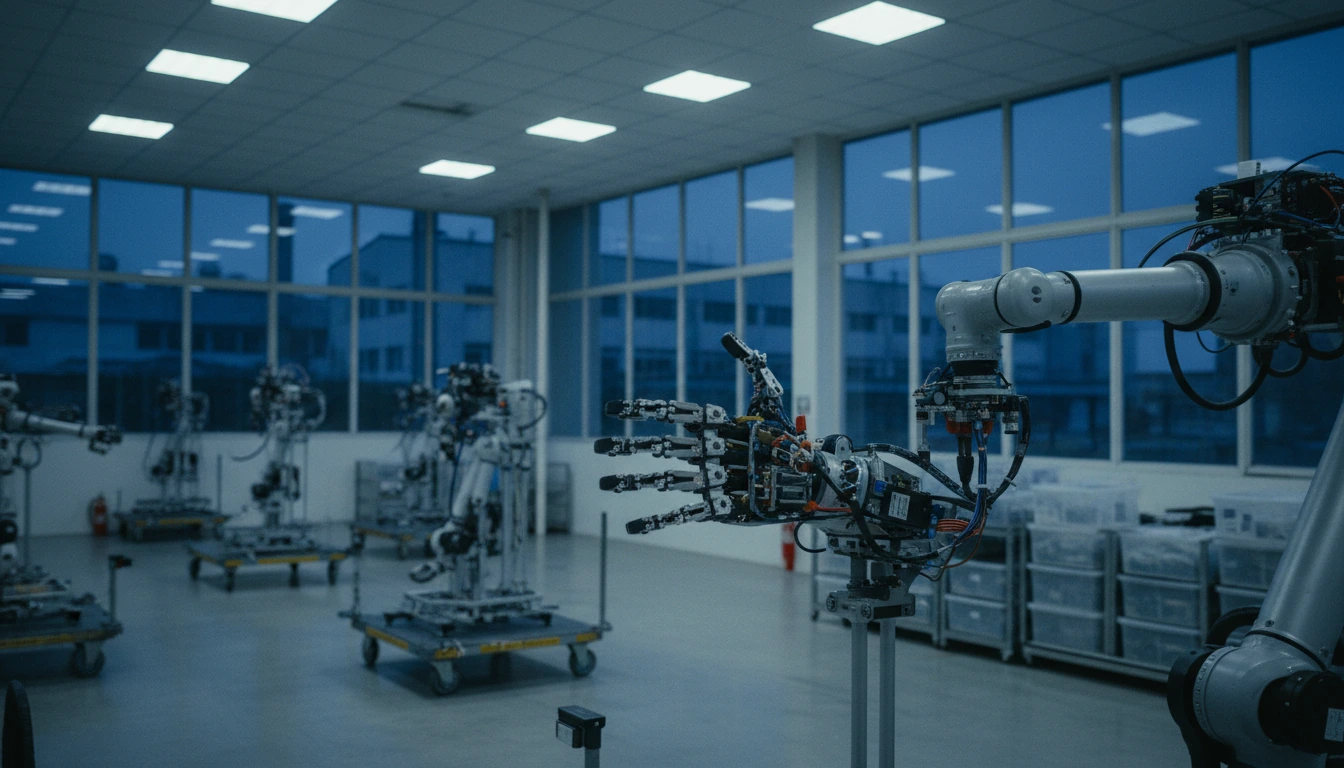
- The hand problem: Fingers must be soft enough for delicate objects yet durable enough to survive constant wear, with over 100 small parts in the hand and forearm.
- AI gap: Tesla lacks a fleet data advantage and plans to build 10,000 to 20,000 robots for an Optimus Academy to train tasks.
- Capex cut: Tesla lowered its 2026 spending target by 20 percent, from over $25 billion to $20 billion, as AI and robot timelines extended.
In plain English
Tesla is building humanoid robots in a factory in California, but the robots are not ready to ship to paying customers yet. The biggest problem is the hand: it has more than 100 tiny parts, and the fingers need to be gentle enough to pick up fragile things but tough enough not to break after a few weeks of work. The robot’s AI also cannot yet handle new tasks it was not specifically trained for, and Tesla does not have thousands of robots in the field collecting data the way its cars do for self-driving. The company now says it will take until the end of 2027 to fix these problems and start selling robots to other companies. Meanwhile, Tesla is spending less money than it planned this year because progress has been slower than expected.
What happened
On October 22, 2026, Musk told investors that Tesla has started early production of the Optimus robot on a high-volume line in Fremont, California, where Model S and Model X vehicles used to be assembled. Most of a line designed to produce about a million robots per year is now installed, but Musk said it will take at least a year, possibly longer, to reach the target rate of roughly 20,000 units per week because parts of the design are still changing.
Musk listed three areas that must be solved before external deliveries can begin: the AI architecture, the electromechanical design, and reliability, including ensuring the robot does not wear out after a month of use. He expects those issues to be resolved around the end of 2027, at which point Tesla plans to deliver Optimus to companies outside Tesla, starting with industrial applications.
When an analyst asked where the design was still changing, a Tesla Optimus engineer pointed to the hand as one of the hardest hardware areas, along with custom gears that still carry reliability concerns. Musk agreed the hand is the main issue, explaining that fingers need to be soft enough to handle delicate objects while surviving constant wear. The hand and forearm contain over 100 small parts assembled by hand, and touch sensors have had reliability issues, according to earlier.
On the AI side, Musk said Tesla is still working through problems with the AI architecture. Because Tesla does not have a fleet of robots collecting data the way its cars do for Full Self-Driving, the company plans to build 10,000 to 20,000 robots and have them practice tasks in what it calls an Optimus Academy. Tesla also plans to integrate its AI5 chip into Optimus around April 2027.
The timeline keeps slipping
This is not the first time Tesla has adjusted its Optimus schedule. In 2024, Musk said Tesla would build Optimus for internal use in 2025 and hopefully in high volume for other companies in 2026. In January 2025, he said Tesla would build about 10,000 robots that year, with several thousand doing useful work by year-end. He later admitted none were doing useful work. Now external deliveries are a late-2027 target.
Tesla’s Q3 shareholder letter called the robots coming off the Fremont line “the first production-quality bots that we have manufactured,” meaning every Optimus built before this quarter was not production quality. Musk promised an Optimus video within a month or two showing the robot doing tasks that are not pre-programmed, arguing that many humanoid demos look impressive but only run scripted routines that would not hold up in the real world.
The capex cut
Tesla’s slower progress on Optimus and AI contributed to a 20 percent cut in its annual capital expenditure guidance. The company lowered its 2026 capex target to $20 billion from more than $25 billion, according to Tesla’s Q3 2026 earnings call. Third-quarter capex of $4.7 billion more than doubled from a year earlier but came in well below the $7.9 billion forecast and was down $1 billion from the previous quarter. Musk had described 2026 as a “year of massive capital expenditure” in July, but actual spending has trailed that goal. Tesla shares rose after the earnings release but turned lower in after-hours trading after the company lowered its capex outlook late in the call.
The competition
Musk said on the call that, to the best of his knowledge, “there is no one that is even close to Tesla” on a general-purpose humanoid robot. That claim is difficult to reconcile with what competitors have shown publicly.
XPeng turned on an automated IRON production line in Guangzhou in September, with more than 80 percent of core processes automated. IRON has 21 degrees of freedom in each hand and runs XPeng’s physical AI model on three in-house Turing chips. XPeng plans mass production by the end of 2026, deliveries in the first half of 2027 starting with stores and malls, and a European rollout in the second half of 2027. That timeline is similar to Tesla’s, if not slightly ahead, though XPeng has not shipped IRON to a paying customer and its timelines have also slipped.
Boston Dynamics started producing its electric Atlas robot in January and says all of its 2026 Atlas deployments are already committed, including to Google DeepMind, whose AI models Boston Dynamics is integrating. In September, it opened a robot training center at Hyundai’s Metaplant in Georgia, where Atlas is learning to sequence car parts for the assembly line. Hyundai plans to deploy 25,000 robots across its plants over the next few years. Boston Dynamics also hired Milan Kovac, Tesla’s former head of Optimus, in January. Boston Dynamics appears to have taken a more pragmatic approach to hands, prioritizing sturdy grippers for industrial parts over human-like dexterity, which is less impressive in a demo but sidesteps the problem Tesla says is holding it back.
The engineering-robotics sector has seen significant activity in 2026, with companies like Agility Robotics beginning public trading and Eka Robotics raising $150 million for physical AI. Meanwhile, NVIDIA has been building a physical AI ecosystem in South Korea, underscoring the global race to solve the same problems Tesla is facing.
What’s still open
- Whether Tesla can demonstrate unscripted, generalizable tasks in the promised video within one to two months.
- How Tesla’s Optimus Academy training approach will compare to fleet data collection once 10,000 to 20,000 robots are built.
- Whether the late-2027 delivery target will hold or slip again, given the pattern of delays since 2024.
- How XPeng’s IRON and Boston Dynamics’ Atlas will perform in real deployments compared to Tesla’s claims.
- What specific reliability metrics Tesla is targeting for hands, gears, and overall durability before external sales begin.
About the analysis
Researched and written with AI assistance under the editorial responsibility of the i10X News team. The title image is an AI-generated image. Read our AI Use Policy. Spotted an error? Request a correction.
This independent i10x analysis is based on comments on Tesla’s Q3 2026 earnings call and the company’s capital-expenditure guidance. Source names are given in the text; we do not link out to those pages.
i10x Perspective
Tesla is facing the same three problems every humanoid robot company is fighting: hands that survive real work, robots reliable enough to pay for themselves, and AI that can handle tasks it was not trained for. Nobody has cracked generalization yet, Tesla included. The difference is that Tesla’s competitors are not telling investors they have no competition. Based on what is public, XPeng has a more automated production line and a similar delivery date, and Boston Dynamics is already deploying Atlas in a car factory with committed customers. Tesla may well have the most robots built, but building robots is not the hard part. Making them useful is. The late-2027 target is the third timeline in three years, and the capex cut suggests Tesla itself is less confident than Musk’s public statements imply.