Quick Take
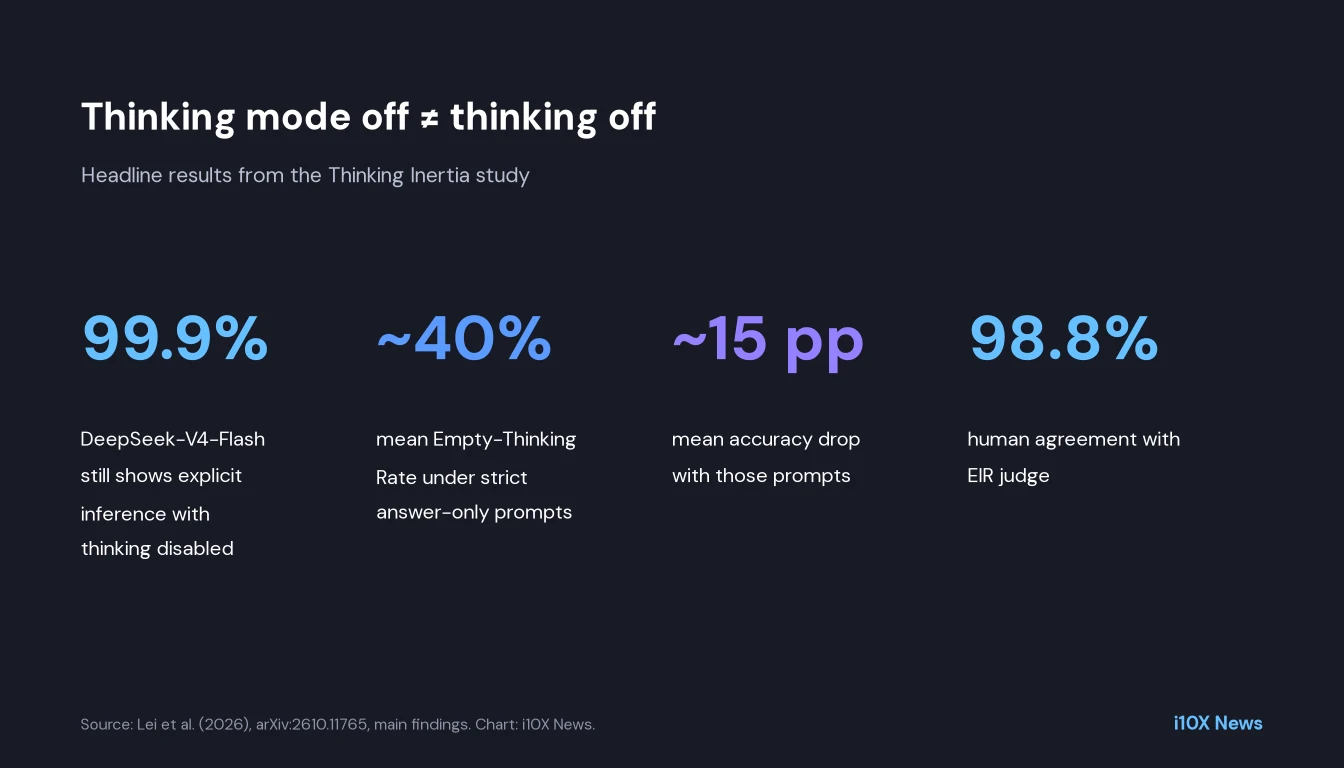
- The finding: Even DeepSeek-V4-Flash (284B) shows visible explicit inference in 99.9% of open-ended responses when its thinking mode is disabled.
- Thinking inertia: Visible inference is organized more by the task’s answer space than by the thinking switch.
- The trade-off: Across five LLMs with fully disabled thinking, strict answer-only prompting raises mean Empty-Thinking Rate from near zero to roughly 40% while cutting mean accuracy by about 15 points.
Models increasingly ship with thinking and no-thinking modes. Researchers from Tsinghua, Oxford and Stanford argue that prior “no-thinking” proxies — a disabled switch or short traces — are unreliable. Disabled modes still emit extended reasoning, and long traces often contain filler.
What the study shows
They normalize every response into a pre-answer trace and final answer, then score Empty-Thinking Rate (strict answer-only), Question–Pre-answer Relevance, and an LLM-as-judge Explicit Inference Rate. Human studies support the metrics; annotators agree with the GPT-5.5 judge on explicit inference at 98.8% mean binary agreement. Six prompting interventions on six open and commercial LLMs.
- Switch ≠ silence: Explicit no-think controls are not reliable no-thinking controls.
- Format matters: Fact-like and candidate-visible formats make answer-only responses easier than open generation for the same question.
- Not just difficulty: The pattern is not explained by benchmark difficulty or answer length alone.
Why it matters: controls that do not control
Safety and cost work that assumes “no thinking” from a switch can silently still pay for reasoning tokens — and still get reasoning content.
Method in brief
Three-level metric stack validated with human boundary audits and relevance judgments across six models and six intervention settings.
What remains open
- Judge dependence: EIR uses an LLM judge (primary GPT-5.5).
- Prompt set: Results depend on the intervention wording.
Context
Related reasoning-control work in Reasoning.
What it means for product and eval teams
- Measure empty-thinking rate: Do not trust the mode flag.
- Expect an accuracy tax: Answer-only compliance costs points.
- Shape the answer space: Constrained formats suppress inertia better.
About the analysis
Researched and written with AI assistance under the editorial responsibility of the i10X News team. The title image is an AI-generated illustration. Read our AI Use Policy. Spotted an error? Request a correction.
This article is based on the full text of the preprint “Thinking Inertia: LLMs Keep Thinking When Told Not To” (arXiv:2610.11765v1, submitted October 8, 2026). All numbers are taken from the paper’s text, tables and figures; i10X did not rerun the experiments. The chart was redrawn by i10X from main findings of the paper, which is published under a CC0 1.0 license.
i10x Perspective
Thinking Inertia is a useful name for a frustrating fact: models do not obey the off switch. If you need silence before the answer, you have to train and measure for it — not flip a boolean.