
Quick Take
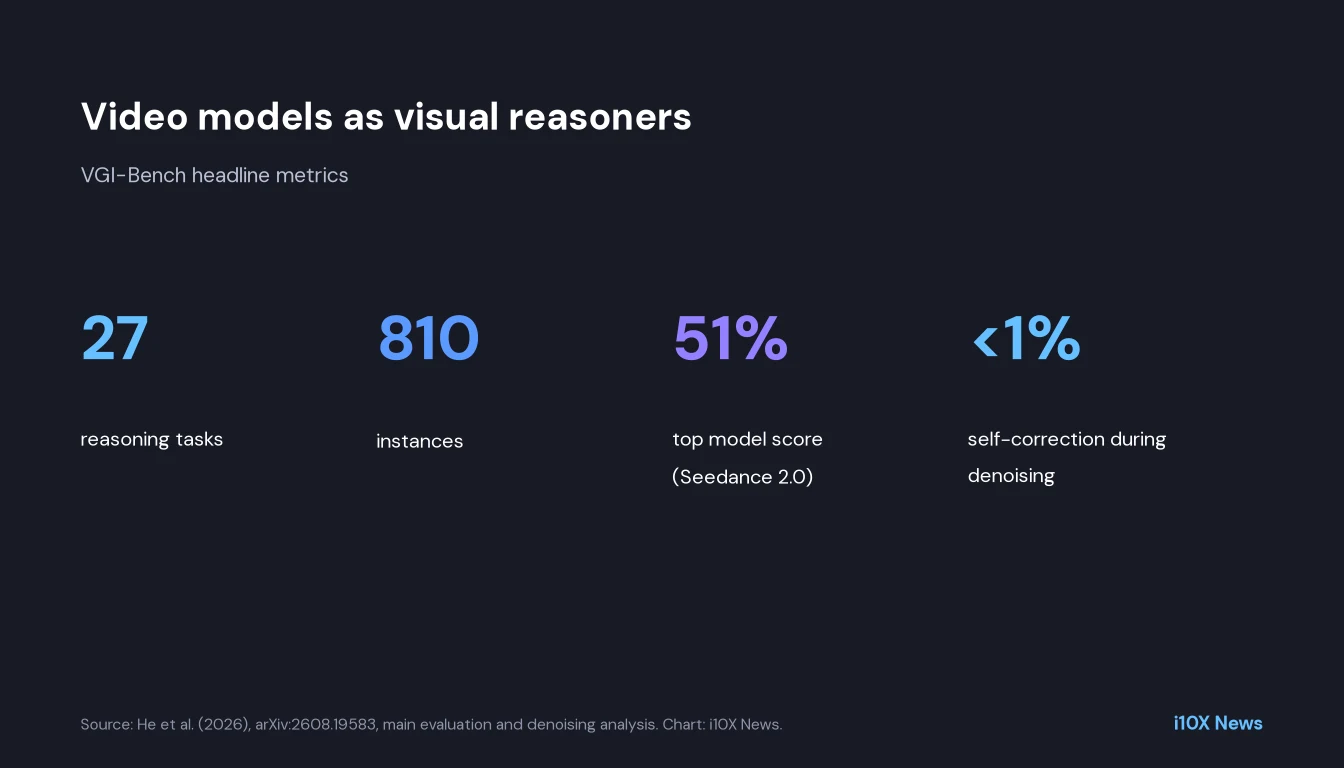
- The finding: Even the strongest video generation model tested, Seedance 2.0, scores only 51.0% on VGI-Bench’s visual reasoning criteria.
- No real self-correction: During denoising, self-correction stays below 1%; wrong states more often morph into other wrong states (about 23–25%).
- What it means: Video models can “imagine” some step-by-step visual processes, but they are not reliable reasoners yet.
Some recent papers claim video generators show zero-shot visual reasoning by emitting intermediate frames. Researchers from UIUC, Tsinghua, Waterloo, MIT, UBC, Microsoft Research and others argue that existing tests are poorly calibrated. They introduce VGI-Bench: 27 tasks and 810 instances organized by domain and skill tags.
What the study shows
Tasks require valid evolving processes, not only a plausible final frame, and use inputs aligned with video-model priors. A VLM-based evaluator (main setup with Gemini-3-Flash) reaches 73.2% agreement with humans; ablations with GPT-5-mini, Claude Haiku 4.5 and Qwen3.6-Plus score lower.
- Far from reliable: Current systems solve a subset of tasks but fail many others.
- Denoising mostly refines guesses: Later steps mainly polish early hypotheses; once a state is readable, stability rises to 90.6% in the second half of denoising, locking in early errors.
- Input sensitivity: Performance depends on input conditions; synthetic fine-tuning transfer has limits.
Why it matters: generation ≠ reasoning
Impressive videos can hide broken intermediate logic. VGI-Bench forces models to show the process, which is what robotics, planning and scientific visualization actually need.
Method in brief
Two-level taxonomy of domains and skill tags; VLM evaluator validated against human annotations. Project page, data and code accompany the paper.
What remains open
- Evaluator dependence: Scores shift with the judge model.
- Task design: Calibrated difficulty still reflects the authors’ taxonomy.
Context
Related multimodal evaluation work is in Multimodal and Benchmarks & Evals.
What it means for video-AI teams
- Score processes, not finals: Require valid intermediate states.
- Watch early denoising: Errors lock in early; late steps rarely fix reasoning.
About the analysis
Researched and written with AI assistance under the editorial responsibility of the i10X News team. The title image is an AI-generated illustration. Read our AI Use Policy. Spotted an error? Request a correction.
This article is based on the full text of the preprint “VGI-Bench: Probing Visual Intelligence in Video Generation Models” (arXiv:2608.19583v3, submitted August 20, 2026). All numbers are taken from the paper’s text, tables and figures; i10X did not rerun the experiments. The chart was redrawn by i10X from main evaluation and denoising analysis of the paper, which is published under a CC BY 4.0 license.
i10x Perspective
51% for the best model is not a dunk on video AI so much as a useful reset. If we want models that reason by imagining, we need tests that punish plausible endings with impossible middles. VGI-Bench is that kind of test.