Every long-running agent eventually fills its context window, and today the harness usually decides what gets squeezed: at a fixed threshold it asks the model to summarize the older history and moves on. A technical report from NVIDIA researchers tests the opposite approach, where the model itself chooses when to compact and which stretch of its history to fold into a summary. The payoff can be large. At a tight 32K-token budget on a document research benchmark, GPT-6.1 Sol went from 21% to 56% correct answers. But the same tool did little for other models, and Claude Opus 5.5 almost ignored it. For anyone building agents, the paper is less a verdict than a map of which models can be trusted with their own memory and how to set them up.
Who gains when the model holds the scissors
Alessio Devoto and six colleagues ran the comparison inside NOOA, the open-source agent harness NVIDIA described in July. In the default setup the harness steps in at 80% of the budget and summarizes everything except the original instructions and the ten most recent events. In the model-driven setup the agent gets a small context API: it can replace any range of past events with its own summary and later pull the archived originals back by tag. It also sees a live usage meter, is told to consider compacting only once usage reaches 85%, and receives a warning when it gets close to the limit.
- Tight budgets, big swings: On OfficeQA Pro v2, a set of 90 questions about U.S. federal receipts and spending answered from a large document corpus, GPT-6.1 Sol scored 56% with self-management against 21% with harness compaction at 32K tokens. By our arithmetic that is 35 points, or about 2.7 times the baseline.
- Fewer tokens for the same result: Kimi K3 at 32K processed 36 million cumulative input tokens per run instead of 62 million, about 26 million fewer, and still scored slightly higher (43% against 41%). At 64K it used about 11% fewer input tokens and scored 57% against 52%.
- Little help elsewhere: DeepSeek V4 Pro improved less, and Opus 5.5 trailed the harness baseline at small budgets until the window was large enough that both approaches converged. On MLE-bench Lite, 22 Kaggle-style machine learning tasks that need much less context, the effect was small and limited to the tightest budgets.
Four models, four habits
The more useful part of the paper looks at behaviour rather than scores. All four models got identical tools and instructions, yet they treated them very differently.
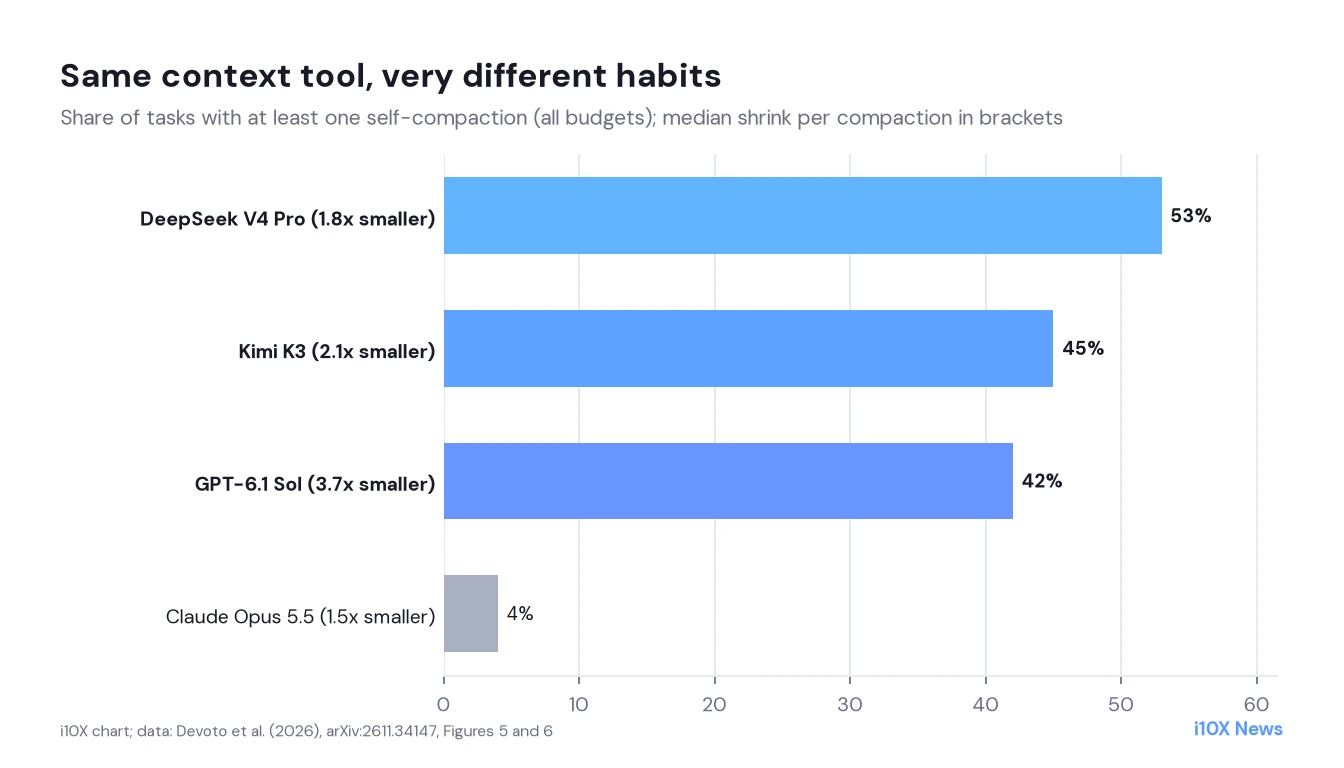
- How often: GPT-6.1 Sol, Kimi K3 and DeepSeek V4 Pro compacted in 42% to 53% of tasks. Opus 5.5 did so in 4%.
- How hard: When GPT compacted, the next request was a median 3.7 times smaller. Kimi reached 2.1 times, DeepSeek 1.8 and Opus 1.5.
- Going back: GPT later reopened archived material after 19% of its compactions, Kimi after 7% and DeepSeek after 3%. Opus sat at 14%, but on so few calls that the figure says little.
- Under pressure: At a 64K budget, after the first warning, Opus mostly wrapped up and returned an answer. GPT read the API documentation before compacting in 69% of these episodes, DeepSeek inspected its history first in 46%, and Kimi compacted straight away in 49%.
The authors suspect GPT benefits from training for exactly this kind of task, pointing to an experimental context-management mode in OpenAI’s Codex harness that was added in a public pull request. They are careful to label that a conjecture: nothing in the paper shows how any of the four models was trained.
Context anxiety: compacting too early
One instruction turned out to matter a lot. When the team removed the line telling models to wait until 85% usage, Kimi’s median first compaction at a 128K budget moved from about 84% of the window to 29%, and DeepSeek’s at 256K from 83% to 40%. Opus, which almost never compacted with the instruction, suddenly compacted early and often, at a median of 16% of the budget at 128K. GPT barely changed. Early compaction is not free: at budgets of 128K and above, the variants without the timing line scored about 8 points below the harness baseline for Kimi and DeepSeek. The authors borrow the term context anxiety for this and link it to training that penalizes long outputs, which Moonshot reports for Kimi K3.
Making edits cheap to serve
Shorter prompts do not automatically mean cheaper inference. Serving engines reuse cached computation, the KV cache, only up to the first changed token, so a summary inserted mid-history forces the engine to recompute everything after it, even unchanged text. The team built a prototype in the SGLang engine that also reuses the cache for that unchanged tail, tested with the open Qwen3.6-27B model at 32K. With model-driven compaction it cut prefilled tokens per request by 15.1% on OfficeQA Pro, 5.6% on MLE-bench Lite and 4.3% on the coding benchmark DeepSWE, with no measurable change in task scores. The saving is largest on document research because about 10K tokens, roughly 60% of the prompt, survive each edit.
How the test was built
Context pressure was simulated by shrinking the budget from 512K down to 8K tokens rather than by running genuinely longer tasks. Each budget was a hard cap: an oversized request had its oldest events dropped and was retried, and three failures counted as a wrong answer. Scores on OfficeQA Pro are averaged over replicate runs, and on MLE-bench Lite they are leaderboard percentiles averaged over 22 tasks.
Where the evidence is thin
- Small benchmarks: 90 questions and 22 competitions, which the authors themselves say cannot separate small differences.
- A proxy for long work: Shrinking the window imitates long tasks but does not reproduce them, and the drop-oldest fallback can distort scores on its own.
- One open model for the serving result: The cache trick was measured on Qwen3.6-27B in one engine, as prefill compute, not as end-to-end latency or price.
- Interested authors, no study code: All authors work at NVIDIA, which builds NOOA and sells inference hardware, and the report includes no funding or conflict statement. NOOA itself is open source, but no code or run data for this study is linked.
How it fits with NVIDIA’s earlier finding
In early November we covered another NVIDIA preprint arguing that agents rarely need long context windows: with regular compaction, frontier models lost little accuracy in short windows, and serving a 256K window cost 3.6 to 7 times more per generated token than a 16K window on open-weight models. Read together, the two papers say short contexts can work, but who triggers the compaction is a model-specific design choice, not a detail. Related academic work such as MEMENTO and Context Language Models reaches a similar conclusion: managing context helps most when the window is small relative to the task.
What agent builders can take from it
- On Claude, keep the harness in charge: Opus 5.5 used the API in 4% of tasks and trailed harness compaction at tight budgets. Do not assume it will manage its own memory; keep automatic compaction or test explicit prompting first.
- On GPT-6.1 Sol, try handing over control: For long document research in tight windows, this is where the gains were largest. Codex already ships an experimental mode in this direction.
- Always state a threshold: A line such as compact only above 85% usage stopped Kimi and DeepSeek from cutting too early and losing about 8 points.
- Archive, never delete: GPT went back to archived content after almost one in five compactions. A summary that throws away the originals removes that safety net.
- Measure total tokens, not window size: Kimi used the same 32K window either way but processed 26 million fewer input tokens per run. Also check whether your serving stack reuses cache after mid-prompt edits, or the savings shrink.
About this analysis
Based on the full text of arXiv:2611.34147v1, submitted on November 25, 2026. Numbers are taken from the paper’s text and from values printed in its figures; the 35-point gain, the 2.7x factor and the 26 million token difference are our own arithmetic. The chart was redrawn by i10X from Figures 5 and 6; the paper is listed under CC BY 4.0, but its pages also carry an NVIDIA copyright line, so no original figure was reused.
i10x Perspective
Context handling is quietly becoming a model feature rather than a harness feature, and this report shows how uneven that shift is today. The striking number is not GPT’s 56% but Opus at 4%: the same tool, the same prompt, and one of the strongest coding models simply did not reach for it. We expect labs to start training explicitly for self-compaction within the next model generation, and we would like to see the tests repeated with released code on longer, real tasks. Until then, the safe default is boring: pick the strategy per model, write the threshold into the prompt and keep the originals. More agent research is collected in our Agent Research section, and Claude coverage on the Claude hub.