Eka Robotics, a Cambridge, Massachusetts startup founded by MIT professor Pulkit Agrawal and former Google DeepMind researcher Tuomas Haarnoja, closed a the company said $150 million Series A on October 20, 2026. The round, led by Andreessen Horowitz (a16z) and F-Prime, values the company at $1.45 billion post-money. Eka is building a physical AI model that combines vision and force sensing to enable robots to perform dexterous manipulation tasks at speeds that exceed human performance.
The company’s approach centers on a vision-force-action (VFA) model trained through large-scale reinforcement learning in simulation. Rather than teaching robots to imitate human demonstrations, Eka’s system learns to reason about physics by experiencing thousands of hours of simulated interactions in minutes, then transfers those skills to real hardware.
Quick Take
- The deal: Eka raised $150 million at a $1.45 billion post-money valuation, led by a16z and F-Prime.
- The technology: A vision-force-action model trained via reinforcement learning in simulation, paired with a custom force-sensitive gripper.
- Performance claims: Eka reports its robot picks 1,500 objects per hour with over 95% reliability, versus roughly 600 for a human.
- Early deployments: The company is running secretive pilots with industrial customers on pick-and-place and wire manipulation tasks.
- Valuation context: At $1.45 billion, Eka is priced well below rivals like Physical Intelligence (reported at $11 billion) and Skild AI ($14 billion-plus).
In plain English
Robots are still bad at picking things up reliably and quickly, despite billions in investment. Eka Robotics thinks it has cracked the problem by teaching robots to feel, not just see. The startup built a special gripper with force sensors and trained an AI model in simulation to understand how hard to squeeze a raspberry or how fast to move a wire without breaking anything. The result is a robot that can handle 1,500 unfamiliar objects an hour, more than twice human speed, and adapt on the fly when something goes wrong. Investors just bet $150 million that this approach will work on factory floors, not just in labs.
What happened
On October 20, 2026, Eka Robotics announced it had closed a $150 million Series A. Andreessen Horowitz and F-Prime, a venture fund affiliated with Fidelity Investments parent FMR LLC, co-led the round. Seed investors Obvious Ventures and E14 Fund continued their backing, joined by MFV Partners, Bison Ventures, Glasswing Ventures, Samsung Next, and several Fortune 500 strategic investors the company did not name. the company said the post-money valuation at $1.45 billion.
Agrawal and Haarnoja, who met as graduate students at the University of California, Berkeley, founded Eka to solve what they call the generality-performance gap in robotics. Commercially deployed robots today sacrifice versatility to achieve speed and accuracy. Research robots that can handle many tasks often work too slowly or unreliably to justify their cost. Eka’s bet is that mastering physics through simulation and reinforcement learning can deliver both generality and performance.
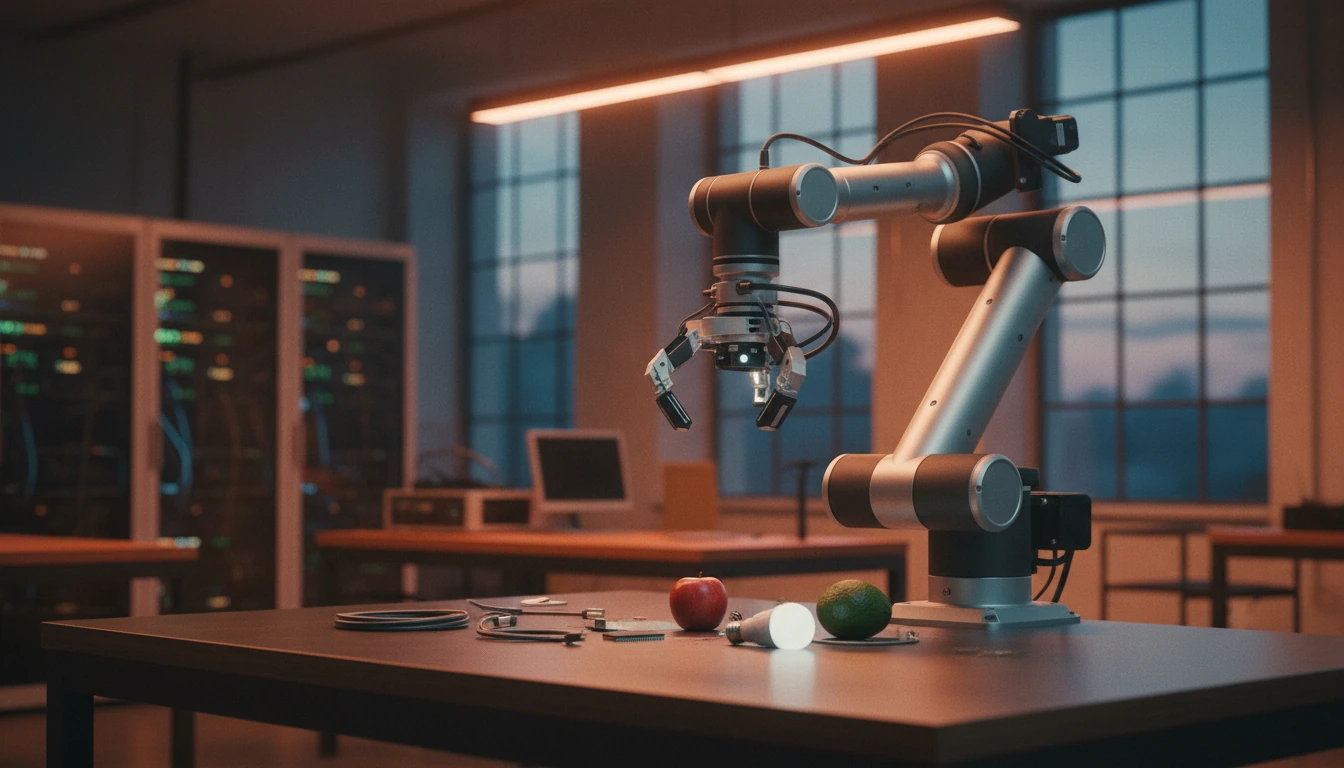
The company’s vision-force-action model focuses on the relationship between what a robot sees, the forces it encounters when touching objects, and the actions it takes. Eka designed a custom gripper, which the company says costs less than $1,000, with more force sensors than standard industrial grippers. The gripper reacts to contact, which is why it can handle a raspberry without crushing it. In one demonstration video, the robot rushes toward a person’s arm, then slows just in time to touch gently.
The technical approach
Eka generates training data by running a physics simulator that models the multiple forces a robot encounters when grasping an object. The company says it can produce thousands of hours of robot experience in minutes by varying objects, environments, and physical conditions in simulation. That simulated experience trains a reinforcement learning model, which then transfers to real hardware.
This approach differs sharply from vision-language-action models, which dominate much of the current physical AI research landscape. Those models learn from videos of humans or robots performing tasks, then try to generalize. Eka argues that vision alone cannot close what Agrawal calls the last millimeter problem. Vision tells a robot roughly where an object is and what pose it has, but the actual grasping and searching happens through forces.
Rodney Brooks, the robotics pioneer and frequent critic of generative AI approaches to robotics, has argued that models will fail without representing force and touch. Eka’s results suggest that critique has merit. Kris Hauser, a professor at the University of Illinois Urbana-Champaign, said the robot had a wow factor compared to other recent demos. He noted it adapted to a large number of different objects without retraining and displayed a humanness in how it would try repeatedly if it failed the first time.
An anonymous roboticist at a frontier lab said that seeing Eka’s robot was an emotional experience, comparable to when robots first achieved reliable legged locomotion five to 10 years ago. The frontier lab observer noted that the robot arm moves fast enough to hurt itself, indicating Eka has significant trust in its algorithm not to break the hardware.
Performance and deployment
Eka reports that its robot picks up about 1,500 objects weighing up to one kilogram per hour, compared to roughly 600 for a human. The company says it reliably picks up objects more than 95% of the time. The same robot can screw in a light bulb, insert wires, and handle a wide variety of unfamiliar objects. Eka describes these figures as company-reported.
The startup is running secretive pilot deployments with a number of industrial customers, focusing on pick-and-place and wire manipulation tasks. Agrawal said that Eka is starting pragmatically with two verticals and aims to make them home runs before expanding. The company’s gripper hardware is currently rated for 5 million duty cycles; Agrawal said the goal is to reach the 20 million cycle standard set by industrial arms.
Hauser cautioned that the big challenge will come when Eka works with integrators on real assembly lines that need to run without breaking for an entire year. He also noted that many high-value industrial tasks involve more than pick-and-place. The open question, he said, is how generalizable Eka’s techniques can be to different tasks.
The funding landscape
At $1.45 billion, Eka’s valuation sits well below several competitors in the physical AI and robotics space. Physical Intelligence was reportedly in talks in March 2026 to raise about $1 billion at a valuation above $11 billion. Skild AI raised $1.4 billion in January 2026 at a valuation above $14 billion. Generalist raised nearly $200 million in August 2026 at a reported $3 billion valuation. Eka’s post-money valuation is roughly 13% of Physical Intelligence’s reported figure and about half of Generalist’s.
The venture capital shift toward AI infrastructure has extended to robotics and physical AI. Crunchbase counted $47.4 billion of physical AI venture funding across 521 deals in the first half of 2026, almost four times the second half of 2025, though that definition includes autonomous vehicles, aerospace, and drones. The International Federation of Robotics reported that factories installed 603,000 industrial robots in 2025, up 11%, lifting the global operating stock past 5 million units.
Raghu Raghuram, the a16z general partner who co-led the round, said that Eka’s robots are already exceeding superhuman performance for certain tasks. He predicted superhuman performance in many dexterous manipulation tasks over the next few months. Kahini Shah, partner at Obvious Ventures, said generalized manipulation will unlock one of the largest markets in history, but solving it is one of the most difficult problems in robotics.
What’s still open
- Can Eka’s robots maintain 95%-plus reliability over months of continuous factory operation, not just in controlled pilots?
- How many duty cycles will the custom gripper actually achieve in industrial settings before the company hits the 20 million cycle target?
- Which tasks beyond pick-and-place and wire handling will the VFA model generalize to, and how much retraining will each new task require?
- How will Eka’s approach compare in cost and performance to vision-language-action models once both are deployed at scale?
- What is the capital efficiency of Eka’s simulation-based training compared to collecting real-world demonstration data?
About the analysis
Researched and written with AI assistance under the editorial responsibility of the i10X News team. The title image is an AI-generated image. Read our AI Use Policy. Spotted an error? Request a correction.
This independent i10x analysis is based on Eka Robotics’ funding announcement on its company blog. Source names are given in the text; we do not link out to those pages.
i10x Perspective
Eka’s $150 million raise at a $1.45 billion valuation is notable less for the headline number than for the technical claim underneath it: that simulation-based reinforcement learning can finally cross the sim-to-real gap for contact-rich manipulation. If the company’s reported 1,500 picks per hour and 95%-plus reliability hold up in year-long factory deployments, not just pilots, the approach will have solved a problem that has consumed billions in capital and decades of research. The valuation discount relative to rivals suggests investors see execution risk, which is appropriate. The leap from a lab demo that impresses professors to a robot that runs 24/7 on an assembly line is where most robotics startups have historically failed. Eka’s pragmatic focus on two verticals and its emphasis on duty cycles and deployability suggest the founders understand that gap. The next twelve months will show whether the physics-first approach scales or whether the generality-performance tradeoff remains as stubborn as ever.